Africa
Tinubu’s Unyielding Policies: Nigeria at the Crossroads of Economic Turbulence and Hope, by Usman Abdullahi Koli

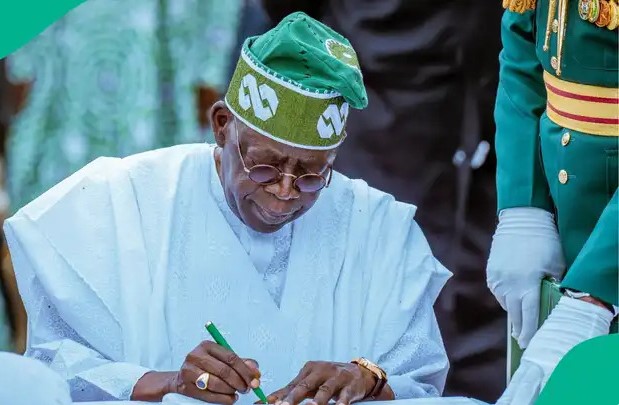
As 2024 draws to a close, Nigeria finds itself grappling with an unprecedented economic crisis. Inflation is at an all-time high, the cost of living continues to skyrocket, and millions of Nigerians are struggling to make ends meet. Against this backdrop, President Bola Ahmed Tinubu, in his maiden media chat aired on December 23, 2024, reaffirmed his commitment to the controversial reforms that have significantly reshaped the nation’s economic landscape. For many Nigerians, his steadfastness in the face of public outcry has been both perplexing and polarizing.
During the televised chat, Tinubu made it clear that he has no regrets about the swift removal of the fuel subsidy, a decision he implemented on May 29, 2023, immediately after assuming office. “I made the swift decision to preserve Nigeria’s future and that of generations yet unborn,” he stated. The move, he argued, was necessary to redirect funds toward critical infrastructure and social investments. However, while the rationale may have been rooted in long-term sustainability, its immediate impact on ordinary Nigerians has been devastating.
The President also defended his administration’s tax reform bills, currently before the National Assembly, insisting they were essential to Nigeria’s economic recovery. Despite significant pushback, particularly from Northern leaders who fear the reforms could deepen regional disparities, Tinubu maintained that these policies were non-negotiable. “The tax reforms have come to stay,” he declared, further solidifying his reputation as a leader unwilling to waver, even in the face of widespread criticism.
For the average Nigerian, these reforms have translated into unbearable economic hardship. Inflation rose to an alarming 33.95% in November 2024, up from 22.41% in May 2023. The cost of basic commodities such as food, fuel, and transportation has nearly doubled, pushing millions below the poverty line. The removal of the fuel subsidy, intended to save the government trillions of naira annually, has instead led to an exponential increase in the cost of petrol, which now hovers around ₦1000 per liter.
The ripple effects are evident everywhere. Transport fares have tripled, food prices are beyond the reach of many families, and small businesses are folding under the weight of operating costs. According to the National Bureau of Statistics, unemployment rose from 33.3% in Q1 2023 to 40% in Q3 2024, leaving millions without a source of income. For many Nigerians, survival has become a daily struggle, with no immediate relief in sight.
While President Tinubu’s reforms are undoubtedly aimed at stabilizing the economy and ensuring fiscal responsibility, their execution has lacked a critical human element. Policy changes of this magnitude require not only technical precision but also empathy and strategic cushioning to mitigate their impact on vulnerable populations. Governments around the world that have implemented subsidy removals or tax reforms have typically done so gradually, accompanied by robust social safety nets.
In Nigeria’s case, the absence of significant palliatives has amplified the suffering of the masses. The promised conditional cash transfers and mass transit buses remain largely theoretical, leaving citizens to bear the brunt of these reforms unaided. There is an urgent need for the government to adopt a more holistic approach that balances fiscal discipline with the immediate needs of its people.
As a writer, it has been my habit to pen a year-in-review piece every December, reflecting on the highs and lows of the past year. This year, however, I chose to wait until President Tinubu’s address to the nation, hoping for a message of hope or at least a roadmap to alleviate the suffering of Nigerians. Unfortunately, his reaffirmation of policies that have exacerbated the economic crisis offers little comfort.
The government must urgently prioritize measures to ease the economic burden on Nigerians. Initiatives such as targeted subsidies for essential goods, tax relief for low-income earners, and the accelerated implementation of promised palliatives could provide immediate relief. Additionally, robust dialogue with stakeholders, particularly those from regions expressing concerns, is critical to fostering a sense of inclusion and national unity.
President Tinubu’s vision for a self-reliant Nigeria is commendable, but the path to achieving it cannot come at the expense of the people’s well-being. Economic reforms must be designed not just to stabilize numbers but to improve lives. As the nation stands at a crossroads, the government has an opportunity to recalibrate its approach, demonstrating that it is not only fiscally responsible but also deeply empathetic to the struggles of its citizens.
The resilience of Nigerians is unmatched, but resilience alone cannot drive a nation forward. It is time for governance that is as humane as it is ambitious—a leadership that listens, learns, and adapts. As 2025 approaches, the hope is that the lessons of the past year will inspire a more inclusive and compassionate governance style, ensuring that no Nigerian is left behind in the pursuit of progress.
Usman Abdullahi Koli,