
Africa
Tribalism: A Dangerous Fire We Must Not Stoke -By Isaac Asabor
We must therefore guard our words, our hearts, and our ballots. Every time we encourage or excuse tribal prejudice, we add fuel to a fire that could one day burn us all. But if we choose unity, tolerance, and mutual respect, we can still redeem the promise of this great nation.

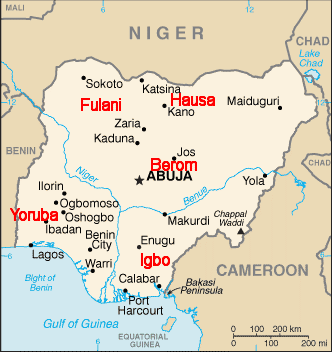
It is no longer news that Nigeria’s fragile unity is being eroded by the rising tide of tribalism. What was once whispered behind closed doors has now become an open conversation. Across the country, particularly in Lagos, on the streets, in markets, workplaces, schools, religious gatherings, and most alarmingly, on social media, tribal sentiment has become the default lens through which many Nigerians now view national issues.
This growing divide has become so deep and normalized that both the educated and uneducated are entangled in it. The once-held belief that tribalism was the exclusive preserve of the unexposed has been proven wrong. Today, professors and artisans, technocrats and traders, social media influencers and motor park touts all share one disturbing commonality: a readiness to defend their tribe above their nation.
The tragedy is that this trend is being openly exploited by politicians who see division as a tool for power. As the 2027 general election draws closer, the old tactics are resurfacing, ethnic narratives, coded messages, and the deliberate stoking of suspicion between groups. Rather than presenting ideas or programs, some politicians are building their campaigns on the dangerous foundation of “us versus them.” They know tribalism is a potent tool for manipulation, and they wield it without shame or restraint.
Sadly, since May 29, 2023, when the current administration came into office, Nigerians have grown even more divided than ever before. Political appointments, policy directions, and national conversations have increasingly been interpreted through ethnic lenses. The feeling of exclusion and imbalance in representation has deepened old mistrusts, hardening tribal lines that were already visible. What should have been a period of national renewal has, instead, become a season of suspicion and bitterness among citizens who now see governance as tilted in favor of some and against others.
But this is a fire we must not stoke. The moment tribal hatred is kindled, its flames become difficult to contain. Africa’s history is full of painful reminders of where such recklessness leads.
Take Rwanda, for example. In 1994, a small East African country that once prided itself on community spirit was turned into a killing field. Within 100 days, more than 800,000 people, men, women, and children, were slaughtered in a genocidal frenzy fueled by tribal hatred. That horror was not born overnight; it was the result of decades of deep-seated prejudice, misinformation, and political manipulation. The world watched in shock as neighbors killed neighbors, not because of any personal quarrel, but because of tribal identity. Rwanda still bears the scars, even as it struggles to heal.
Another tragic example is South Sudan. When it gained independence in 2011, it was hailed as Africa’s newest hope, a land finally free to chart its destiny. Yet, just two years later, the nation descended into a brutal civil war driven largely by tribal loyalties and political greed. The fighting displaced millions and destroyed a country that had barely begun to live. Once again, ethnicity was weaponized, and an entire generation paid the price.
Kenya, too, has felt the sting of tribal politics. The post-election violence of 2007 remains a painful chapter in its history. Fueled by politicians who turned communities against each other, the unrest claimed over a thousand lives and displaced hundreds of thousands. Kenya eventually recovered, but only after learning the hard way that no nation can survive long when its people see themselves first as tribes and only second as citizens.
These are not distant stories. They are warnings; mirrors showing what can happen if Nigeria continues on this perilous road. Already, the signs are visible. Our social media spaces have turned into war zones of ethnic slander. A mere disagreement about politics, sports, or national policy quickly degenerates into insults about people’s origins. Marriages are breaking under the weight of cultural suspicion. Job opportunities are being filtered through the narrow lens of “who is your own?”
We have allowed tribalism to infiltrate every layer of our society. Even our religious and professional associations, which should be bastions of unity, are not spared. What is worse, many Nigerians no longer see anything wrong with this dangerous drift. It has become fashionable to wear tribal bias as a badge of honor, to boast about “standing with one’s people,” and to demonize those who dare to preach unity.
Let it be said plainly: love for one’s culture or ethnic identity is not wrong. It is natural, even commendable, to take pride in one’s heritage. But pride becomes poison when it turns into prejudice, when it blinds us to the humanity of others. The strength of Nigeria lies in its diversity, not in division. Every ethnic group contributes something beautiful and vital to our shared national identity.
Unfortunately, we are fast forgetting this truth. We now measure patriotism by how fiercely one can defend their tribe, not by how much one contributes to national growth. That is a tragedy. No country can progress under the burden of tribal mistrust. It corrodes unity, breeds mediocrity, and empowers corrupt leaders who use division as a shield against accountability.
The responsibility to arrest this decline does not rest on government alone, it begins with the people. We must unlearn the language of hate that has become so common in our national discourse. We must challenge stereotypes whenever we encounter them, whether in our homes, offices, or online spaces. Parents must teach children that their tribe does not make them superior or inferior to anyone else. Schools should emphasize national values alongside cultural appreciation.
The media also has a critical role to play. Sensational headlines that pit one group against another may sell papers or attract clicks, but they deepen the divide. Journalists and editors must report responsibly, with an understanding that words can heal or harm. Similarly, religious leaders must use their pulpits to promote unity, not parochial interests.
Politicians must be held accountable for their words. Any leader who rises to prominence by dividing people along ethnic lines is not fit to lead a nation. We must reject them at the polls, no matter what tribe they claim to represent. Voting for someone simply because they are “one of us” is the surest way to empower incompetence.
History shows that tribalism offers no winners. The flames it ignites consume both the innocent and the guilty. In Rwanda, South Sudan, and Kenya, no tribe truly benefited from the bloodshed. Everyone lost, homes, families, livelihoods, and futures. Nigeria must not learn this lesson the hard way.
Our diversity should be our strength, not our undoing. The late Nelson Mandela once said that people are not born hating others because of their race or background, they learn to hate. But if they can learn to hate, they can also be taught to love. Nigeria must begin to teach love again: love of neighbor, love of country, love of humanity.
As the 2027 elections approach, Nigerians must remain vigilant. Politicians who exploit tribal sentiments for selfish gain must be rejected. When they say, “vote for your own,” we must boldly respond, “we are all Nigerians.” The true patriot is not the one who defends his tribe at the expense of others, but the one who defends justice, fairness, and unity.
Tribalism is not just a political problem; it is a moral crisis. It devalues our common humanity and weakens the foundation upon which our nation rests. Nigeria stands at a crossroads today, one path leads to harmony and progress, the other to bitterness and chaos. The choice is ours.
We must therefore guard our words, our hearts, and our ballots. Every time we encourage or excuse tribal prejudice, we add fuel to a fire that could one day burn us all. But if we choose unity, tolerance, and mutual respect, we can still redeem the promise of this great nation.
Tribalism is a dangerous fire, and we must not, under any circumstance, stoke it.

















You must be logged in to post a comment Login