Africa
Trump’s Geoeconomics, its Implications, and Africa’s Challenges -By Kestér Kenn Klomegâh
The global financial architecture under the age-old Bretton Woods needs faster change to address the developmental financing needs of Global South particularly in the Least Developed Countries, most of which are in Africa. The developmental partners in EU countries, who are presently preoccupied with the crisis caused by the lingering Russia- Ukraine war, must not undermine the various commitments made under SDGs, as well as the Paris Agreement on Climate Action.

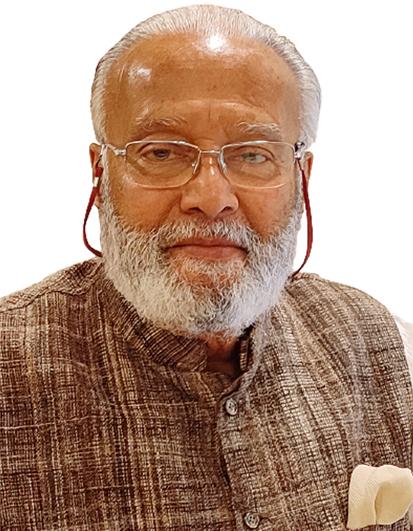
In this interview, Pradeep Mehta, Secretary General of the Jaipur-based Consumer Unity and Trust Society (CUTS International) and an Honorary Adviser to the Commerce and Industries Minister of India, discusses President Donald Trump’s current US policy, aspects of geoeconomics and the challenges for Africa and the continent’s future perspectives. In spite of his heavy working schedule, Pradeep Mehta found time to discuss the United States policy issues with Kestér Kenn Klomegâh. Here are the interview excerpts:
What are your arguments for Trump’s geoeconomics and its likely impact on Africa?
Pradeep Mehta: Despite all the scholarly efforts and inferences about guiding ‘ism’s or in other words, ideological or philosophical foundations for Trump’s governance and impulsive actions for what is commonly found is lack of any coherent foundation or solid theoretical base to support the arguments.
However, there are reasons to concur with the assessment of many that what Trump has been following is an American variant of the far-right and the national-populist sentiment seen in multiple nations starting over a decade ago, who are concerned about the dwindling fortunes of the once powerful Anglo Saxon nationhood.
From a historical perspective, the geoeconomic argument of the US under Trump seems to have some semblance of the so called ‘middle country’ world view of the Chinese emperors, who once believed that China was the centre of the world and other countries, and people were less endowed, civilised and remained dependent on China for their prosperity.
Irrespective of the various geo-economic reasons for Trump’s actions and reactions on the economic and military front, one should agree that they have quite a bit of implications or disturbances in the existing world political and economic order. The noticeable lack of any focus on Africa in his geoeconomics has created considerable turbulence in Africa, especially through the shutting down of aid infrastructure as well as restrictions on travel and migration.
Do you think the points raised above are also contributing toward the collapse of western-led hegemony and the United States economic system?
Pradeep Mehta: Although what Trump and his cronies are trying to achieve is the hegemony of the US and its ideological partners in the West, the common understanding among the Global South is that the reverse trend is happening at a faster phase than ever earlier.
And the fall of the United States currency, the dollar? What about financial remittances from the Asian and African diaspora back home from the United States?
Pradeep Mehta: It is a fact that the US controlled petro-dollar currency system had its goods and bads for the developing world particularly in Asia and Africa, there are many countries, trying to increase re-stocking of gold, as a practical option to base the value of their currencies. The general impression is that the US dollar does not seem to be an indispensable currency.
The general thinking in Asia and Africa is that the fall of the US dollar is not imminent, but could happen eventually at a slow phase. The prevalence of US dollar in the domestic economic transactions and trade is quite pronounced in Africa, compared to its Asian counterparts. It is quite probable that the share of remittances from Asian and African diaspora will shrink along with the decreased role and value of the US dollar.
How would African exporters be paid for their trade with the United States, most of them advocate for de-dollarized trading system?
Pradeep Mehta: If the use of US dollar is reduced/limited for transactions between Africa and there is no compulsion that exporters ought to be paid in US dollars but options such as Euro, Yen, RSA Rand, Chinese Yuan, etc are always there to fill the gap. It is not a sound argument to think that decline or the US dollar will derail global or bilateral trade as trade preexisted the dollar using various mediums of exchange.
How are Global South countries especially Africa reorienting ultimately to all these current changes?
Pradeep Mehta: Most countries in the Global South have been focusing on domestic and regional economic and industrialisation strategies, coupled with reforms in the trade and business environment, as well as reorienting supply chains for many years. However, there have been challenges with rules-based trade, public debt restructuring, development and infrastructure financing to achieve Sustainable Development Goals (SDGs), among others. The recent focus has been finding solutions through South-South Cooperation, national efforts and regional economic groupings and Continental efforts such as African Continental Free Trade Area (AfCFTA).
What could be the expectations, in terms of economic architecture, in the near future?
Pradeep Mehta: The global financial architecture under the age-old Bretton Woods needs faster change to address the developmental financing needs of Global South particularly in the Least Developed Countries, most of which are in Africa. The developmental partners in EU countries, who are presently preoccupied with the crisis caused by the lingering Russia- Ukraine war, must not undermine the various commitments made under SDGs, as well as the Paris Agreement on Climate Action.
In addition, I have four other points:
- a) Top three African economies are either members of BRICS (South Africa, Ethiopia and Egypt) or having an observer status (Nigeria and Uganda). BRICS as “the” platform of the Global South is fast getting established. Among these three, the case of Egypt is most interesting because it is a staunch ally of the US. In January this year, when Trump stopped foreign aid to all countries, Egypt and Israel were exceptions. Increasingly, there will be attempts in Africa (and the Global South) to portray BRICS as anti-west, which is not the case and should be countered by African (and other) stakeholders of the Global South.
- b) The American dollar is losing its prominence as the “reserve currency” of the world. Of course, it will take at least a couple of decades for another currency (maybe a new currency) to replace the American dollar. Central Bank-backed digital currencies and their interoperability will be gaining more traction. I do not know the status of major African countries on this matter. However, countries are also stacking gold and some of it is by reducing their foreign reserve in American T-bills. For example, India is reducing its holding of American T-bills and not buying dollars but increasing our gold reserve. Will we go back to the gold standard?
- c) Africa needs a HIPC 2.0. Today’s high indebtedness in Africa is different from what it used to be three decades ago. Such a demand (HIPC 2.0) should emerge from Africa and it will be interesting to see reactions from other major players of the Global South.
- d) Africa is the youngest continent and will remain very young for, at least, next 50 years. But they do not have the purchasing power and that’s because of the low level of human capital. If HPIC 2.0 calls for debt forgiveness for Africa, provided such “released capital” (principal and interest) is used for human capital formation then that will create a new market for goods, which are primarily produced in the Global South.