
Football
When a Feud Becomes a Fight Card, it is the Human Body that Pays -By Damian Ugwu
Consent is the standard defence, and it deserves a fair hearing. These are adults. The event was, we are told, sanctioned by the Nigeria Boxing Board of Control. Boxing is lawful, and fighters have the right to take risks with their own bodies. I accept all of that. But consent under heavy commercial and social pressure is not the same as free choice. Cash prizes, a following of millions and the fear of being called a coward after a public challenge all narrow the room for refusal. A person who has been dared, in front of a national audience, to put up or shut up is not choosing in the way a human rights framework understands the word.

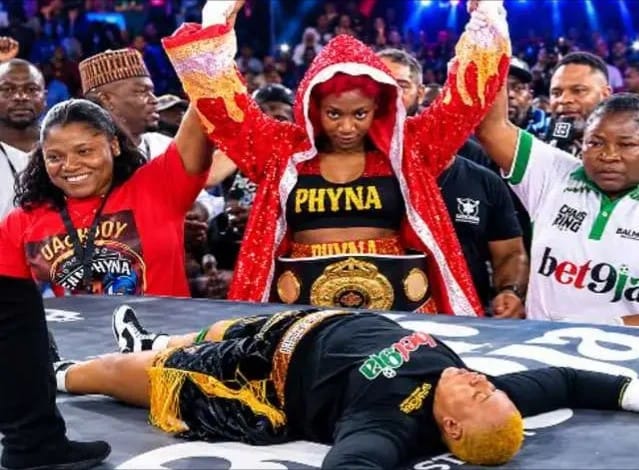
Nigeria’s celebrity boxing craze is sold as harmless spectacle. Behind the prize cars and viral clips lies a public-health problem and a question of dignity that regulators have barely begun to ask.
In the early hours of Friday, a woman was floored in a Lagos ballroom while a crowd filmed it. The referee stopped the bout in the fourth round, and the organiser announced a technical knockout for the reality star Phyna over the Nollywood actress Nkechi Blessing. The winner went home with a car and a ceremonial ₦50m cheque. By breakfast, the clip had been shared thousands of times, and the winner had called out her next opponent.
Nigerians love a spectacle, and I do not begrudge anyone their entertainment. But we should be honest about what we watched. This was not sport in any sense that a trainer, a ringside doctor or a neurologist would recognise. It was a personal quarrel, turned into a commodity and settled with fists.
Consider how it began. The dispute reportedly started when one actress asked the other for her rate card for a film project, and the reply escalated into insults such as “grandmother” and “old woman”. A spat that once might have ended with a deleted post became a four-round contract. At the pre-fight press conference, one woman threw a raw egg at the other’s face, and a plastic bottle was thrown back. The promoters did not discourage the hostility. They sold it.
The commercial machinery is considerable. The “Chaos in the Ring” series is powered by a betting company, is broadcast on DAZN and SuperSport, and has already featured entertainers such as Portable, Charles Okocha, Speed Darlington and Carter Efe. When an earlier rematch was promoted, security personnel had to step in to stop a face-off between two of the fighters from escalating. Enmity sells tickets. A bout that feels like a real grudge is worth more than one that does not.
Boxing is the one sport whose central aim is to strike the head. Repeated blows can cause concussion, bleeding in and around the brain, and, over time, chronic traumatic brain injury, with consequences that surface years later as memory loss, mood disorders and impaired judgement. Professional fighters spend years building the conditioning, the technique and the neck strength to absorb and avoid punishment. Entertainers, influencers and actors, however brave, have none of that. A skit maker or a singer who has trained for a few weeks is far more exposed than a seasoned boxer.
Nor does a knockout end the risk. A fighter who is dropped, gets up and returns to ordinary life can have a brain injury that nobody examines. I see no evidence that Nigeria has a post-fight neurological follow-up regime for these contests, or that anyone is tracking the long-term health of those who take part. Spectators will not see the cost of a bout when the cameras go dark. They will see it later, if at all, and the fighter will be the one to bear it.
As someone who has spent two decades documenting how bodies and reputations are used and abused in this country, I find the social dimension equally troubling. Public humiliation is being rebranded as a business model. The first women’s bout in the series was built on ageist and gendered abuse, and the crowd cheered the insults before it cheered the punches. Young viewers are being taught that a disagreement is settled by violence, that a woman’s worth in public life is her willingness to be hit for money, and that the audience’s amusement justifies almost anything.
Consent is the standard defence, and it deserves a fair hearing. These are adults. The event was, we are told, sanctioned by the Nigeria Boxing Board of Control. Boxing is lawful, and fighters have the right to take risks with their own bodies. I accept all of that. But consent under heavy commercial and social pressure is not the same as free choice. Cash prizes, a following of millions and the fear of being called a coward after a public challenge all narrow the room for refusal. A person who has been dared, in front of a national audience, to put up or shut up is not choosing in the way a human rights framework understands the word.
Nigeria has obligations in this area. The right to health is guaranteed under the African Charter on Human and Peoples’ Rights, which forms part of our domestic law, and the state’s duty extends to regulating private actors whose businesses endanger it. At a minimum, the Boxing Board and the sports ministry should require three things before any celebrity bout goes ahead: independent medical clearance, including a neurological check; a minimum period of supervised training; and a mandatory post-fight protocol, with follow-up care paid for by the promoter. They should also review the sponsorship of such events by betting firms, and examine the incitement of personal abuse as a promotional tool.
None of this means banning the sport. It means treating the people in the ring as human beings rather than content.
When Phyna announced her next opponent from the canvas, the crowd roared. Somewhere in that noise was a question nobody was asking: who is checking on the woman who was knocked down? In a country with as many urgent health and rights problems as ours, the least we owe those who entertain us is that someone asks.





















You must be logged in to post a comment Login