
Entertainment
Where is Bobrisky, as Nigeria Makes Progress? -By Prince Charles Dickson, Ph.D
The prisoner’s paradox teaches that systems can be confounded by their contradictions. Nigeria’s democracy, too, defies doom prophecies. Its progress is nonlinear—a dance of setbacks and breakthroughs. Bobrisky’s theatrics fade, but Nigeria’s youth, tech, and tenacity endure.

A prisoner is told, “If you tell a lie, we will hang you, and if you tell the truth, we will shoot you”
What did the prisoner say to save himself?
The prisoner can create a paradoxical statement that prevents the guards from carrying out either punishment consistently. By saying: “You will hang me.”
This creates a logical contradiction:
- If the statement is true (they hang him), then he should have been shot for telling the truth.
- If the statement is false (they don’t hang him), then he should have been hanged for lying.
Neither punishment can be applied without violating the original rule, forcing the guards to spare him.
Nigeria’s social media space has forgotten Bobrisky?” The self-styled transgender icon and socialite vanished after his arrest in April 2024 for naira abuse, leaving gossip mills churning. Yet, while Bobrisky has stopped captivating tabloids, a far deeper narrative unfolds—one that transcends celebrity scandal and speaks to Nigeria’s democratic resilience, to understand this, we must look beyond the noise and interrogate history: How does Nigeria’s 25-year democratic journey since 1999 compare to the formative decades of even the world’s oldest democracies, like the United States? The answer reveals a story of paradoxical progress, where flaws coexist with strides forward, much like the prisoner’s clever escape from his captors’ logic.

The prisoner’s dilemma—“If you lie, we hang you; if you tell the truth, we shoot you”—is resolved through a statement that collapses the system’s logic. Nigeria’s democracy, too, operates within contradictions. Critics highlight its imperfections: electoral violence, corruption, and inequality. Yet, like the prisoner’s paradox, Nigeria’s progress defies simplistic judgments. When measured against the early years of the United States (1776–1806), a period romanticized as democracy’s “golden age,” Nigeria’s Fourth Republic emerges not as a failure but as a work in progress—messy, flawed, but undeniably alive.
Existential crises marked the United States’ first 30 years. The Articles of Confederation collapsed under economic chaos, Shays’ Rebellion exposed federal weakness, and the 1800 Jefferson-Burr electoral tie nearly triggered a civil war. Voting was restricted to white male landowners, and dissent was criminalized under the Alien and Sedition Acts. Progress was halting, violent, and exclusionary.
Nigeria’s Fourth Republic, by contrast, has maintained uninterrupted civilian rule since 1999—a feat in coup-prone West Africa. Despite flawed polls, four presidents have handed power to rivals, including the 2015 defeat of Goodluck Jonathan, a first in Nigeria’s history. The Independent National Electoral Commission (INEC) has digitized voter registration, with 93 million Nigerians registered in 2023—a figure unimaginable in 1800s America, where voter participation rarely topped 10%. Nigeria’s system is imperfect, but its continuity amid ethnic diversity (250+ groups) and extremist threats like Boko Haram underscores a resilience the early U.S. lacked.
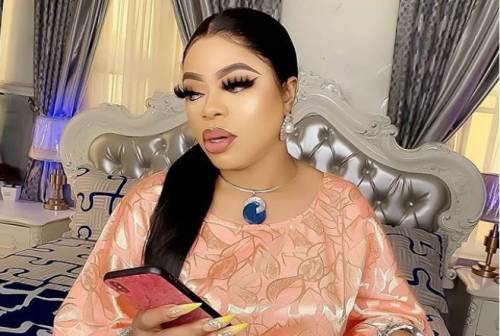
Bobrisky
In 1806, the U.S. economy relied on enslaved labor and small-scale farming. Infrastructure was sparse; innovation lagged. Nigeria, however, has leveraged globalization to diversify beyond oil. Startups like Flutterwave and Paystack dominate African fintech, attracting $2 billion in investments since 2020. Lagos, once a congested megacity, now rivals Nairobi and Cape Town as a tech hub. Agricultural reforms have revived cocoa exports and slashed rice imports by 60% since 2015. Though 40% live in poverty, GDP has tripled since 1999, and the middle class has surged from 4% to 23% of the population.
This trajectory mirrors America’s 19th-century industrial rise but at a 21st-century pace. Where the U.S. needed 100 years to build railroads, Nigeria’s digital economy leapfrogs traditional stages—mobile money adoption outpaces banks, and remote villages access global markets via WhatsApp. The challenges—corruption, and inequality—are real, but so is the progress.
The U.S. Founding Fathers feared direct democracy, designing a republic buffered from “mob rule.” Nigeria’s civil society, however, thrives on chaos. Movements like #EndSARS (2020), which forced the dissolution of a brutal police unit, showcase a digitally empowered populace. Courts have overturned fraudulent elections and jailed once-untouchable figures—former governors, ministers, and even Bobrisky, whose prosecution, however performative, signals declining and sometimes topsy turvy tolerance for impunity.
Compare this to early America: the 1798 Sedition Act jailed critics of President Adams, while the Supreme Court’s 1857 Dred Scott decision entrenched slavery. Nigeria’s judiciary, though sluggish, has no equivalent stain, yet stains for those that don’t understand what it did in Imo State. Its media, ranked among West Africa’s freest, amplifies dissent in ways America’s partisan 18th-century press could not.
Nigeria’s struggles—corruption, terrorism, ethno-religious strife—are real but not unique. The early U.S. normalized slavery, genocided Native Americans and weathered a Civil War. Nigeria’s Boko Haram insurgency and farmer-herder clashes are devastating, yet the state persists. Corruption, though rampant, is being challenged: the EFCC recovers billions annually, and whistleblowers expose graft via social media.
Even Bobrisky’s trial reflects this duality. His arrest for naira abuse was criticized as selective, yet it sparked debates about currency respect—a discourse inconceivable in 1800s America, where elites burned banks without consequence.

Bobrisky’s absence symbolizes a shifting Nigeria. His fame relied on outrage—a society wrestling with gender norms, wealth display, and moral hypocrisy. But as Nigeria matures, a new generation seeks substance over spectacle. They care less about “Mummy of Lagos” dramas than holding leaders accountable. They build tech startups, vote with PVCs, and demand climate action.
Nigeria’s democracy, like America’s at 25, is raw and fragile. But history teaches us that democracies grow through crises. The U.S. needed centuries to expand rights; Nigeria, in 25 years, has navigated coups, insurgencies, and pandemics while expanding civic space.
The prisoner’s paradox teaches that systems can be confounded by their contradictions. Nigeria’s democracy, too, defies doom prophecies. Its progress is nonlinear—a dance of setbacks and breakthroughs. Bobrisky’s theatrics fade, but Nigeria’s youth, tech, and tenacity endure.
Where is Bobrisky? He is a footnote. The real story is Nigeria—a nation scripting its future, not in isolation, but as part of democracy’s arduous, global march. As America’s past shows, the path to stability is long. But Nigeria, against the odds, is walking it—May Nigeria win!
—
Prince Charles Dickson PhD
Team Lead
The Tattaaunawa Roundtable Initiative (TRICentre)
Development & Media Practitioner|
Researcher|Policy Analyst|Public Intellect|Teacher
234 803 331 1301, 234 805 715 2301
Alternate Mail: pcdbooks@yahoo.com
Skype ID: princecharlesdickson




















You must be logged in to post a comment Login