Africa
Who Has Peter Obi’s Brother Offended? The Worsening Drama Of Lawlessness In Nigeria -By Isaac Asabor
Peter Obi, by his rising popularity among Nigeria’s youth and middle class, has rattled many entrenched political interests. His calls for prudent governance, his humble lifestyle, and his refusal to play the usual “settlement” politics have made him a target. It would be naïve to view the Ikeja incident in isolation. It fits into a disturbing pattern of intimidation and calculated destabilization aimed at his person and ideals.

In a nation that proudly proclaims itself as a democracy, and constantly woos foreign investors with catchy phrases and policy blueprints, one would expect the sanctity of property rights and human dignity to be a non-negotiable cornerstone of governance. Yet, Nigeria continues to nosedive into a cesspool of lawlessness where even the most basic constitutional rights of citizens, irrespective of their social status, are brazenly trampled upon without consequences.
The recent complaint by Mr. Peter Obi, former Anambra State Governor and 2023 presidential candidate of the Labour Party, has once again brought to the fore the deep rot and coordinated impunity plaguing Nigeria. One is compelled to ask: Who has Peter Obi’s brother offended? What is his crime in a country where owning property and doing legitimate business should be a source of security, not persecution?
Given the political stature of Mr. Obi, and the timing of the lawlessness and injustice meted against his brother, it is not out of place to ask, “Is it a personal attack or a political vendetta?
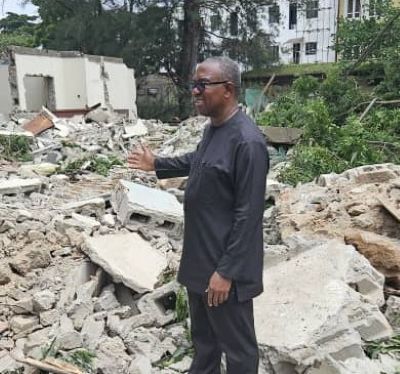
According to Peter Obi, his younger brother’s company property in Ikeja, Lagos, legitimately owned for over a decade, was mysteriously invaded and demolished by unidentified agents under the guise of executing a court judgment against “unknown persons and squatters.” Imagine the absurdity! A judicial pronouncement allegedly issued against ghosts was the basis for destroying a structure that had stood for 15 years. This goes beyond the realm of error. This reeks of a calculated vendetta.
If a man of Peter Obi’s stature, one of the most prominent political figures in the country, can have his family property invaded without a single shred of legal procedure followed, then what is the fate of the ordinary Nigerian in Agege, Umuahia, or Birnin Kebbi? If someone with influence, a media presence, and access to the corridors of justice cannot secure protection for his brother’s property, what hope is there for the common trader in Alaba or the farmer in Gboko?
This incident begs a deeper, more troubling question: Is Peter Obi being punished for daring to challenge the status quo, and with that, is his brother paying the price?
Nigeria’s democracy has long been plagued by the weaponization of state institutions. From security agencies to the judiciary, the tendency of those in power to use state machinery as tools of intimidation has become all too common. What transpired in Ikeja is not just an act of demolition, it is symbolic of the silent war being waged against dissent, against opposition, and against anyone who dares to stand on the side of change.
Peter Obi, by his rising popularity among Nigeria’s youth and middle class, has rattled many entrenched political interests. His calls for prudent governance, his humble lifestyle, and his refusal to play the usual “settlement” politics have made him a target. It would be naïve to view the Ikeja incident in isolation. It fits into a disturbing pattern of intimidation and calculated destabilization aimed at his person and ideals.
At this juncture, it is germane to ask, “Where Is the Rule of Law?” The answer to the foregoing question cannot be farfetched as the Nigerian Constitution guarantees property rights, fair hearing, and protection against unlawful demolition. Yet here we are, reading a firsthand account of a property being bulldozed without any demolition order, without proper notice, and shockingly, without identifying the supposed court litigants. What manner of judgment is served upon “unknown persons”?
This is not merely administrative recklessness, it is judicial mockery. The courts themselves must ask hard questions: Who issued this judgment? Against whom? Who executed it? Under whose orders?
Let it be clear: democracy without the rule of law is dictatorship in disguise. The courts must purge themselves of these dark shadows if they hope to retain any iota of public trust.
Without any iota of exaggeration, the demolition of Obi’s brother property has a dire implications for the Common Man.
If Peter Obi’s brother can be so casually dispossessed, the average Nigerian, like this writer, is basically at the mercy of any thug in uniform or bulldozer driver with fake paperwork. No one is safe. This environment fosters fear, discourages enterprise, and makes nonsense of every government effort at economic reform or foreign direct investment.
It is no wonder that an investor recently told Obi he preferred to keep his money in Ghana, Senegal, and Benin Republic because Nigeria is “a lawless country.” This is not propaganda; it is a raw truth known to every Nigerian business owner.
Government officials love to travel to economic forums, boasting of reforms and ease-of-doing-business rankings. But when bulldozers start rolling without legal backing, and properties are destroyed with no accountability, those glossy brochures become worthless.
The incident also sets a dangerous precedent: that the powerful can act with impunity, while the law-abiding are left to lick their wounds. Today it is Peter Obi’s brother. Tomorrow it could be a civil servant who mistakenly bought land with “untraceable history.” It could be a pastor whose church is on the wrong side of a politician. It could be you. It could be me.
This level of coordinated lawlessness is why Nigeria continues to hemorrhage talent, investment, and credibility. We are in a state where truth, order, and fairness are luxuries that only a few can afford. And even they are not immune from the madness. So again, who has Obi’s Brother Offended?
The answer may lie in proximity. Proximity to a man who dares to question the political status quo. Proximity to a man who has refused to join the rot. In Nigeria, even being related to someone fighting for change can make you a target. That is the terrifying reality we now live in.
At this juncture, it is not out of place to ask, “Which way forward?”
This incident must not be swept under the carpet. Nigerians must speak out, not just in defense of Peter Obi’s family, but for the future of due process in Nigeria. The judiciary must investigate the issuance of that mysterious court judgment. The Lagos State Government must explain why a property was demolished without proper legal procedure. And those responsible must face the consequences.
More importantly, citizens must become defenders of the rule of law, not just when celebrities are involved, but at all times. We must demand institutional reform, judicial independence, and accountability across all tiers of government.
Peter Obi ended his statement with the optimistic reminder that “A new Nigeria is POssible.” But that Nigeria will never be born if lawlessness continues to thrive. It will never happen unless those in power stop treating critics as enemies and start seeing justice as the foundation of leadership.
Until then, we will keep asking: Who did Peter Obi’s brother offend? And by extension, when will Nigeria stop offending its own citizens?