
Breaking News
2027 Presidency: Tinubu, Obi, Atiku, Other Political Leaders Sign Peace Pact Ahead of Campaigns
Presidential candidates for the 2027 elections have signed a peace accord in Abuja, rejecting violence, hate speech, fake news and ethnic incitement.

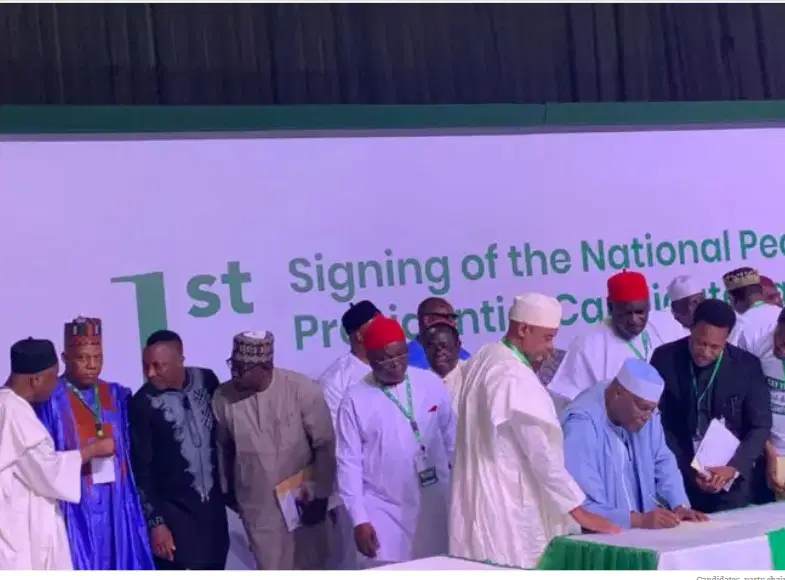
Nigeria’s leading presidential candidates and political parties have signed a National Peace Accord ahead of the 2027 general elections, pledging to run peaceful, issue-based campaigns and reject violence, hate speech, fake news, personal attacks and ethnic or religious incitement.
The agreement was signed on Tuesday in Abuja by political stakeholders under the National Peace Committee (NPC), working with The Kukah Centre.
The ceremony came a day before the official commencement of the 2027 electioneering campaign on Wednesday, August 19.
Organisers said the accord is backed by the Constitution, Electoral Act, INEC guidelines and other relevant laws and is intended to prevent political competition from turning into violence, intimidation, misinformation and electoral conflict.
President Bola Ahmed Tinubu and ADC presidential candidate Atiku Abubakar were absent from the ceremony. Tinubu was represented by SGF George Akume.
Among the presidential candidates present were Peter Obi of the Nigeria Democratic Congress (NDC), SDP’s Adewole Adebayo and AAC’s Omoyele Sowore.
INEC Chairman Prof. Joash Amupitan was also present.
Obi: Voters should punish politicians who breach accord
Peter Obi said the ultimate punishment for politicians who violate the peace agreement should come from Nigerian voters.
Asked what should happen to a candidate who breaches the accord, Obi said: “Well, the punishment is that Nigerians should not vote for them.”
He stressed that politicians seeking elective office should exhibit exemplary conduct.
“You can’t answer ‘His Excellency’ without being an excellent person. So, the process that will make you answer ‘His Excellency’ should be excellent, and the only way to do it is to conduct yourself properly,” he said.
Obi also appealed for an election where Nigerians’ votes would count.
“I don’t have any fear [going into next year’s election] except to say that, please, for the sake of the children of Nigeria, can we have an election where people’s votes will count?” he asked.
Commenting on deaths recorded during the recent Osun governorship election, Obi said elections should never cost Nigerian lives.
“We should comfort their families, and we should remain prayerful and conduct ourselves in a way that in our democracy, nobody needs to die for an election. It shouldn’t be. It is painful, and I wish it never happened again,” he said.
He also questioned the necessity of signing a peace accord.
“We don’t even need to sign this. We’re seeking an office where we should be exemplary,” Obi said.
On whether he still believed in Nigeria’s electoral process, he said: “Well, because I want to change the process, I have to go through it. So, I have to believe in it.”
Peace Committee: Accord is backed by law
Asabe Ndaye, Project Manager of the National Peace Committee at The Kukah Centre, described the agreement as a legally backed public commitment rather than a ceremonial exercise.
“The Peace Accord is a public commitment by political parties and candidates to peaceful political competition, respect for the rule of law, democratic accountability and the will of the people,” she said.
Ndaye said the committee had engaged electoral stakeholders in March 2026 and provided legal annotations to clarify the consequences of violating the accord.
“The accord we’ll be signing today is not just a document, but it is a document that is backed by law,” she stressed.
She said the agreement binds parties, candidates, campaign spokespersons, officials and supporters against spreading or knowingly amplifying misinformation capable of inciting violence or undermining electoral integrity.
Ndaye disclosed that the committee had facilitated 31 peace accords since its establishment.
She warned that political actors must respect the boundaries of peaceful competition.
“Our competition will not become war and disagreements will not degenerate to violence. Political mobilisation will not become intimidation. Electoral disputes will not become conflict, and information will not become a weapon against electoral integrity,” she said.
2023 campaigns: Issue-based violations topped breaches
Ndaye revealed that monitoring of the 2023 elections showed that issue-based campaigning was the biggest area of violation, accounting for 43 per cent of recorded breaches.
Violations involving insults and violence accounted for 13.5 per cent, while fake news and disinformation represented nine per cent.
She said party spokespersons accounted for 58 per cent of violations relating to issue-based campaigns, affecting 22 states.
Kaduna, Plateau, Kano, Lagos, Rivers and Benue were among the states most affected.
“Political language is not just communication. In a tense electoral environment, it can actually become a risk signal,” Ndaye warned.
She said the committee had also monitored at least 70 off-cycle elections, by-elections and re-run polls since 2023, recording attacks involving candidates, supporters and campaign teams.
2,510 security incidents recorded between 2025 and 2026
The Election Security Information Hub established by the committee recorded 2,510 security incidents between June 2025 and August 2026, Ndaye disclosed.
Zamfara, Borno, Kaduna, Niger, Benue and Plateau were among the states most affected by banditry, kidnapping, terrorism and other forms of insecurity.
The hub also documented 381 electoral offences during the period, with the FCT, Osun, Oyo and Lagos recording significant incidents.
Vote-buying, political violence, thuggery, physical attacks, intimidation, misinformation, party disputes, electoral malpractice and voter suppression were identified as major electoral threats.
Ndaye warned that election-related violence often develops from unresolved tensions during party primaries, defections, political realignments, litigation and nomination disputes.
She urged political parties and candidates to focus their campaigns on policies and programmes.
“For the party and candidate spokesperson, we expect a lot from you because this is where most of the issues start,” she said.
“We expect respectful messaging. Kindly verify information and avoid inflammatory or inciting statements.”
She also urged journalists and civil society groups to verify information before publication and called on security agencies to remain neutral.
INEC chairman: 2027 election must be a ‘marketplace of ideas’
INEC Chairman Prof. Joash Amupitan said the peace accord came at a crucial moment, with campaigns beginning on August 19.
According to him, presidential and National Assembly elections are scheduled for January 16, 2027, while governorship and House of Assembly elections are scheduled for February 6.
Amupitan warned against the increasing use of hate speech, misinformation, toxic polarisation and personality-driven political discourse.
He urged politicians to address issues such as economic growth, insecurity, infrastructure, healthcare, education and social inclusion.
“Electoral contests in a constitutional democracy are not total wars; they are competitive job interviews before the electorate,” he said.
The INEC chairman called for a 2027 election that would serve as a “marketplace of ideas”, where candidates explain both their policies and how they intend to implement them.
He disclosed that INEC was preparing to deploy approximately 1.4 million ad-hoc personnel across more than 176,000 polling units.
“It is not the signatures written on this Accord today that preserve democracy; it is the character of the leaders who hold the pen,” Amupitan said.
Police: ‘You cannot preach peace while encouraging violence’
Inspector-General of Police Tunji Disu, represented by DIG Umar Shehu, warned political parties and candidates against conduct capable of threatening election security.
He said security during elections must be built throughout the electoral cycle and called for campaigns based on policies rather than ethnic or religious mobilisation.
Disu also warned politicians against using armed groups, criminal elements or illegal firearms to intimidate opponents.
“You cannot publicly preach peace while privately encouraging violence,” he said.
He called for greater inclusion of women, youths, persons with disabilities and other groups traditionally underrepresented in political activities.
Tinubu’s representative pledges APC commitment
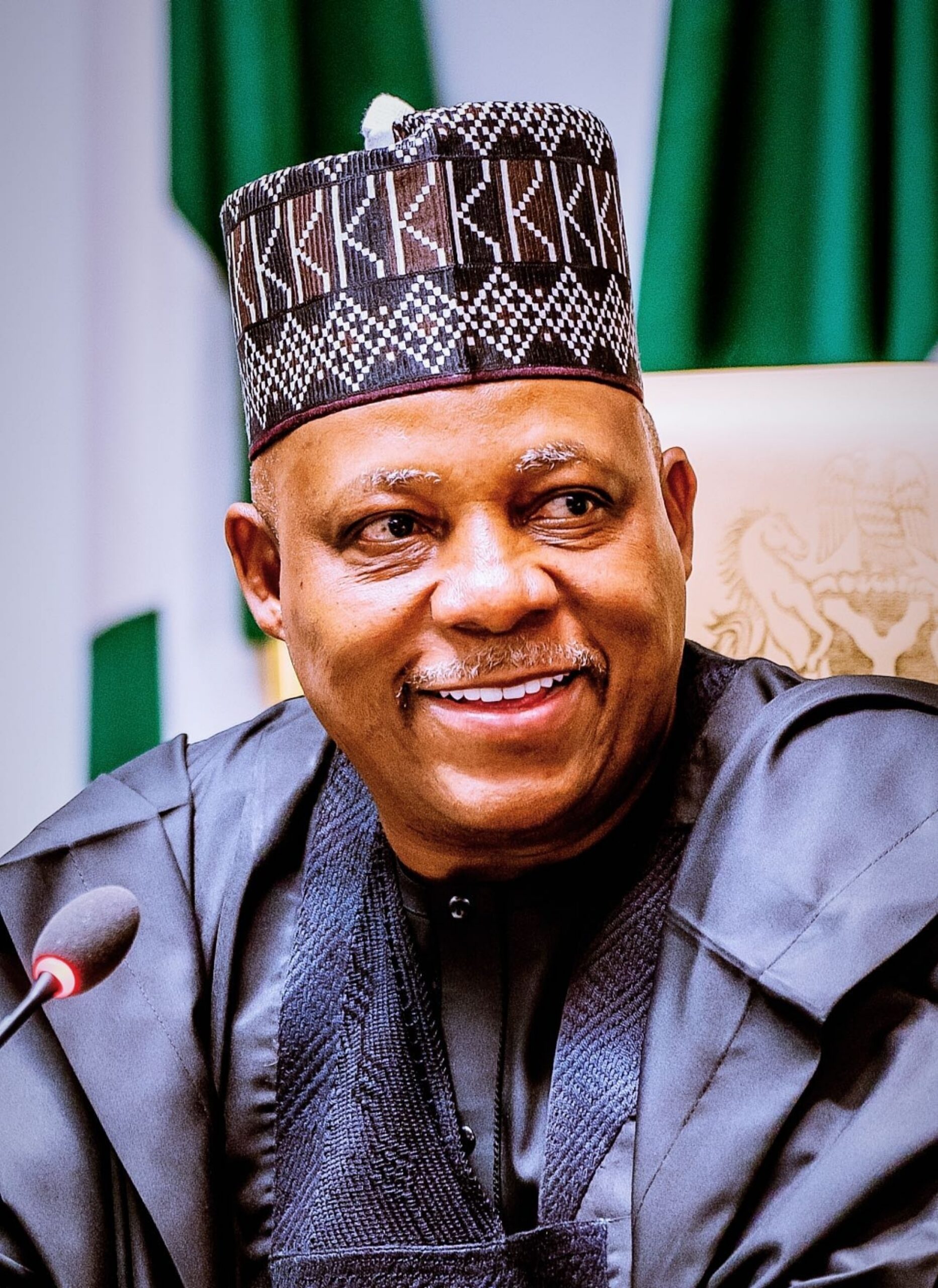
SGF George Akume, representing President Tinubu, said the President and the APC were committed to the principles of the peace agreement.
“As the campaign season kicks off, I commit myself and my party, the All Progressives Congress, to the tenets of this accord,” Akume said.
He said the APC rejected violence, hate speech, misinformation, including AI-generated misinformation, and incitement on social media.
SDP candidate questions accord’s effectiveness
SDP candidate Adewole Adebayo expressed doubts about the effectiveness of the peace agreement, arguing that previous accords had been breached without sufficient consequences.
He also accused the government of intimidating opposition politicians and called for government institutions, security agencies and INEC to operate independently and transparently.
The National Peace Committee, however, said the accord was designed to provide a framework for peaceful competition before, during and after the 2027 elections.
The committee said its post-election phase would focus on acceptance of electoral outcomes and democratic stability.
The National Peace Committee was established in 2014 ahead of the 2015 elections and comprises prominent elder statesmen who intervene in national issues through mediation and alternative dispute resolution.
The organisers said the initiative transcends partisan interests and is aimed at protecting Nigeria’s democratic future.
“Today’s not about party colours. It’s about the Nigerian colour. That is the green and the white of Nigeria,” they declared.
Africans Angle News




















You must be logged in to post a comment Login