
Forgotten Dairies
Death In Uburu: The Questions David Umahi Must Answer -By Vitus Ozoke, PhD
The objective of an autopsy is not to assign guilt. It is to establish scientific truth. Truth protects the innocent just as surely as it exposes the guilty. That is why an autopsy, if legally available, serves everyone’s interest, including Senator Umahi’s own.

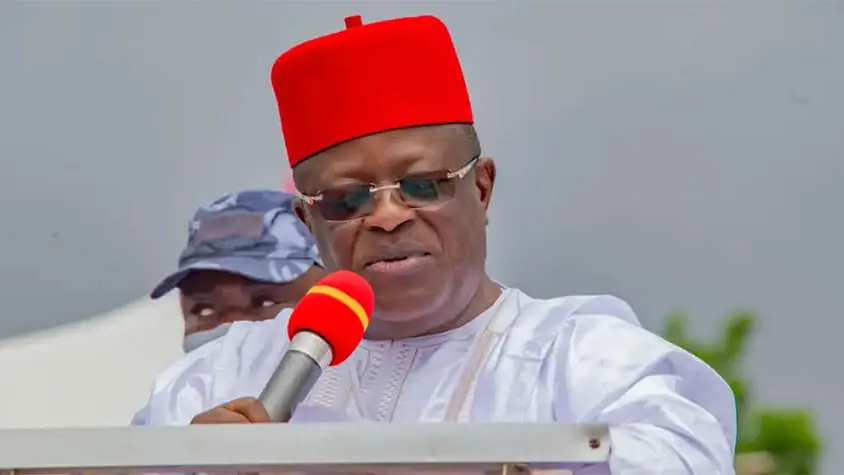
The death of a young woman is always a tragedy. The death of a young government employee inside the private residence of a serving federal minister is something more. It is a matter of undeniable public interest.
This is not because anyone should rush to accuse the Minister of Works, Senator David Umahi, of wrongdoing. On the contrary, no one should be convicted in the court of public opinion before the facts are known. But neither should legitimate questions be dismissed as speculation.
In any democracy governed by the rule of law, transparency is the antidote to speculation. When facts are promptly and fully disclosed, rumors die naturally. When they are not, questions multiply. Unfortunately, Senator Umahi’s official statement, while attempting to reassure the public, raises almost as many questions as it answers.
The statement confirms that the deceased, Miss Mary Habila, and another physical therapist, Anita Baski, were employees of the David Umahi Federal University of Health Sciences, Uburu, who had been on secondment to the Federal Ministry of Works for the past three years. It further states that the incident occurred at the minister’s residence, that the police and medical personnel were notified, and that the minister advised the family to permit an autopsy, which they initially declined.
Those facts naturally invite further questions. The first concerns the secondment itself. How did two physical therapists employed by the David Umahi Federal University of Health Sciences come to be seconded to the Federal Ministry of Works? Was the secondment formally approved under the applicable public service rules? Who initiated it? What official duties were they assigned to perform? Who supervised their work? Who paid their salaries during the period of secondment? Was the university responsible? Was the Federal Ministry of Works responsible? Or was there some shared arrangement? These are administrative questions that should have straightforward documentary answers.
The second issue concerns their presence at the minister’s private residence. If they were employees assigned to the Federal Ministry of Works, what official responsibilities would have brought them to Senator Umahi’s private home? Were they providing physical therapy as part of their official duties? If so, under what authorization? How frequently? To whom were they rendering those services? If they were treating the minister, who made the medical referral? Was there an established treatment plan? These are not intrusive questions. They are accountability questions.
Equally important is the question of residence. Did the two physical therapists maintain independent accommodation while on secondment? Or were they residing at the minister’s residence? If they lived there, under what arrangement? Who else resided in the compound? Who was present on the night before Miss Habila’s death? Where was the minister at the relevant time? Again, these are factual matters capable of objective verification.
Another issue concerns institutional transparency. If Miss Habila remained an employee of the university while serving on secondment to the Federal Ministry of Works, when were her work colleagues officially informed of her passing? Did the university publicly announce the death of one of its employees? Did the ministry communicate the loss of a member of its workforce? Or did many first learn of it through media reports? Government institutions owe not only condolences but also transparency to their employees and to the public they serve.
The official statement also raises broader questions about the secondment program itself. How many other employees of the David Umahi Federal University of Health Sciences are currently on secondment to the Federal Ministry of Works? Is this a common institutional arrangement? Are other Nigerian ministries beneficiaries of similar deployments? If physical therapists are assigned to ministers, what is the governing policy? The public deserves to understand whether this is routine public administration or an exceptional arrangement.
Finally, there is the question of the autopsy. The minister now strongly advocates one and says he had earlier recommended it to the family. If that is correct, then an obvious question follows. Given the unusual circumstances – a government employee dying inside the private residence of a serving cabinet minister – should a forensic examination have been pursued immediately as part of the investigative process? Whether the family initially agreed or not, this was plainly a case with significant public implications.
The objective of an autopsy is not to assign guilt. It is to establish scientific truth. Truth protects the innocent just as surely as it exposes the guilty. That is why an autopsy, if legally available, serves everyone’s interest, including Senator Umahi’s own.
The purpose of raising these questions is not to accuse. It is to insist. To insist that the investigation be independent. To insist that the facts be established. To insist that official silence never substitute for official accountability.
In a constitutional democracy, public office carries extraordinary privilege. But it also carries extraordinary scrutiny. When a citizen dies under unusual circumstances in the private residence of a public official, questions are not acts of hostility. They are acts of citizenship.
The greatest service Senator David Umahi can now render – to himself, to the deceased’s family, and to the Nigerian public – is not another press statement. It is complete transparency. Because in matters such as these, unanswered questions rarely disappear. They simply become larger.
Dr. Vitus Ozoke is a lawyer, human rights activist, and public affairs analyst based in the United States. He writes on politics, governance, and the moral costs of leadership failure in Africa.

















You must be logged in to post a comment Login