
Breaking News
‘Debt Is Worse Than Leprosy’: Obasanjo Fires Back at Tinubu Over Borrowing, Warns Nigeria
Obasanjo warns that Africa risks a new form of digital colonialism if it fails to control its data and artificial intelligence, while questioning Nigeria’s rising debt and naira depreciation.

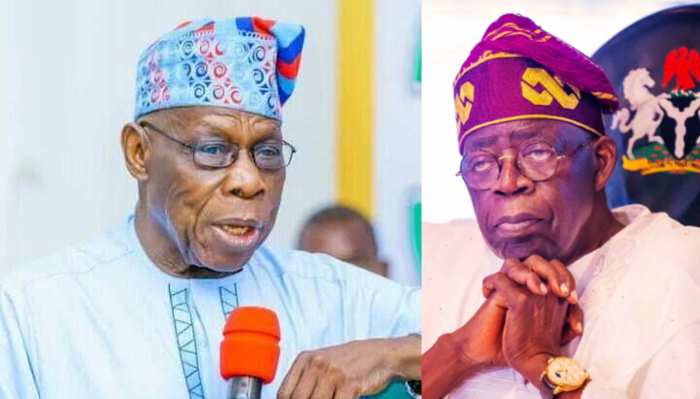
Former President Olusegun Obasanjo has taken a swipe at President Bola Tinubu over his administration’s borrowing policy, declaring that debt is worse than leprosy because its consequences can destroy entire generations.
Obasanjo warned that Nigeria’s growing debt burden could mortgage the country’s future and leave generations yet unborn struggling with the consequences of excessive borrowing.
The former president also raised concerns about Africa’s growing dependence on foreign artificial intelligence technology, warning that the continent could face another form of colonial exploitation if it failed to take ownership of its digital future.
He made the remarks on Friday at the Ajibosin Platform in Abeokuta, Ogun State, during a public forum themed, “Leveraging Artificial Intelligence to Solve Grassroots Problems and Accelerate National Development”.
Taking issue with Tinubu’s earlier declaration that borrowing was not leprosy, Obasanjo dismissed the President’s position and argued that the consequences of public debt extend far beyond the present generation.
“And for anybody to say debt is no leprosy, is absolute nonsense. Debt is worse than leprosy because leprosy destroys only one person. Debt destroys generations,” he declared.
Tinubu had defended his administration’s borrowing policy in April, arguing that borrowing was acceptable as long as the country could repay its obligations.
“If we have to borrow, we borrow. Borrowing is not leprosy; we just have to work hard to be able to pay for it,” the President said during a meeting with Plateau State leaders, led by Governor Caleb Mutfwang and APC National Chairman, Prof. Nentawe Yilwatda, at the State House.
The President’s defence of borrowing came against the backdrop of concerns about Nigeria’s increasing public debt and the substantial portion of government revenue allocated to debt servicing.
‘What Has Nigeria Done in 47 Years?’ Obasanjo Questions Naira’s Decline
Obasanjo also questioned Nigeria’s economic direction, particularly the dramatic fall in the value of the naira against the United States dollar.
Recalling when he established his farm 47 years ago, the former president said the naira was then stronger than the dollar.
“When I started my farm, 47 years ago, naira to the dollar was one naira to $1.85. Forty-seven years ago. What has Nigeria done in 47 years that we now have 1,500 naira to a dollar? What have we done?” he asked.
He challenged political leaders to demonstrate their understanding of the country’s challenges and explain what they were capable of doing to improve the situation.
“What do our leaders know? And what do they not know? And from what they know, what can they do for us?” he queried.
The former president also questioned Nigeria’s continued dependence on the World Bank and International Monetary Fund, arguing that the institutions were not established to address the specific needs of the country.
“World Bank and IMF were not designed for us. They were not built by us. They were built before we became independent. And that’s the people who would determine what we do,” he said.
He urged Nigerian leaders to carefully assess economic recommendations from foreign institutions instead of blindly adopting policies that might not reflect the country’s development priorities.
Obasanjo Sounds Alarm Over Foreign Control of AI
Beyond Nigeria’s economic challenges, Obasanjo warned that Africa could be heading towards another era of colonialism if foreign interests were allowed to dominate artificial intelligence.
He argued that African countries must develop the capacity to own and control the technology to prevent it from being used against their interests.
Although he admitted that he lacked extensive technical knowledge of AI, the former president insisted that control of technology was crucial.
“I don’t know too much technically about AI, but I know that anything that is not under your control can be abused against you. And you can see that this has already started,” he said.
Comparing the emerging technology with Africa’s experiences of slavery, colonialism and economic dependency, Obasanjo urged governments across the continent to be cautious about their dealings with foreign technology providers.
He also questioned the idea of technology transfer, demanding clarity about what African countries actually gain from such arrangements.
“But what exactly is technology transfer? Who transferred technology to them, and what did they pay for it?” he queried.
He further criticised international economic arrangements that restrict agricultural subsidies in developing countries while allowing developed economies to continue supporting their farmers.
24 Million Out-of-School Children Could Become Nigeria’s Next Disaster
Obasanjo also expressed alarm over the estimated 24 million Nigerian children who are not attending school, describing the situation as a major threat to the country’s future.
“We have 24 million Nigerian children who should be in school but are not. If you are looking for the disasters of tomorrow, these children represent one of them,” he warned.
He urged policymakers and technology experts to explore practical ways artificial intelligence could help address educational challenges and improve access to learning.
On agriculture, the former president advocated the application of AI to help farmers determine suitable crops, increase agricultural output and improve food and nutrition security.
Historian: Africa Risks Another Era of Exploitation Through AI
Also addressing the gathering, historian and guest speaker, Dr Umar Ardo, warned that Africa could be entering another phase of economic exploitation if it failed to establish ownership and control over its data, technological infrastructure and intellectual resources.
Speaking on the topic, “From Slave Ships to Server Farms: Artificial Intelligence and Africa’s Unbroken History of Extraction”, Ardo argued that artificial intelligence could either transform the continent’s economy or deepen existing inequalities.
He maintained that Africa’s continued dependence on foreign technology companies could allow external interests to capture the economic benefits of innovations built using African data and resources.
“AI offers Africa important opportunities, but without ownership, safeguards and public purpose, it could extend a long history in which Africa supplies value while others control and capture it,” he said.
Tracing the continent’s economic history over five centuries, Ardo identified the transatlantic slave trade, colonial exploitation of natural resources and post-independence economic dependency as successive stages of external extraction.
He explained that while slavery exploited African people, colonialism focused on extracting mineral and agricultural resources. After independence, many African economies continued exporting raw materials while importing finished goods.
According to him, colonial infrastructure, including railways, steam engines and administrative systems, was largely designed to facilitate the movement of African resources to foreign markets.
“We supplied resources and labour; others controlled the machinery and captured much of the value,” he stated.
He also identified the migration of skilled African professionals, including doctors, nurses, engineers and scientists, to foreign countries as another major loss to the continent.
Ardo warned that data could become the next valuable resource extracted from Africa, pointing to information generated by citizens, hospitals, farmers, businesses, indigenous communities and public institutions.
“Data may become the fourth commodity in this long history of extraction,” he cautioned.
He questioned the ownership of information and knowledge collected from African communities and subsequently incorporated into artificial intelligence systems controlled by foreign companies.
“When farmers’ planting patterns are recorded, who controls that knowledge; the farmer or the platform?” he asked.
Ardo Demands African Ownership of Technology and Data
To prevent AI from becoming another instrument of foreign domination, Ardo called for technological sovereignty, stronger data protection, indigenous innovation, grassroots development and cooperation among African countries.
He advocated stronger legal protections against the exploitation of personal information and traditional knowledge.
Although he recognised the Nigeria Data Protection Act 2023 as an important development, he argued that protecting privacy alone would not guarantee African ownership of data.
He called for policies that would protect community knowledge, ensure fair compensation and allow Africans to benefit from the commercial value generated through their information and intellectual resources.
Ardo also urged the Federal Government to invest more in domestic computing facilities, reliable electricity, semiconductor technology, research institutions and locally developed AI systems.
“A country of over 230 million people should be more than a market for foreign technology,” he declared.
He further called for the development of African-owned datasets and AI models capable of understanding local languages, agricultural practices, medicinal traditions and customary knowledge.
On the grassroots level, he urged governments to deploy artificial intelligence in primary healthcare, agricultural extension, local government administration, revenue collection, conflict resolution and disaster management.
He also recommended extensive AI training in universities, polytechnics and colleges of education to develop the professionals needed to build and manage local technology.
Ardo called for stronger cooperation among African countries to harmonise data regulations, establish shared technological infrastructure and improve the continent’s negotiating position with international technology companies.
He identified the African Union’s Data Policy Framework, adopted in 2022, as an important foundation for achieving this objective.
Warning that digital exploitation could be harder to detect than the extraction of physical resources, he said information could move across national borders without the knowledge or meaningful understanding of the communities that generated it.
“One of the most efficient systems of extraction is the one its subjects volunteer to use,” he warned.
He insisted that Africa must move beyond consuming foreign innovations and become an active participant in developing, owning and regulating the global technology ecosystem.
Summarising the continent’s history of exploitation and the emerging threat posed by digital extraction, Ardo said:
“Five centuries ago, they came for our bodies. Then they came for our land and its riches. Then our commodities and trained minds. Today, they come for our data.”
Despite the challenges, he said Africa still had the opportunity to determine how artificial intelligence would shape its future.
“The choice is ours. Artificial intelligence can become another instrument through which Africa is managed, or an instrument through which Africa begins to manage its own destiny,” he added.
Africans Angle News















You must be logged in to post a comment Login