
Breaking News
South African Court Allows Anti-Migrant Protests Under Tighter Restrictions Amid Deadly Unrest
South Africa’s High Court has imposed strict conditions on anti-migrant protests in Durban amid rising violence and concerns over public safety.

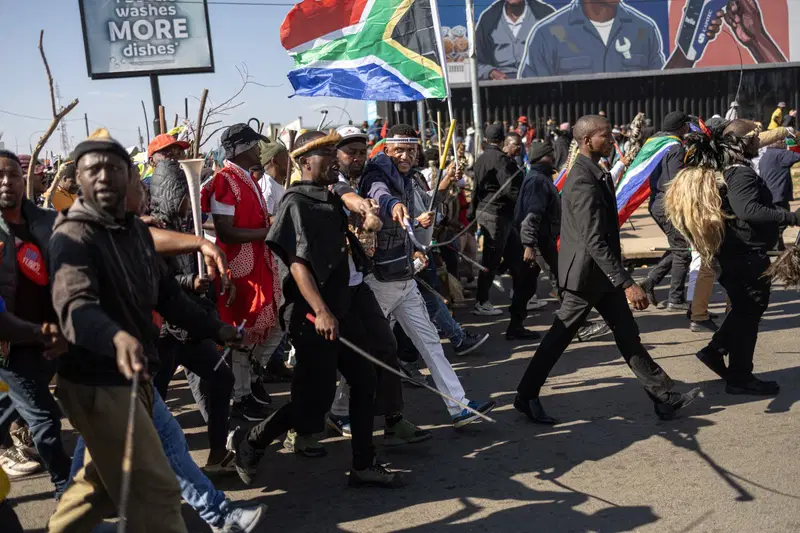
A South African court has allowed an anti-migrant movement to continue its planned demonstrations but imposed strict conditions on the protests as authorities seek to contain growing violence against foreign nationals.
The ruling came on Friday as hundreds of demonstrators gathered outside the High Court in Durban, where the government had sought judicial intervention to curb protests that have become increasingly violent, including an attack that left a foreign national dead last week.
Durban, a major city in the Zulu heartland, has become a centre of anti-migrant agitation organised by the March and March movement. The group has spent months mobilising demonstrations against undocumented foreigners in different parts of South Africa.
Violence surrounding the protests intensified last week when a mob of around 50 people reportedly beat a foreign national to death. The incident prompted President Cyril Ramaphosa to deploy more than 500 soldiers to support police operations.
Protesters outside the court sang and chanted slogans while displaying placards reading “reclaim our country” and carrying sticks. Police officers monitored the gathering closely.
Political supporters from various parties, including the centre-right ActionSA and former president Jacob Zuma’s uMkhonto weSizwe (MK) party, also joined the demonstration in support of the protesters.
In his ruling, Judge Peter Olsen authorised the March and March movement to hold its planned demonstrations, but imposed additional restrictions following amendments to the government’s application.
The new conditions limit marches to between 9am and 3pm. Protesters are forbidden from carrying weapons, concealing their faces, damaging property or setting buildings ablaze.
The dispute is expected to return before the court next year.
Acting Police Minister Firoz Cachalia brought the case, arguing that the demonstrations threatened public safety, public order and the lives of foreign nationals.
He also presented police intelligence suggesting an alleged plan to burn down the Home Affairs Refugee Reception Centre in Berea, an inner-city neighbourhood where asylum seekers seek official documentation.
Police have linked the growing unrest to misinformation surrounding a Constitutional Court ruling issued in July. The ruling established that asylum seekers cannot be excluded from South Africa’s asylum system solely because of procedural requirements.
Police warn of escalating lawlessness
During Friday’s proceedings, lawyers representing the police warned that the situation in Durban had “degenerated into lawlessness” that conventional policing methods could no longer contain.
They told the court that although more than 400 officers had been deployed, the operation had “proved structurally unable to stem the widespread violence”.
However, the March and March movement maintained that its demonstrations were protected by the constitution, rejecting any responsibility for violent acts committed by individuals.
Speaking to reporters before the court delivered its decision, the group’s legal representative, Xolani Zuma, accused authorities of attempting to suppress public dissent.
“The agenda is to try and silence the people,” he said.
“The real problem are illegal immigrants who are here in the country and terrorising people,” Zuma added.
The legal battle is unfolding just days before South Africa’s local elections on November 4. Lawyers have raised concerns that police resources are already stretched as authorities prepare for the vote.
Populist movements organising the protests accuse foreign nationals of taking employment opportunities and access to public services away from South Africans, making immigration a major political flashpoint ahead of the elections.
According to police, at least five foreign nationals have died in anti-migrant violence across the country this year. However, some African governments have reported higher figures.
Authorities said the nationality of last week’s victim had not yet been established, as investigations continue.
Africans Angle News


















You must be logged in to post a comment Login