
Africa
Expediency Of Calling Gun-Bearing Farmers And Hunters To Order As “Gun Nor Be Catapult” -By Isaac Asabor
To further buttress the foregoing view, it is germane to opine that a gun is not a catapult; its presence escalates conflicts rather than resolves them. The government must, therefore, take decisive steps to regulate firearm ownership, strengthen regional security outfits, and address the root causes of violence. By doing so, Nigeria can move towards a more peaceful and secure society, where disputes are settled with dialogue rather than bullets.

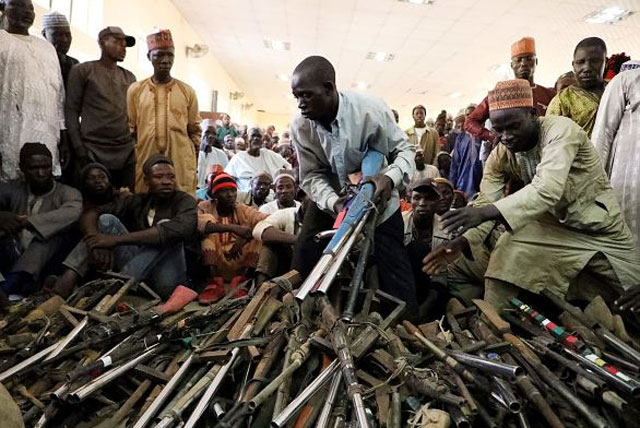
The recent tragic incident in Uromi, Edo State, where 16 alleged hunters were killed by a vigilante group, has once again brought to the fore the ever-worsening security concerns in Nigeria. This development has fueled discussions on the dangers of bearing arms under the guise of farming or hunting, especially given the mutual suspicion that exists between northern herdsmen and southern farmers. It is imperative for both state and federal governments to implement decisive policies to control the movement of firearms across regions. The truth is that a gun is not a catapult, it is a lethal weapon, and its proliferation in a fragile society like Nigeria is an invitation to anarchy.
The reason for the foregoing view cannot in any way be pooh-poohed as the rising security tensions between farmers and herdsmen in Nigeria is unarguably concerning.
Without a doubt, Nigeria has been grappling with violent clashes between farmers and herdsmen for years. These conflicts have led to significant loss of lives and property, particularly in states like Benue, Plateau, and Edo. The core of these hostilities lies in competition over land resources, grazing routes, and the perceived bias of security agencies. As farmers and herders arm themselves in self-defense or retaliation, the violence continues to escalate, deepening ethnic and religious tensions in the country.
Against the backdrop of the foregoing view, it is germane to opine that the unfortunate incident in Uromi is a manifestation of this deep-seated mistrust. Reports suggest that the 16 individuals killed were suspected hunters, but local vigilante groups perceived them as threats. The question that begs for answers is: why were these alleged hunters bearing arms? If they were only out to hunt game, why were they mistaken for threats by the vigilante group? The presence of firearms in the hands of civilians under the guise of hunting or self-defense is a ticking time bomb that needs to be defused before it spirals further out of control.
In fact, there are obvious dangers of unregulated firearms in civilian hands. This is as in many parts of Nigeria, individuals and groups have taken the law into their own hands due to the failure of the state to provide adequate security. This has led to the emergence of self-styled vigilantes, hunters, and private security outfits wielding dangerous weapons, often with no clear distinction between lawful self-defense and outright criminality.
Without any iota of exaggeration, arms proliferation among civilians is one of the major reasons for the heightened violence in Nigeria. When farmers, hunters, and herders are allowed to move freely with firearms, the chances of confrontations escalating into deadly clashes, like the gory incident in Uromi, become inevitable. Unlike a catapult, a gun does not offer a second chance; a single shot can claim multiple lives, and the ease of access to firearms makes conflicts even more brutal.
Moreover, the illicit arms trade has also contributed to the problem. Many of these weapons come from smuggling networks that exploit porous borders, supplying arms to criminal elements and individuals looking to defend themselves. With no central regulatory framework to monitor gun ownership in rural areas, weapons fall into the wrong hands, further worsening security challenges.
Given the foregoing backdrop, there is an urgent need for the government to implement a sustainable policy towards the need for firearm control.
Without a doubt, the government at both state and federal levels must address this menace head-on. This is as the unchecked movement of firearms under the pretext of hunting or farming must be curtailed through stringent policies.
The foregoing suggestion can be achieved by strengthening firearm laws. The Nigerian government must reinforce existing firearm regulations and ensure that only authorized security personnel are allowed to bear arms. The Firearms Act must be updated to reflect contemporary realities, with severe penalties for illegal possession and movement of arms across regions.
There should be a national firearms database to track ownership, usage, and renewal of gun licenses. In developed countries, firearm registration is mandatory, and only those who meet strict eligibility criteria can own guns. Nigeria must adopt a similar approach to curb the indiscriminate use of firearms.
In a similar vein is the establishment of regional security frameworks. Instead of allowing civilians to arm themselves, the government should empower local security frameworks like Amotekun in the Southwest and Ebube Agu in the Southeast. These outfits, working in collaboration with law enforcement agencies, should be equipped to handle security challenges without resorting to unnecessary bloodshed.
To make these outfits effective, there should be proper training, adequate funding, and a clear mandate that ensures they do not become tools for ethnic profiling or vendettas. Additionally, technology such as surveillance drones and communication gadgets should be deployed to detect potential security threats before they escalate into violent confrontations.
Also in a similar vein is the need to embark on the exercise of disarming unauthorized groups. There should be a nationwide campaign to retrieve illegal firearms in circulation. This can be achieved through a combination of voluntary surrender programs and aggressive law enforcement operations targeting those in possession of unlicensed weapons.
In fact, disarmament programs should also be followed by rehabilitation initiatives for those who have relied on firearms for survival. Skill acquisition programs and economic empowerment schemes should be introduced to discourage people from resorting to violence as a means of livelihood.
Added to the foregoing is the need to address root causes of violence. While firearm regulation is critical, the government must also address the underlying causes of these conflicts. Economic deprivation, land disputes, and ethnic divisions must be tackled holistically to reduce the desperation that drives people to arm themselves.
Also, policies should promote modern ranching systems to prevent conflicts between farmers and herdsmen. If herders have designated areas for grazing, they would not have to move across regions, reducing the likelihood of clashes with farmers. Additionally, farm security measures such as fencing, irrigation systems, and alternative livelihood programs should be introduced to protect agricultural investments.
Not to be ignored in this concerning issue is the role of traditional rulers and community leaders. Beyond government policies, traditional rulers and community leaders must play a role in de-escalating
tensions. Sensitization programs should be launched to educate farmers and hunters on the dangers of carrying firearms and the need to embrace peaceful conflict resolution mechanisms.
Furthermore, communities should establish early warning systems where suspicious movements and activities can be reported to security agencies before they degenerate into violent confrontations.
Religious and cultural leaders must also be actively involved in discouraging gun violence. Sermons, town hall meetings, and advocacy campaigns should emphasize peace and unity over armed retaliation. The culture of resolving disputes through dialogue rather than violence must be reinforced.
The tragic killings in Uromi should serve as a wake-up call to the Nigerian government. The unchecked movement of arms in the name of hunting and farming is a recipe for disaster. While self-defense is a fundamental human right, it must be exercised within the confines of the law.
To further buttress the foregoing view, it is germane to opine that a gun is not a catapult; its presence escalates conflicts rather than resolves them. The government must, therefore, take decisive steps to regulate firearm ownership, strengthen regional security outfits, and address the root causes of violence. By doing so, Nigeria can move towards a more peaceful and secure society, where disputes are settled with dialogue rather than bullets.
Only through decisive action can Nigeria curb the growing trend of unauthorized firearms proliferation and ensure that communities coexist peacefully. The safety of citizens should be the topmost priority of the government, and urgent steps must be taken to restore law and order in regions affected by gun violence.

























You must be logged in to post a comment Login