Breaking News
Historic Senate Vote Creates State Police System, Retains Federal Control Over National Security
Nigeria’s Senate has approved a constitutional amendment establishing state police across the 36 states, marking a major shift in the country’s security and policing structure.

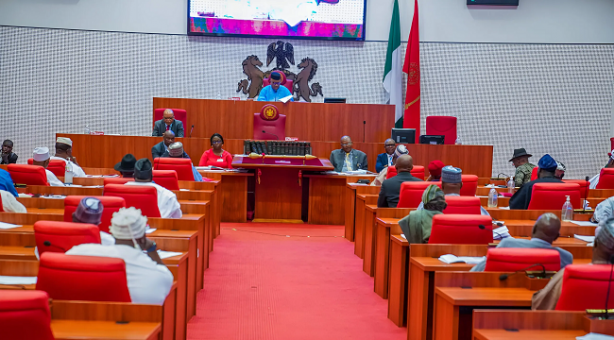
The Senate has approved a constitutional amendment bill establishing state police services, marking one of the most significant security reforms since Nigeria returned to democratic rule in 1999.
The executive bill, forwarded by President Bola Tinubu, introduces a two-tier policing structure that will replace the exclusive dominance of the Nigeria Police Force with separate Federal and State Police Services.
The passage came after an unexpected technical setback when the Senate’s electronic voting platform failed during proceedings. Following a motion by Senate Leader Opeyemi Bamidele and support from Minority Leader Abba Moro, senators adopted a manual voting process, with all 88 lawmakers present voting through a show of hands.
Federal Police Retain Key Security Responsibilities
Despite the creation of state police, the bill preserves federal authority over major security matters.
The Federal Police Service will continue to oversee terrorism, cybercrime, interstate criminal activities, arms trafficking, international crime networks, the Federal Capital Territory and federal institutions.
State police services will be restricted to policing within their respective states and cannot operate beyond state borders except where authorised by federal legislation.
The constitutional amendment states:
“There shall be a police service for the Federation to be known as the Federal Police Service.”
It also provides for the establishment of a State Police Service in every state, subject to constitutional provisions and federal legislation.
States Must Meet National Standards
The Senate Committee on the Review of the Constitution recommended that states must satisfy strict national requirements before establishing police services.
Under the bill, no state police service can become operational until the state legislature passes the necessary law and the National Assembly certifies compliance with prescribed standards.
The measure seeks to prevent the emergence of poorly regulated or politically influenced security structures.
President Granted Emergency Powers
The legislation also outlines circumstances under which the President may temporarily assume control of a state police service.
Such intervention can occur if a state police force is unable to contain a security crisis, becomes operationally ineffective, or is found to be engaging in serious abuses such as electoral intimidation, ethnic persecution or violations of fundamental rights.
Federal intervention must be formally documented, communicated to relevant authorities within 48 hours and approved through Senate oversight. Courts will also retain authority to review the legality and duration of such actions.
Leaders Back Reform
The significance of the debate attracted senior government officials and governors to the Senate chamber, including Chief of Staff to the President Femi Gbajabiamila, Kaduna State Governor Uba Sani, Ogun State Governor Dapo Abiodun and Ondo State Governor Lucky Aiyedatiwa.
Several state Attorneys-General and representatives of the Nigeria Governors’ Forum were also present during deliberations.
Supporting the bill, Senate Leader Opeyemi Bamidele said the reform would improve local security responses and strengthen federalism.
“By establishing concurrent jurisdiction through the formal creation of state police services alongside the existing Nigeria Police, this decentralised framework aligns with the core principles of true federalism.
“It empowers subnational authorities with local knowledge and cultural competence necessary for rapid response and effective intelligence gathering.”
The bill also introduces tenure protections for police chiefs and explicitly prohibits the use of police institutions for partisan political purposes, discrimination or the suppression of lawful political activities.
Africans Angle News