
Forgotten Dairies
Is Nigeria’s Democracy Driven By Ideology Or Personal Interest? -By Isaac Asabor
Until Nigerian politicians are forced to choose between the principles they profess and the political convenience they pursue, voters must stop mistaking party logos for real conviction. The true measure of Nigeria’s democracy is not the sheer number of political parties registered, but whether those parties, and the leaders who guide them, stand for a clear, accountable vision beyond the immediate pursuit of power.

The most troubling sign of a democracy in decline is not necessarily that politicians change political parties. In a constitutional democracy, switching party allegiance remains a legitimate exercise of free association, particularly when a politician sincerely believes their former party has abandoned its founding principles, compromised its platform, or no longer offers the nation a credible path to sustainable development.
What should deeply trouble Nigerians, however, is a more pernicious and growing phenomenon: the practice of prominent politicians retaining formal membership in one political party while actively coordinating, financing, and leading campaigns for the presidential candidate of another, all without demonstrating any ideological consistency or offering a convincing public explanation for the glaring contradiction.
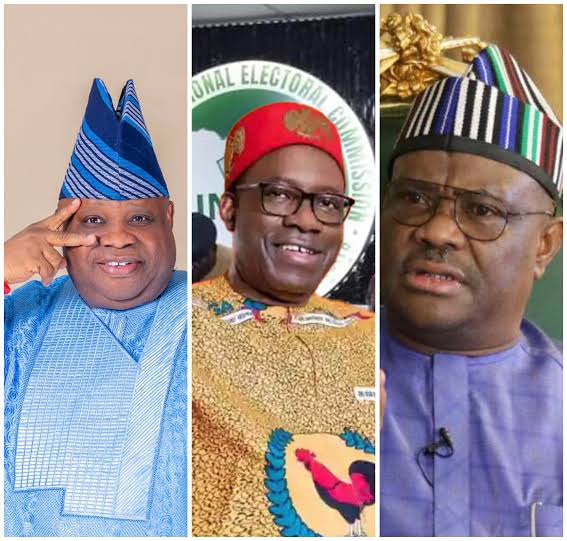
The recent inclusion of high-profile opposition figures in the All-Progressives Congress (APC) Presidential Campaign Council for President Bola Tinubu’s 2027 re-election bid has brought this systemic contradiction into sharp, unavoidable focus. Chief Nyesom Wike remains a self-proclaimed chieftain of the Peoples Democratic Party (PDP); Professor Chukwuma Charles Soludo holds executive office on the platform of the All-Progressives Grand Alliance (APGA); and Senator Ademola Adeleke governs Osun State under the banner of the Accord Party. Yet, this threesome has been handed strategic, high-stakes campaign responsibilities to secure a second term for President Bola Ahmed, who unarguably flies the APC presidential flag.
For the sake of clarity, Nyesom Wike has been tasked with driving campaign operations across Rivers State and the Federal Capital Territory (FCT), Chukwuma Soludo is slated to anchor the campaign machinery in Anambra State; and Ademola Adeleke has been named state coordinator for the APC campaign in Osun.
This unusual configuration forces a fundamental question upon the political class: “What does political party membership actually mean when high-ranking party leaders can mobilize voters for a rival party’s flagbearer while retaining their original institutional identities?”
Dismissing this trend as merely “pragmatic politics,” “strategic coalition-building,” or the standard realpolitik required to win elections is deeply insufficient. Those terms may sound politically sophisticated, but they serve as a thin veil over a structural erosion. When political affiliation becomes elastic enough to legitimize opposing electoral loyalties, citizens have every right to ask whether Nigerian democracy is driven by competing governance philosophies or by the self-serving calculations of a transient political elite.
Political parties are not meant to be mere taxicabs designed to carry ambitious individuals into elective office. In an enduring democracy, parties represent identifiable ideological commitments, distinct policy choices, and coherent blueprints for governance. Party manifestoes are supposed to articulate a clear vision for the economy, security, and social welfare, while candidates are expected to embody those promises. Membership in a party implies a public commitment to those shared values and an obligation to advance them.
So, when political actors disregard these commitments whenever electoral arithmetic demands it, party politics is reduced to empty theatrical performance. Elections cease to be robust debates over competing ideas and instead collapse into transactional contests between shifting networks of patron-client relationships and personal survival strategies.
Consider Nyesom Wike, the former PDP Governor of Rivers State and current Minister of the Federal Capital Territory under President Tinubu’s APC administration. Wike’s political trajectory has exposed deep fractures within Nigeria’s primary opposition party. During the 2023 presidential election, Wike openly worked against his own party’s presidential candidate, Alhaji Atiku Abubakar, actively redirecting his local political structure toward the APC.
Wike’s integration into the cabinet and his appointment to the APC’s 2027 campaign council take this political anomaly to a ridiculous level. The fundamental issue is not whether Wike has the right to support President Tinubu; as an individual citizen, he possesses the constitutional freedom to support whichever candidate he deems qualified. The problem lies in his insistence on operating within the machinery of the PDP while actively working to dismantle its national presidential prospects.
If Wike believes the PDP is fundamentally incapable of offering visionary leadership, the honorable course of action would be to state that position clearly, relinquish his party standing, and formally align with the APC. Conversely, if he believes the APC offers the best governance model for the nation, he owes his constituents a reasoned defense of that shift. What Nigerians should reject is a hybrid arrangement where an opposition politician enjoys the institutional benefits and internal leverage of one party while acting as an operational engine for another.
In a similar vein, the involvement of Governor Chukwuma Soludo presents challenge to democratic accountability. Soludo secured his governorship under the APGA banner, a party with a specific historical identity rooted in the political expression and socioeconomic aspirations of the South-East. Therefore, accepting an executive role in the APC’s presidential re-election campaign places him directly inside the machinery of a rival national party.
Federalism undoubtedly requires intergovernmental cooperation. A state governor must work productively with the President, regardless of party affiliation, on national security, revenue sharing, infrastructure development, and economic planning. However, cooperation in governance is fundamentally different from actively campaigning to keep a rival political party in power.
Soludo did not earn his mandate under the APC platform. Voters who aligned with APGA had a reasonable expectation that their governor would protect and promote the political philosophy associated with the party that brought him to office. If Soludo believes that President Tinubu’s performance merits a second term, he owes his electorate a transparent policy explanation detailing why APGA’s regional and national alternative should be set aside at the presidential level.
A similar dynamic is evident in Osun State, where Governor Ademola Adeleke, re-elected under the Accord Party platform, has accepted the role of state coordinator for the APC presidential campaign. This creates an obvious institutional conflict: Accord and the APC are separate registered political parties, each legally entitled to present distinct visions, candidates, and policy critiques to the electorate.
Adeleke may argue that coordinating the President’s campaign secures federal goodwill and strategic resources for Osun State. But when a governor elected under one platform dedicates state political assets to deliver votes for another party, the identity of his original party is effectively erased. What happens to Accord’s internal platform, its local candidates, and the citizens who voted for Adeleke specifically to offer an alternative to the APC’s governance model?
The issue goes beyond these three politicians. Nigeria’s political culture has routinely demonstrated how easily party structures can be subjugated to the personal ambitions of powerful individuals. Political figures move across party lines, forge alliances with former ideological adversaries, abandon campaign promises, and redefine their allegiances without public accountability.
In mature constitutional democracies, formal political coalitions are common. Parties construct alliances to pass legislation, form parliamentary majorities, or manage national crises. However, those arrangements are typically transparent, codified in formal agreements, structured around explicit policy objectives, and subjected to public debate. In Nigeria, cross-party alliances are far too often built around personalities rather than policy programs:
Politicians who spent years publicly criticizing one another’s records can suddenly embrace as political allies without explaining what policy shifts made their union possible. This personalistic approach disincentivizes long-term institutional development. Instead of building internal party democracy, refining policy platforms, and engaging voters through persuasive arguments, political leaders invest their resources into personal patron-client networks capable of negotiating access to power.
Consequently, the electorate is treated not as a sovereign body whose policy preferences determine the direction of the country, but as an electoral resource to be mobilized through top-down alignment.
Given the foregoing point of views, it is not out of place to ask, “Where are the manifestoes and ideological distinctions? As the foregoing seems to be unanswerable, it is tempting to ask again, “What is the actual value of a political manifesto in Nigeria today?”
In fact, if the PDP, APGA, and Accord present themselves as genuine alternatives to the APC, how can their prominent figures justify leading campaign efforts for the ruling party’s presidential candidate? If the policy differences between these parties are so negligible that their top leaders can freely alternate campaign responsibilities, then Nigerians must confront the reality that party platforms may be little more than instruments for personal negotiation.
Conversely, if real ideological differences exist regarding economic management, state security, federalism, and social welfare, these leaders must explain how they reconcile those policy divergence with their campaign choices.
Furthermore, this practice undermines internal party democracy and demoralizes grassroots organizers. What message does it send to loyal party members who sacrifice time and resources to build local party structures, only to watch their senior leaders leverage those exact structures to support a rival party’s national candidate?
In fact, the prevailing political situation been argued in this context is unarguably creating an unfair double standard for down-ballot candidates. A candidate running for the National Assembly under the PDP, APGA, or Accord banner is expected to critique the APC’s record, only to find their own governor or regional leader actively campaigning for the APC’s presidential candidate.
Without a doubt, Nigeria faces profound national challenges: economic volatility, high inflation, widespread security concerns, youth unemployment, and infrastructure deficits. Addressing these issues requires structured political debates, clear policy alternatives, and accountable governance institutions.
So, when politics is reduced to a game of elite realignment across party lines, substantive policy discussions are pushed aside in favor of elite survival strategies. Citizens struggling with the rising cost of living should not have to guess what a candidate or party stands for. They should be able to examine a party’s platform, assess its record, and cast an informed vote based on competing visions for the country.
Given the foregoing awkward and partisan situation, it is expedient to opine that ahead of the 2027 general election that the Nigerian electorate must demand greater clarity and accountability from its political class: The APC must explain the policy and ideological basis for absorbing rival party leaders into its presidential campaign structure. On the other hand, the PDP, APGA, and Accord must clarify their institutional identities when their key leaders campaign for the ruling party.
Most importantly, the politicians involved must speak directly to the public and explain the principles behind their actions, rather than treating their dual alignments as self-explanatory.
In fact, democracy requires more than the strategic assembly of political heavyweights. It requires ideological clarity, institutional integrity, and a respect for the voters’ intelligence. A system where politicians can belong to every party and stand for no fixed principles may produce convenient short-term alliances, but it damages public trust in democratic institutions.
Until Nigerian politicians are forced to choose between the principles they profess and the political convenience they pursue, voters must stop mistaking party logos for real conviction. The true measure of Nigeria’s democracy is not the sheer number of political parties registered, but whether those parties, and the leaders who guide them, stand for a clear, accountable vision beyond the immediate pursuit of power.















You must be logged in to post a comment Login