
Global Issues
Is Trump Afrocentric? A Hard Look At The Facts -By Isaac Asabor
As Trump continues his second term, Africans, both on the continent and in the Diaspora, must keep this track record in mind. Respect is not optional in international relations. It is foundational. Africa is not a jungle to be tamed. It is not a burden to be managed. It is a vibrant, diverse, and rising continent that demands and deserves global respect. And anyone who fails to see that, let alone acknowledge it, Trump included, cannot and should not be called Afrocentric.

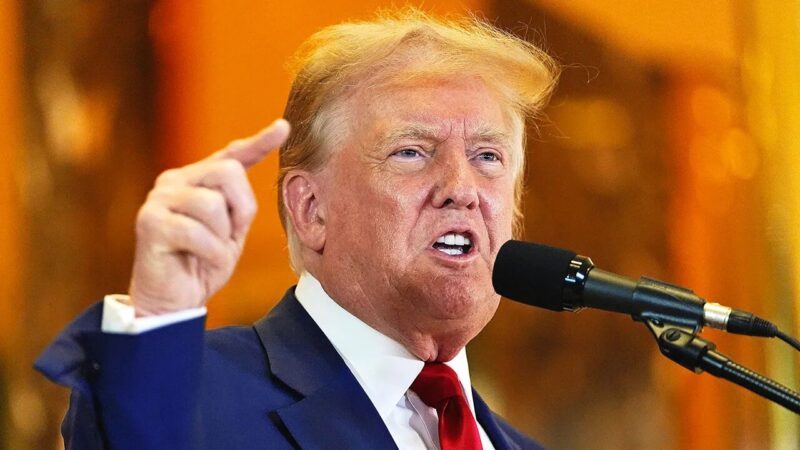
Afrocentrism demands a leader who respects Africa’s sovereignty, understands its cultural and historical wealth, acknowledges its global contributions, and relates with Africans on the basis of equality. It is not performative. It is not charity. And it certainly does not accommodate casual racism or ignorance masquerading as diplomacy.
So, in light of his well-documented remarks and posture toward African nations, the question arises: “Is Donald Trump Afrocentric?” Looking closely, the answer is unambiguous and uncomfortable “No”, rather, available evidences show he is Afro phobic. For the sake of clarity, Afrophobic is a term used to describe a person who has negative attitudes and feelings towards black people or people of African Descent around the world.
What we have seen from Donald Trump, both during his first term presidency and in his ongoing second term as American president is a disturbing blend of condescension, ignorance, and outright disrespect for Africa and its people.
Let us begin with a major diplomatic event when President Muhammadu Buhari paid a visit to the White House in April 2018. For a continent that often struggles for fair representation on the global stage, Nigeria, as Africa’s most populous nation and economic powerhouse, deserved a meaningful, respectful engagement. What the world witnessed instead was a choreographed diplomatic engagement marred by undertones of superiority and dismissiveness from Trump.
Observers noted Trump’s uninterested body language and thinly veiled disregard for the Nigerian leader during that historic visit. More symbolic than sincere, the meeting did little to advance U.S.-Africa relations. Buhari, unfortunately, left Washington looking more like a colonial appointee summoned for instructions than a head of state received with full honor.
This diplomatic coldness was amplified by Trump’s earlier remark, widely reported and confirmed by lawmakers, that he had referred to African nations as “shithole countries” during an immigration policy discussion. He contrasted them with places like Norway, indicating a clear racial and geographic preference that excluded Africa from his vision of a “great” America.
Fast forward to a recent interaction between Trump and Liberian President Joseph Boakai. Trump, in his characteristic tone, mockingly, or perhaps ignorantly, asked the Liberian president, “Where did you learn to speak English so well?” This question reveals more than it intended. Liberia was founded by freed African-American slaves in the 19th century. English is its official language. For Trump to express surprise at an African president’s eloquence in English is not only patronizing, but also exposes a severe lack of knowledge about African history and geopolitics.
Such remarks are not new. They are part of a pattern of superiority complex, where Trump seems to see Africans as anomalies when they exhibit intelligence, civility, or competence, traits he apparently does not associate with the continent.
Trump’s ignorance about Africa was once again on full display during a reported White House intelligence briefing early in his presidency. Recently, when being briefed by senior officials about Lesotho, a small, landlocked country in Southern Africa, Trump allegedly asked: “Is that a real country?” The question, while shocking, was consistent with Trump’s other interactions concerning African countries. Lesotho has been a sovereign state since 1966, with defined borders, a functioning democratic system, and a rich culture. But in Trump’s worldview, Africa is a vague, undifferentiated mass, not a continent of 54 diverse, sovereign nations with individual identities. Such ignorance would be laughable if it were not dangerous, especially coming from the leader of the world’s most powerful nation.
This perspective is further cemented by the recent contentious visit of South African President Cyril Ramaphosa to the White House. Instead of a respectful dialogue, the meeting was reportedly dominated by Trump confronting Ramaphosa with a video alleging “white genocide” in South Africa, a narrative Trump has long promoted. This act forced the South African leader onto the defensive and serves as a stark, contemporary example of the condescension and disrespect detailed earlier. Much like the encounter with Nigeria’s President Buhari, this engagement was framed by Trump’s own racially charged narratives rather than mutual respect, powerfully reinforcing the conclusion that his approach to Africa is the very antithesis of Afrocentrism.
Despite Trump’s repeated portrayal of African countries as impoverished and chaotic, Africans in America have consistently outperformed many immigrant groups, even native-born Americans, in educational and professional metrics. Nigerian-Americans, for instance, are among the most highly educated groups in the United States, with over 60% holding at least a bachelor’s degree, far above the national average.
African doctors, engineers, nurses, pharmacists, and academics have become indispensable to America’s healthcare, tech, and research sectors. Entrepreneurs like Tope Awotona, founder of Calendly; literary icons like Chimamanda Ngozi Adichie; and medical pioneers such as Dr. Oluyinka Olutoye are powerful examples that Africans in the U.S. do not merely contribute, they excel.
Yet, Donald Trump has rarely, if ever, acknowledged this growing wave of African excellence. Instead of celebrating these achievements, he has often pushed a narrative that paints African immigrants as burdens rather than assets.
Trump’s political posture has consistently leaned toward a hardline anti-immigration stance, and Africans have not been exempt. During his first term, he expanded the infamous travel ban to include Nigeria, Sudan, Eritrea, and Tanzania. Immigration applications from African countries faced high denial rates, while many African asylum seekers were detained and left in prolonged legal limbo.
Now, with his return to the White House, Trump’s immigration agenda has reemerged with greater intensity. He has not only reinstated but also expanded the travel ban, once again targeting countries like Nigeria, Sudan, Eritrea, and Tanzania. Immigration applications from African nations now face even stricter vetting and soaring rejection rates.
There are growing fears that African asylum seekers are once again being detained in large numbers, with extended uncertainty and limited access to due process. Trump’s rhetoric continues to signal a renewed crackdown, and many observers believe his second term has formally institutionalized policies that disproportionately affect African migrants.
This policy framework was less about national security and more about systemic exclusion. It signaled to African nations and their citizens: “You are not welcome here.”
An Afrocentric leader would seek to build bridges with Africa, not walls. Unlike past presidents who left behind tangible legacies of U.S.-Africa engagement, George W. Bush with PEPFAR, Barack Obama with the Young African Leaders Initiative (YALI), Trump left nothing left nothing in first term, and he is likely going to leave nothing at the end of his ongoing second term.
There was no Africa summit, no flagship policy, and no regional engagement strategy. In fact, several ambassadorial postings to key African nations remained vacant during his tenure. In the eyes of Trump’s White House, Africa simply did not matter.
On the rare occasions when Trump referenced Africa or appeared alongside Black supporters, the intention was almost always performative. Token African-Americans were showcased at campaign rallies as proof of diversity, but there was no accompanying policy shift or investment in Black communities, let alone African nations.
Without a doubt, Trump used Africa and its diaspora as “props”, not partners. That is not Afrocentrism. That is exploitation.
For the sake of clarity, Afrocentrism is built on dignity, knowledge, and mutual respect. By that standard, Donald Trump is not only not Afrocentric, he is the very antithesis of it. This is as his words betray ignorance, his actions show disinterest, his policies reflect exclusion and his attitude borders on disdain.
From dismissing Lesotho’s sovereignty, mocking Liberia’s president, to labeling the entire continent as a “shithole,” Trump’s relationship with Africa has been marked by arrogance, ignorance, and condescension.
As Trump continues his second term, Africans, both on the continent and in the Diaspora, must keep this track record in mind. Respect is not optional in international relations. It is foundational. Africa is not a jungle to be tamed. It is not a burden to be managed. It is a vibrant, diverse, and rising continent that demands and deserves global respect. And anyone who fails to see that, let alone acknowledge it, Trump included, cannot and should not be called Afrocentric.
















You must be logged in to post a comment Login