
Africa
Kenya Do Nigeria Right Hand: Trapped in Cycles of Chaos -By Prince Charles Dickson, Ph.D
As the juju man screamed for divine intervention, so must these nations. The road ahead demands more than switching driving sides—it requires accountability at all levels. Kenya’s youth must channel digital prowess into governance; Nigeria’s creatives should weaponize art for activism.

A man, convinced his wife was unfaithful, visited a village juju man for answers. The diviner demanded sand from the man’s yard for a ritual. Two weeks later, the man returned with the sample. After incantations, the juju man revealed shocking truths: the man’s children were not his, his daughter was entangled with five men, and his wife carried his brother’s child. Instead of despair, the man laughed. He confessed he’d forgotten his own soil and dug sand from the juju man’s compound. The diviner’s horrified cry—“JESUS CHRIST!”—echoed the irony: the rot was not just in one home, but in the very ground of the “healer” himself.
This allegory mirrors Kenya and Nigeria—two nations where citizens and leaders alike dig into each other’s “compounds,” blaming systemic decay on the other, only to find corruption, debt, and disillusionment are shared burdens. Their stories, separated by geography but united by post-colonial paradoxes, reveal a haunting truth: the poison is not “out there” but in the soil beneath their feet.
Kenya drives on the left, Nigeria on the right—a superficial distinction masking deeper parallels. Kenya’s British colonial legacy left a Westminster-style democracy and tea plantations; Nigeria’s amalgamation of British and French influences birthed a fractured federalism and oil dependency. Yet both nations inherited extractive institutions designed to serve foreign masters, now repurposed by local elites.
The traffic norms symbolize this dissonance. Kenya’s $3.2 billion Chinese-built Standard Gauge Railway, envisioned as a “path to modernity,” now bleeds $100 million annually, its debt repaid by taxing diapers and schoolbooks. Nigeria’s 4,000km coastal highway project, launched with fanfare in 2023, has displaced thousands while contractors vanish with advance payments. Citizens in both countries navigate potholed roads, literal and metaphorical, as leaders prioritize vanity projects over functional infrastructure.
Kenya’s debt-to-GDP ratio nears 70%, with Chinese loans consuming 67% of revenue. Nigeria’s $130 billion debt drowns its $24 billion oil earnings. Both nations now sacrifice education and healthcare to service obligations. Kenya spends $5 billion yearly on debt repayment—triple its health budget. Nigeria allocates 97% of 2023 revenue to debt servicing, leaving 3% for 220 million people.
The bitter irony? These loans, sold as “development,” vanish into private vaults. Kenya’s Eurobond scandals saw $4 billion disappear into offshore accounts. Nigeria recycled the Abacha loot recovery ($505 million) into another scam: officials repackaged repatriated funds as “infrastructure investments,” only to re-loot them. As a Lagos trader lamented, “Our leaders eat today, tomorrow, and the day after—while we starve in eternal yesterday.”
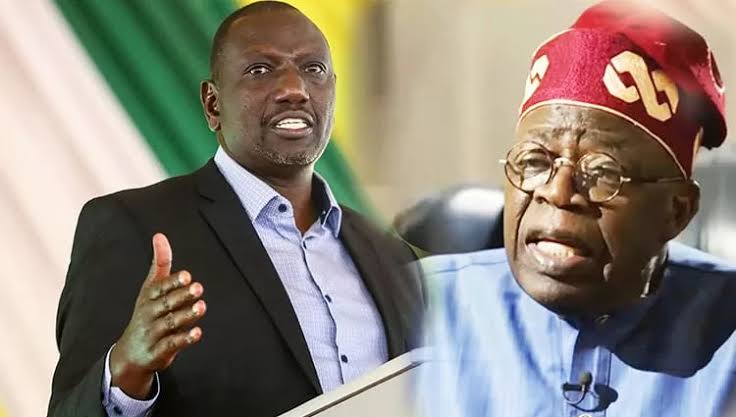
Kenya’s William Ruto and Nigeria’s Bola Tinubu rose to power on populist promises. Ruto, a self-styled “hustler,” vowed to uplift the poor but imposed taxes on bread and smartphones, sparking Gen-Z protests under #RejectFinanceBill2024. Tinubu, a former activist, canceled petrol subsidies without warning, spiking inflation to 33% and earning the nickname “Agbado” (a Yoruba term mocking his out-of-touch elitism).
Both leaders preach austerity while legislators feast. Kenyan MPs earn $12,000 monthly—52 times the minimum wage—and Nigeria’s Senate president with public funds has an entourage that will take you to heaven. Ruto’s allies face graft probes over $15 million fertilizer subsidies; Tinubu’s cabinet includes ministers indicted for embezzlement. The message is clear: politics is a buffet, not public service.
Corruption isn’t incidental—it’s systemic. Kenya’s Goldenberg scandal (1990s) saw $1 billion stolen via fake gold exports. Anglo-Leasing (2000s) siphoned $800 million through phantom security contracts. Nigeria’s NNPC became a kleptocratic hydra: $20 billion vanished under former Minister Diezani Alison-Madueke, while “subsidy cabals” invoice the state for fuel never delivered.
Citizens enable this decay. Kenyan police extort $200 million annually at roadblocks; Nigerian officials demand bribes for birth certificates. A Lagos businessman shrugged: “If I don’t pay, someone else will. The system eats everyone.”
Kenya’s median age is 20, Nigeria’s 18—demographics that could catalyze renewal or chaos. Kenya’s #RejectFinanceBill2024 protests, led by Gen Zs on TikTok, forced Ruto to scrap the bill. Nigeria’s #EndSARS movement (2020) saw youths dismantle police brutality networks, only to be crushed by state violence.
Yet disillusionment festers. Kenya’s 5% unemployment masks underemployment: graduates hawk trinkets in Nairobi’s Kibera slum. Nigeria’s 33% jobless rate fuels exodus—75% of medical interns plan to emigrate. Those who stay join gangs or extremists: Kenya’s Al-Shabaab recruits in coastal poverty; Nigeria’s bandit warlords rule forests, taxing villages and kidnapping students.
Insecurity binds both nations. Kenya’s 2013 Westgate Mall attack (67 dead) and Nigeria’s Chibok girls abduction (276 kidnapped) are symbols of state failure. Bandits kill 5,000 Nigerians yearly; Kenya’s cattle rustling escalates into ethnic massacres. Security budgets vanish: Nigeria’s ex-army chief Tukur Buratai allegedly stole $2.2 billion meant for weapons, while Kenya’s police chief lives in a $12 million mansion amid cop barracks infested with rats.
The parable’s conclusion—that rot permeates the healer’s own soil—poses a question: Can poisoned systems be redeemed? Kenya’s tech innovators (e.g., M-Pesa) and Nigeria’s cultural power (Afrobeats, Nollywood) hint at dormant potential. But transformation requires digging up entrenched rot.
Kenya must confront land grabs by political dynasties and audit Chinese debt. Nigeria needs to dismantle oil mafias and invest in renewables. Citizens must reject tribal politics: Kenya’s ethnic voting birthed post-election violence in 2007; Nigeria’s North-South divide fuels marginalization.
As the juju man screamed for divine intervention, so must these nations. The road ahead demands more than switching driving sides—it requires accountability at all levels. Kenya’s youth must channel digital prowess into governance; Nigeria’s creatives should weaponize art for activism.
The man’s laughter—a mix of irony and despair—echoes from Nairobi’s Mathare slum to Lagos’s Makoko floating village. It asks: Will we keep digging in each other’s yards, or till our own soil? Until then, the wheels spin, the debts mount, and the future hangs on a question only time can answer.
—
Prince Charles Dickson PhD
Team Lead
The Tattaaunawa Roundtable Initiative (TRICentre)
Development & Media Practitioner|
Researcher|Policy Analyst|Public Intellect|Teacher
234 803 331 1301, 234 805 715 2301
Alternate Mail: pcdbooks@yahoo.com
Skype ID: princecharlesdickson

























You must be logged in to post a comment Login