
Africa
Low Food Prices: A Bittersweet Experience That Requires Urgent Action -By Abachi Ungbo
Government must urgently work towards achieving a balance between food affordability for Nigerians and provision of incentives for farmers. And, it is imperative that government put forth the political will in implementing its policies toward improving agricultural productivity and, ensuring the restoration of peace and security.

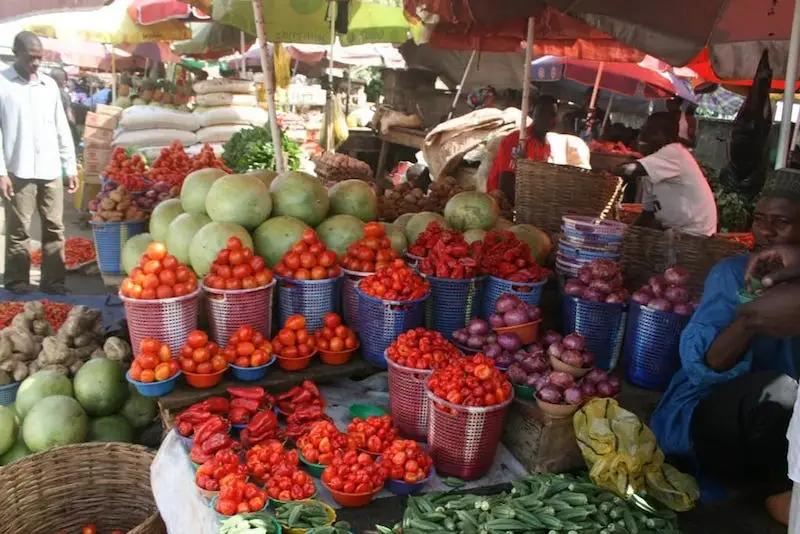
Food is an important basic necessity for human survival, growth and development. It ensures social stability, healthy society and economic productivity. This constitute the basis for a functional food system which guarantees food security. According to the World bank the four pillars of food security are physical availability of food, economic and physical access to food, food utilisation and stability.
Nigeria agriculture is moving on the wheels of a huge number of scattered smallholder farmers that makes up about 20 percent of the country’s population, preponderantly living in the rural areas of the agricultural regions, where the ravages of insecurity are widespread.
The security challenges have spawned a disrupted food system characterized, though not limited to the loss of a large swathe of productive farmlands, displacement of farming households, delayed planting and harvesting especially in areas where farmers brave the odds to till the ground, high cost of transportation occasioned by subsidy removal which added another layer to the challenge and issues around inputs which altogether constricted production.
As a consequence of the crippled production, supply expectedly tapered off in the face of huge demand, especially for staple crops, with resultant price increase forcing many households to struggle to meet their food needs.
Basically, high food prices confer severe and disproportionate strain on poor and vulnerable families. It drains both the emotional and physical strength of struggling families. It forces a cutback on food consumption. Severely restrict food choices, as attention is shifted to mainly cheaper starchy food with micro and macro nutrients requirement given scant attention. Disposable incomes are massively expended on food while other needs like education, health etc are pushed quietly to the corner.
Regrettably, family assets are liquidated to meet food needs. It consign many to the wide poverty net. Increases inflation and sets the conditions for social instability and nutritional and health crises.
According to the National Bureau of Statistics (NBS) data, there has been a steady pattern of increase in food inflation from 2022- 2025, on a year-on-year basis. With 2024 recording the highest while 2025 the lowest.
During the periods of high food prices, farmers and commodity dealers recorded huge receipts. In fact, It later became a gold rush of some sorts that brought opportunism into full display as new investment poured into farming, with not a few investing hugely in buying and storing up huge quantities in anticipation of higher prices which further tightened supply. The implications of the situation were too dire to be ignored
Against this background, government intervention needed to be drastic and urgent enough to stave off the possible consequences of hunger, poverty severe inflation, social instability. Like the emergency that the situation was, the government threw in a raft of emergency measures among which was the free import waiver which encouraged the importation of cheaper imports to bridge the huge deficit. Undoubtedly, it was a game changer. The reaction of the market led to the opening of the floodgates of hoarded food items as prices began to nosedive.
Interestingly, there was also a marked increase in food production in the 2025 wet season which was driven by expanded cultivated areas, improved practices and the resilience of farmers according to Agricultural Performance Survey (APS) conducted by the National Agricultural Extension and Research Liaison Services (NAERSL), Ahmadu Bello University, Zaria.
However, the obverse side of the swift intervention was the huge losses incurred by farmers which may come to haunt the country. And, the current relief may turn out to be a lull before the storm unless measures that will be as swift and effective as those taken to rein in rising food inflation are instituted.
The turn of events has effectively placed farmers in a serious financial strait. Farmers depend on the farmgate prices to meet their needs and other obligations as well as prepare for a new planting season. Unfortunately, the farmers are now left to swim in debt and certainly in poverty. In fact, it came at an epoch of prohibitive costs of agricultural inputs which engendered the high cost of production.
Farmers’ apathy is running deep and it comes with consequences. Already, it has been projected that nearly 35 million Nigerians will likely face hunger especially in the lean period in 2026. Therefore, the country cannot afford to drop the ball in the 2026 wet season by widening the food deficit.
The current situation leaves serious food security challenges due to the unsustainability of the measures taken by government. We shouldn’t outsource our feeding to outsiders when huge potential exists to take care of ourselves. It is also a self-inflicted economic sabotage as the cost of food import mounts. In effect, the food import bill rose to 5.27 trillion naira in 2025 from 4.71 trillion naira in 2024 which represents a huge haemorrhage of scarce foreign exchange.
Government must urgently work towards achieving a balance between food affordability for Nigerians and provision of incentives for farmers. And, it is imperative that government put forth the political will in implementing its policies toward improving agricultural productivity and, ensuring the restoration of peace and security.
Abachi Ungbo
abachi007@yahoo.com


























You must be logged in to post a comment Login