Africa
Nigerian Aviation Drama: When A Woman’s Breasts Become National Treasure -By Patrick Iwelunmor
The deeper current here is cultural: our readiness to treat women’s bodies as national exhibits. The altercation was a safety matter; her chest was not. Yet we replay the footage as though her body were the true offence or, worse, the true entertainment. In the name of morality, we commodify vulnerability. And it is telling that so many viewers could decry her behaviour while privately savouring the exposure. The hypocrisy is almost as stark as the incident itself.

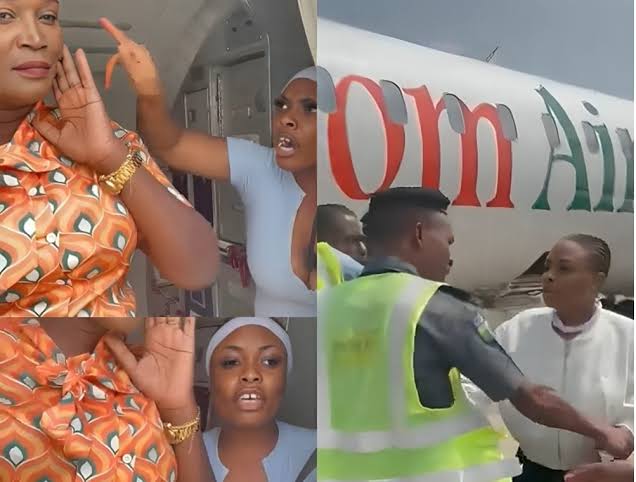
Some national stories begin in parliament; others, in the cramped aisle of an Ibom Air flight. The incident involving Comfort Emmanson on 10 August 2025 began as a mundane inflight safety dispute. Within hours, it had spiralled — with grim predictability — into a viral morality play about violence, dignity, and our endless appetite for spectacle. It was part courtroom drama, part tabloid frenzy, part social media theatre.
Accounts and videos show a confrontation between Ms Emmanson and the cabin crew over pre-take-off phone use — a rule as old as modern aviation and as ignored as the Nigerian Highway Code. The pilot, exercising the sort of authority enshrined in global aviation law, taxied the aircraft back to the terminal. Tempers flared; words became shouts; blows were allegedly exchanged; airport security boarded the plane. By the end of the day, she had been arraigned and remanded, accused of assaulting airline staff. Ibom Air quickly announced a travel restriction and reported the matter to the Nigerian Civil Aviation Authority, framing it as a textbook case of zero-tolerance for unruly passengers.
But what transformed an otherwise procedural enforcement into a national sensation was not the safety violation or even the physical altercation. It was the moment — captured, shared, and endlessly replayed — when Emmanson’s breasts became partially exposed as she was dragged from the aircraft to the apron bus. In seconds, a private body part was turned into public property, pored over by millions with the peculiar blend of mockery, voyeurism, and moralising that passes for public debate in our digital age. The original question — what happened on board, and why — was quickly replaced with a more prurient one: have you seen the clip?
There are three distinct strands to untangle here, each revealing something about the state of our institutions and our culture.
First, safety and the law. In commercial aviation, the captain’s authority is absolute during critical phases of flight. Compliance with crew instructions is not a matter of politeness; it is the bedrock of keeping a cabin of strangers aloft in a thin aluminium tube. Disobeying such orders — and especially assaulting staff — crosses a bright red line. Globally, passengers have been jailed for less. Swift prosecution in this case sends the right message: chaos in the cabin cannot be normalised. Yet due process demands the full story. If she struck crew, the courts must say so. If she was provoked, mishandled, or subjected to disproportionate force, that too should be established in law. Safety must not become a shield for misconduct.
Second, dignity in enforcement. Even when a passenger is combative, they retain the right to be restrained without degradation. The Nigerian Bar Association has rightly condemned the public exposure of Emmanson’s body as a violation of her dignity and called for accountability. Security protocols should anticipate such situations. Gender-sensitive restraint measures, modesty wraps, and the presence of female officers when handling female detainees are not optional extras — they are obligations. The failure to maintain her dignity is not a footnote to this story; it is part of the story.
Third, the political economy of virality. The Nigerian internet thrives on humiliation. A bystander films; blogs repackage; talk shows weigh in; and the central human being becomes a consumable asset. The original issue — inflight safety — is overshadowed by the spectacle of a woman’s body, which, once exposed, is no longer protected but consumed. In the process, we reveal a troubling truth: in our online marketplace, outrage and titillation often sit side by side, each boosting the other’s engagement metrics.
An ethic fit for both aviation and civil society would insist on holding two truths at once: inflight order must be maintained, and dignity must be preserved. This is not a contradiction. It means airlines investing in de-escalation training for crew, with culturally aware scripts that can defuse confrontation before it spirals. It means airports and carriers stocking modesty kits for immediate use during removals. It means media houses and content platforms agreeing to blur or redact nudity in both official and viral clips. It means making airline sanctions transparent, with clear durations and appeal paths, so that punishment is proportionate and understood.
The deeper current here is cultural: our readiness to treat women’s bodies as national exhibits. The altercation was a safety matter; her chest was not. Yet we replay the footage as though her body were the true offence or, worse, the true entertainment. In the name of morality, we commodify vulnerability. And it is telling that so many viewers could decry her behaviour while privately savouring the exposure. The hypocrisy is almost as stark as the incident itself.
What will follow? There will be legal consequences for Emmanson, perhaps for Ibom Air or airport security personnel if mishandling is proven. The NCAA may issue new guidelines. But there ought to be a civic outcome as well — a recalibration of how we balance enforcement with humanity. Safety without dignity is not safety worth having. The reverse is also true: dignity without safety is not dignity worth defending.
Until we achieve that balance, the script will repeat itself. Another flight. Another quarrel. Another passenger dragged down the aisle. Another viral clip, slowed down, zoomed in, stripped of all context. Another moment when we, as a society, prove we are better at consuming the spectacle than preventing the harm.
The next “aviation drama” is already taxiing for take-off. The question is whether we will keep turning human beings into national treasures of shame — or whether we will finally choose to land in a place of justice, order, and respect.