
Africa
Nigeria’s Democracy at a Crossroads: The Struggle Between Promise and Reality -By Ibrahim B. Mshelia
In essence, Nigeria’s democracy is at a crossroads—between the promise of progress and the peril of disillusionment. The direction it takes will depend not only on the actions of those in power but also on the determination of the people to reclaim democracy’s true meaning: governance that works for all, not just for a few

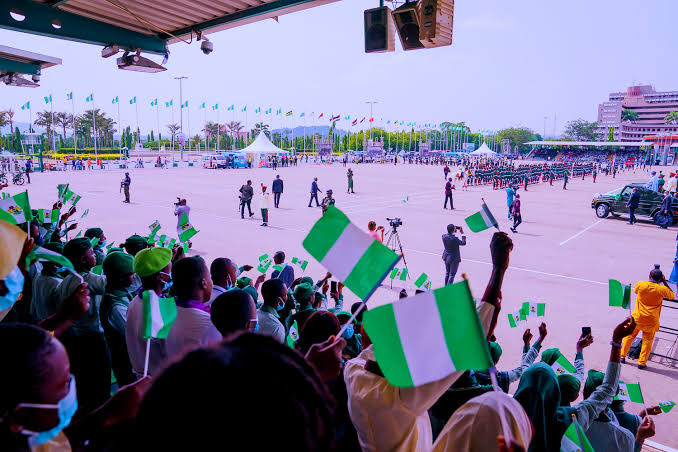
Nigeria’s democratic journey has reached a critical juncture as citizens increasingly question whether the system in place truly delivers on its promise of “government of the people, by the people, for the people.” For many Nigerians, the 26 years of uninterrupted civilian rule since 1999 warrant celebration, yet the mood is tempered by growing frustration over unfulfilled expectations. In the streets of Lagos, Abuja, and other major cities, the slogan #EndBadGovernance has become prominent—a reflection that democracy in Nigeria may have achieved its form, but not its substance.
Underlying this frustration is a deep trust deficit in public institutions. Surveys indicate that Nigerians’ confidence in their national government and judicial system is among the lowest in Africa—only about a quarter of citizens say they trust their national leaders. The perception that the state is distant, detached, or unresponsive has fed cynicism and apathy. In turn, this undermines the very foundations upon which democratic legitimacy is built: accountability, rule of law, and meaningful participation.
Part of the challenge lies in governance structures that remain heavily centralized, even though Nigeria is constitutionally a federal state. Experts argue that local governments and states are financially dependent and politically subordinate, limiting their capacity to bring meaningful change to the grassroots. This concentration of power in the federal center makes democracy feel like a distant project rather than a lived reality for many ordinary Nigerians who rarely feel the impact of government at the community level.
As the federal government continues to dominate revenue collection and allocation, states and local councils often lack the autonomy and resources to deliver basic services. Prominent legal minds such as Olisa Agbakoba have argued that without genuine devolution of power and fiscal responsibility, democracy will remain fragile. The result is a democracy in which communities do not feel ownership—they feel governed, not included.
Complicating matters further is the growing use of technology in Nigeria’s political space. On one hand, digital platforms offer new avenues for citizen engagement and mobilization; on the other hand, they also provide channels for manipulation. In Nigeria’s 2023 elections and beyond, AI-driven misinformation, deepfakes, and coordinated disinformation campaigns have eroded public confidence in electoral processes. When the very tools of democratic participation are compromised, citizens begin to doubt the authenticity of the system itself.
Political culture also remains a formidable hurdle. Defections, one-party dominance, and internal party conflicts have eroded the principles of internal democracy. For instance, several high-profile resignations in recent months have been linked to what members describe as “persistent erosion of core values” within major political parties. Such developments suggest that the playing field is skewed in favor of incumbents, weakening competition and stifling democratic vibrancy.
Meanwhile, institutions that should safeguard democracy—especially the judiciary—are under immense pressure. Civil society groups have raised alarms about institutional capture and the growing trend of using court processes to suppress dissent. When the judiciary loses credibility as an independent arbiter, citizens lose faith in the fairness of the system. A democracy without an impartial judiciary risks sliding toward authoritarianism masked by periodic elections.
Security and governance are also deeply intertwined in Nigeria’s democratic health. The persistence of insurgency, banditry, communal violence, and separatist tensions continues to weaken state authority. The inability of the government to guarantee safety undermines public confidence and distracts from developmental goals. A democracy that cannot ensure peace risks alienating its citizens, who may begin to view governance as irrelevant to their survival.
Yet, despite these challenges, there remains room for cautious optimism. Nigeria stands as one of the few countries in West Africa to maintain civilian rule amid a wave of coups in the region. The fact that elections still hold—no matter how contentious—shows that democratic institutions, though fragile, retain some resilience. The ongoing debates around constitutional reform, restructuring, and devolution indicate that citizens are not giving up on democracy; they are demanding a better version of it.
For Nigeria’s democracy to evolve from mere form to substance, critical reforms are essential. Power must be decentralized to give citizens a sense of ownership. The judiciary must be protected from political interference. Political parties must embrace internal democracy, and the digital space must be safeguarded against disinformation. More importantly, governance must become citizen-centered—responsive, transparent, and accountable. Only then will democracy in Nigeria transcend symbolism and become a true instrument of national renewal and social justice.
In essence, Nigeria’s democracy is at a crossroads—between the promise of progress and the peril of disillusionment. The direction it takes will depend not only on the actions of those in power but also on the determination of the people to reclaim democracy’s true meaning: governance that works for all, not just for a few
Angelic Bitrus Yerima student of mass communication Kashim Ibrahim University, Maiduguri.



















You must be logged in to post a comment Login