Africa
Nigeria’s Governors: Halfway To Where? (1) -By Abiodun Komolafe
Oyebanji too has shown imaginative thinking in his two years in the saddle. A man of wisdom, foresight and simplicity, he has broken the mindset and breathed fresh perspectives into the development process, critically trying to break away from the ‘growth-without-development’ mindset. This break from the past has led to remarkable achievements in good governance, economic development, infrastructure, agriculture and social welfare.


To begin with, any assessment of the subnational level must acknowledge that Nigeria’s federal system is defective and quasi-federalist in nature. Put bluntly, it operates with the ethos of a tightly centralized “Bonapartist state”.
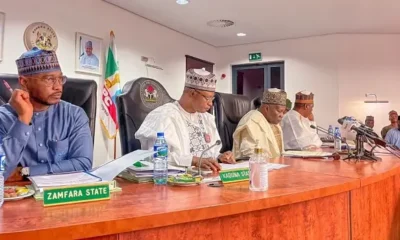
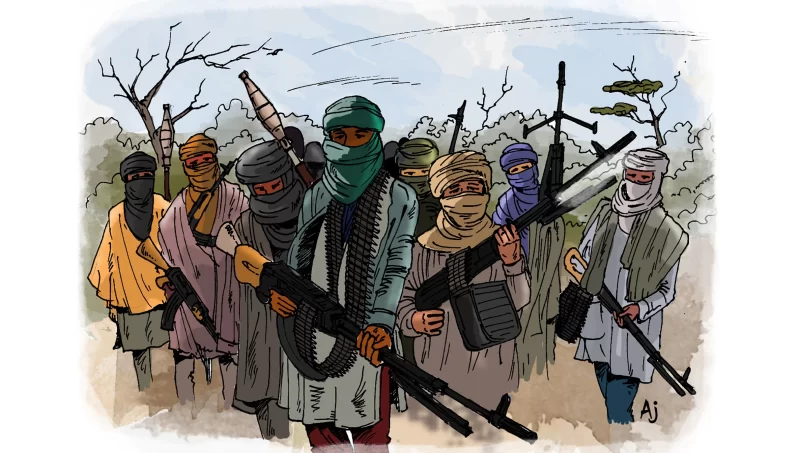
This is the truth of the matter: no matter how well a subnational governor performs, the operating framework handicaps him. It’s like a boxer fighting with one hand behind his back. In other words, there’s a debilitating limit to what a governor can achieve. For instance, governors of states like Benue, Plateau and Zamfara have discovered that the title of Chief Security Officer is more in humour than in reality. To drive meaningful development, subnational governors need full operational command of internal security forces in their states, similar to their counterparts in countries like the USA, Australia, Brazil and Canada.
“Natio quae suos alit, prosperitatem colit” (A nation that nurtures its people, cultivates prosperity). What scorecard can you give the governor of Benue State in agricultural development when the ecosystem is perennially disrupted, hindering short-, medium-, and long-term planning for farmers, government and logistics alike? How can a governor in that situation create an enabling environment to attract the much-needed investments into the agricultural value chain, with a view to generating hundreds of direct jobs and thousands of indirect ones?
Today, it is challenging for governors to perform optimally, unlike past leaders like Lateef Kayode Jakande in Lagos, Michael Adekunle Ajasin in Ondo, the outstanding Sam Onunaka Mbakwe in Imo, and Muhammadu Abubakar Rimi in Kano. While some contemporary governors, such as Biodun Abayomi Oyebanji (BAO) in Ekiti, Babajide Olusola Sanwo-Olu (BOS) in Lagos, and Oluseyi Abiodun Makinde (GSM) in Oyo, exhibit flashes of good performance, they are swimming against a stultifying tide.
Makinde, for example, even before Donald Trump’s disruption, had a commendable foresight to aspire for an Oyo State that’d evolve into an export-oriented economy. He deserves kudos for this; for, with Nigeria’s balance of payments crisis, it is a very good route to responsible growth. A school of thought even opines that GSM is a progressive who, unfortunately, has found himself in the wrong political party.
We recall that, in the 1950s and the 1960s, the economies of Nigeria’s Western Region were, to a considerable extent, export-oriented, leading to the export of commodities to build social and physical infrastructure. Makinde here is trying to recreate a more productive time, and he is on his way to proving so with initiatives such as the Fashola project – an agro-industrial landmark. He, of course, in his endeavour, must confront the painful reality of underperforming Federal agencies such as the Standards Organization of Nigeria (SON), numerous tolls on the highways, as well as the grotesquely underperforming ports. This is why only institutional reforms can make Nigeria a competitive economy.
Oyebanji too has shown imaginative thinking in his two years in the saddle. A man of wisdom, foresight and simplicity, he has broken the mindset and breathed fresh perspectives into the development process, critically trying to break away from the ‘growth-without-development’ mindset. This break from the past has led to remarkable achievements in good governance, economic development, infrastructure, agriculture and social welfare.
BAO’s leadership has shown accountability, transparency and responsiveness. It has promoted social justice, equality and human well-being. Most importantly, the governor’s policies and actions have demonstrated a commitment to democratic principles, improvement in the quality of life and a sense of unity among Ekiti people. I will come back to that later!
In Lagos State, Sanwo-Olu has made significant strides in establishing a solid internal security framework, which has made the state arguably the safest in the country. Leveraging this stability, BOS has created an environment conducive to attracting local and foreign direct investments.
Once upon a time, Lagosians were of the view that BOS was wanting in performance because the Big Boss was around and watching from Bourdillion. But now that the Big Boss has landed a bigger job in Abuja, BOS is condemned to delivering the real dividends of democracy to the good people of the ‘Centre of Excellence’.
There are also flashes of performance here and there. Nevertheless, we must muster the political will to define development, particularly sustainable development, within today’s context. India’s founding post-independence Prime Minister, Pandit Nehru, aptly noted that sustainable development begins with constructing water systems, followed by dispensaries (now known as Primary Health Care centers), then nursery and primary schools, and finally, establishing bank branches to mobilize credit. These fundamental tools drive development, unlike highfalutin vanity projects.
As I’ve argued elsewhere, development isn’t just about ‘projects’, but about the fundamental effects of proper linkages for sustainability. This raises a crucial question: what comes first – issuing Certificates of Occupancy (C of O) or building flyovers? Frankly, the development process should start with issuing title deeds, as it will empower citizens economically through credit worthiness, which would then attract meaningful projects.
It might seem silly to fuss over a governor’s image or appearance. A governor’s first and major responsibility is serving the people and managing state affairs; it’s about prioritizing citizens’ welfare and well-being. This includes developing policies, managing resources, and delivering public services, not searching for the fleeting spark of power. It is about being accountable to citizens, not strutting the catwalk.
A governor’s duty is not about letting his robe and ring become idols that overshadow the priorities of the office. Instead, it’s about getting plugged into the pulse of the people, attuned to the rhythms of their struggles and aspirations, and harnessing the power of collective wisdom to drive meaningful change.
For Oyebanji, it’s past midterm already. His government clocked midterm last October, which means he has already put in 30 months as the governor of Ekiti State. Now, he should be counting down to the governorship election while others are still battling with midterm and its concomitant issues. Given this timeline, the next election in the state is most likely to take place between June and August next year.
I’ve visited Ekiti State and seen things firsthand. “From the bustling streets of Ado-Ekiti to the quaint towns of Ikere-Ekiti, Ikole-Ekiti and Oke Ako-Ekiti, Oyebanji’s transformative initiatives have inspired optimism among residents, who appreciate his people-first leadership.”
Chief Wole Olanipekun is respected both locally, nationally and internationally, and his views have always counted in Nigeria’s elections, post-1999. Though not a politician, Olanipekun’s life and work are deeply intertwined with the complex social, political and economic landscape of Nigeria. Here’s what the Senior Advocate of Nigeria (SAN) and the Asiwaju of Ikereland said about Oyebanji, recently: “The Ekiti scenario is unique, largely due to the governor’s distinctive approach. While any hypothesis about the lack of cohesive opposition is compelling, assuming such an opposition exists in Ekiti, I doubt whether the governor can be upstaged, given his strong connection with the people.”
According to the foremost nationalist, BAO’s “warmth, humility and effective management of the state’s meager resources have endeared him to the populace.” While fearing for “the sustainability of our democracy without a viable opposition”, the legal luminary maintained that, “even with a strong opposition, which is highly desirable”, Oyebanji “may still maintain his popularity due to several factors, including his rapport with the people.”
Former Governor Ayo Fayose of Ekiti State believes Oyebanji is unbeatable, citing his personal qualities and widespread support. Fayose predicts he will win in all 177 wards, claiming that his own records show wins in 158 wards. He asserts four former governors, including himself, support Oyebanji’s administration, challenging anyone to dispute this claim.
Perhaps these perspectives come from the elites, but they align with the views of the masses regarding BAO.
*To be concluded.
*KOMOLAFE wrote in from Ijebu-Jesa, Osun State, Nigeria (ijebujesa@yahoo.co.uk; 08033614419 – SMS only)