Forgotten Dairies
Obi-Datti Fallout: The Unravelling of a 2023 Political Alliance -By Oluwafemi Popoola
But in a political culture where yesterday’s running mate can become today’s prosecutor, perhaps there is something refreshing about answering an old ally with a policy proposal rather than an insult. Sometimes the loudest response to betrayal is not revenge. It is restraint.


Politics is a strange river. People cross it together, drink from the same cup of ambition and sometimes swear they are rowing toward the same shore, until one day, one of the rowers picks up an oar and begins pointing fingers at the other. That is where Datti Baba-Ahmed and Peter Obi appear to have arrived. In 2023, they offered Nigerians a shared political promise; today, one half of that partnership says the other half cannot improve the country they once promised to rescue together. One has stepped outside and declared that the other cannot fix the leaking roof. That is the peculiar poetry of politics. Yesterday’s comrade can become today’s critic, and yesterday’s shared dream can suddenly acquire a completely different meaning.
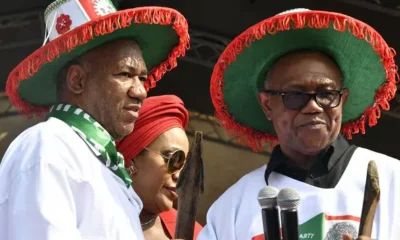
Yusuf Datti Baba-Ahmed’s latest statement about Peter Obi has generated so much heat. In an interview on the Mic On Podcast, Datti did not merely criticise Obi. He placed him among the politicians he believes cannot improve Nigeria, telling President Bola Tinubu to leave office but not hand power to any of his major challengers. When the interviewer specifically asked whether that included Peter Obi, his former running mate, Datti answered: “Including Peter Obi, I’m sorry to say.”
I find the statement fascinating. It is not because Datti is forbidden from changing his mind, but because of the extraordinary distance between where he stood in 2023 and where he stands today. In 2023, Datti was not an outsider observing Obi from the balcony. He was the man standing next to him on the presidential ticket. They travelled together, campaigned together and sold Nigerians a political project together. Now, Datti says Obi cannot ‘improve’ Nigeria.
Let me state that people are allowed to disagree. We have seen political partnerships collapse. Friends also fall out. Political philosophies evolve. But when the former partner becomes one of your fiercest critics, the public is naturally entitled to ask: what exactly changed? But the best place to look for an answer is not always the latest podcast or political rally, but the old pages of history,
There is a long history of such political journeys, of men who once marched beneath the same banner only to discover, somewhere along the road, that they were no longer walking towards the same destination. Revolutionary Russia offers perhaps one of the clearest examples.
Leon Trotsky and Joseph Stalin had once belonged to the same revolutionary project, but their relationship eventually became a bitter struggle for the direction and soul of the Soviet state. Isaac Deutscher chronicled that rupture in his famous three-volume biography of Trotsky, beginning with The Prophet Armed, published in 1954, and continuing through The Prophet Unarmed and The Prophet Outcast. Deutscher’s second volume, first published in 1959, specifically examined the struggle between Stalin and Trotsky after the Russian Civil War and Lenin’s death.
The point, however, is not to manufacture a historical resemblance where none exists. Datti is not Stalin, Obi is not Trotsky, and Nigerian politics does not need another exaggerated historical analogy. What history does give us is perspective. It reminds us that political partnerships are rarely permanent contracts; they are often marriages of interests, convictions and circumstances, and when those ingredients change, the marriage can become a courtroom.
One does not have to travel far from Russia to find another remarkable case. In France, Charles-Maurice de Talleyrand built a career around surviving political earthquakes. He served revolutionary France, Napoleon and later the restored Bourbon monarchy. Duff Cooper’s 1932 biography, Talleyrand, captures the extraordinary career of a man whose instinct for political survival became almost legendary. If political loyalty had a rubber band, Talleyrand might have been its inventor.
This is where Datti’s present position becomes politically interesting. He says Obi left his “comfort zone” against his advice and that he could no longer help him. He also says he warned Obi against joining the ADC and was vindicated when Obi left the party within months. Perhaps Datti genuinely believes he was right. Perhaps he believes Obi has made serious political mistakes. He is entitled to that opinion.
But I also understand why Obi’s supporters are angry. Some have asked the simplest question: if Datti knew Peter Obi could not improve Nigeria, why did he agree to be his running mate in 2023? Others have accused him of suffering from what they jokingly describe as “loss of limelight syndrome.” One particularly colourful description compared former associates of Obi to peacocks trying to retain feathers after leaving the flock. Nigerian politics, thankfully, still has enough comedians in the audience.
I actually agree with one part of the criticism of Obi: he was too politically naïve and inexperienced in 2023, and I think the extraordinary energy of the Obidient movement sometimes carried him further than his political machinery could support. But Datti himself was hardly the picture of political restraint during that campaign. He was often too tactless, too combustible and, at times, almost pyromaniacal in his political rhetoric. Today, his tone feels different: more nostalgic, more combative and, in some moments, almost vengeful
But Obi’s response is instructive. Instead of returning insult for insult, he pointed to his record. “I passed through Anambra State, and I improved the state in critical areas of development. And I can do the same thing in Nigeria,” Obi said. He spoke about reducing waste, fighting corruption, restoring order, strengthening institutions, securing the country and prioritising health, education and poverty reduction.
That response deserves some credit. Obi could have called Datti names. He could have opened the political wardrobe and started pulling out old clothes. Instead, he essentially said: judge me by what I did. That is exactly where political arguments should be.
Datti’s supporters may argue that Obi’s record is insufficient. Fine. Let them produce the numbers. Let them interrogate Anambra’s finances, infrastructure, education, healthcare and governance record. But saying someone cannot improve Nigeria is a serious political verdict. It requires more than personal disappointment.
Then came another development that made me dig deeper.
Some Obi supporters began insinuating that Datti’s current posture might have something to do with the reported government scholarship expenditure involving Baze University, which Datti founded. Sahara Reporters reported on July 13, 2026, that government payment records on Govspend showed ₦673.85 million had been released as the first 50 percent payment for tuition for 254 students at Baze University, implying a projected total of about ₦1.347 billion for the academic session. The report said the average tuition cost was about ₦5.31 million per student.
That is certainly a matter worth questioning, especially because Baze is Datti’s institution. But here I must draw a line. A government payment to an institution associated with a politician is not, by itself, evidence that the politician has been “bought.” Another report noted precisely that there was no publicly available evidence linking the scholarship to political considerations.
So, no, I would not make that leap. But I would ask the government a straightforward question: why was such a large scholarship allocation directed to private universities under the scheme, and what transparent criteria determined the beneficiaries? Sahara Reporters said its review found billions directed to private universities while no federal or state-owned university appeared among the beneficiaries of the Niger Delta scholarship scheme. Those are legitimate accountability questions regardless of who owns Baze University.
And this brings me back to Datti. Perhaps he is genuinely convinced that none of the leading opposition politicians can rescue Nigeria. Perhaps he believes he represents a purer political alternative. Perhaps his quarrel with Obi is entirely ideological. Perhaps it is simply the normal turbulence that follows political partnerships.
But if you once stood beside a man and asked Nigerians to trust the two of you with the country, you owe the public something more substantial than “including Peter Obi, I’m sorry to say.” You owe them an explanation.
As for me, I am not convinced Peter Obi is likely to win the 2027 presidential election. The opposition is fragmented, the momentum of the Obidient movement is not what it was in 2023, and the political arithmetic is considerably more complicated this time.
But there is something I find useful about Obi’s current approach. Whether one likes him or not, his public argument has largely remained around policy, governance, waste, corruption, education, healthcare, security and institutional reform rather than personal warfare. That may not win him an election.
But in a political culture where yesterday’s running mate can become today’s prosecutor, perhaps there is something refreshing about answering an old ally with a policy proposal rather than an insult. Sometimes the loudest response to betrayal is not revenge. It is restraint.
Oluwafemi Popoola is a Nigerian journalist, media strategist, and columnist. He can be reached via bromeo2013@gmail.com