Africa
Of Sacred Cows, Their Crop-Eating Cows, And Cowered Nigerians -By Isaac Asabor
It is time for Nigerians to rise above tribal sentiment and face the truth: no group, no cow, and no sacred cow is above the law. Justice must be seen to be done, swiftly and evenly, if the country is to survive its deepening security crisis. We must demand accountability from every level of government. We must question the complacency of our leaders. We must insist that protecting lives is not a political favor, but a constitutional duty.

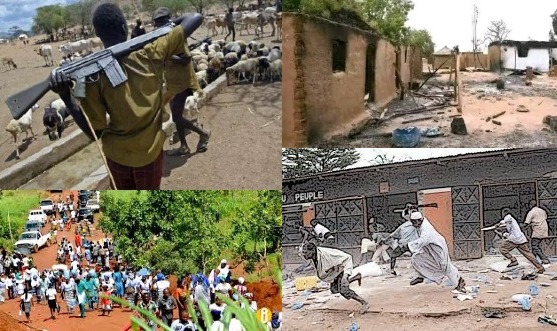
In Nigeria today, a tragic irony persists in the heart of our national dilemma: the lives and livelihoods of millions are routinely sacrificed on the altar of impunity. There exists a class of untouchables, metaphorically known as “sacred cows”, whose actions, no matter how grievous, are exempt from the consequences of the law. Among the most devastating symbols of this injustice are the marauding herdsmen whose cattle trample crops, destroy farms, and leave entire communities in fear, mourning, and hunger. The silence or outright complicity of those in power has transformed once-thriving villages into ghost towns, and resilient farmers into beggars. It is against this backdrop that the title, “Of Sacred Cows, Their Crop-Eating Cows, and Cowered Nigerians” becomes painfully apt.
The term “sacred cow” in its classical sense refers to a person, institution, or idea that is beyond criticism, no matter how flawed. In Nigeria, these sacred cows wear many garments, politicians, militants, corrupt security agents, and more recently, killer herdsmen. The peculiar horror of the herdsmen saga is that they are often linked with mass killings and land grabbing, especially in states like Benue, Plateau, Southern Kaduna, and parts of Taraba and Nasarawa. Yet, despite the bloodshed, there is a disturbing pattern of reluctance, or refusal, by federal authorities to treat them as the terrorists they clearly are.
Take Benue State for instance. In just a span of a few days, over 200 people were killed in separate but coordinated attacks by suspected herdsmen. Communities such as Guma, Logo, and Agatu have repeatedly been under siege. This is not new. Year after year, reports of mass killings in Benue and other parts of the Middle Belt surface, trend briefly in the media, and then fizzle out without any significant arrests or convictions. The story repeats itself with sickening regularity. One must then ask: “Why are these murderers shielded?” “Who are they working for?” “And more critically, who is protecting them?”
It is this very shield of impunity that emboldens them. The sacred cows know that the state has become too timid or too complicit to act. The cowered Nigerians, farmers, children, widows, and local vigilantes, are left to fend for themselves, often with dane guns and bare hands, against well-armed assailants.
Sadly, this issue is no longer regional or isolated. What began as a “herders-farmers clash” narrative has spiraled into full-blown terrorism. From Zamfara to Enugu, from Katsina to Ogun, stories abound of communities sacked by marauders who leave behind trails of blood, burned huts, and broken spirits. The herdsmen menace, coupled with banditry and kidnapping, has reshaped Nigeria’s rural economy and food security. Thousands of farmers have abandoned their lands for fear of being slaughtered. In a country already grappling with inflation and hunger, the consequences are catastrophic.
Even worse is the lack of coordinated federal response. Despite the clear and present danger, successive administrations have danced around the issue. The refusal to decisively designate armed herdsmen as terrorists has been one of the most glaring failures in Nigeria’s security policy. Instead, what Nigerians often hear are excuses about “climate change,” “transhumance,” or “misunderstandings between communities.” But what about the AK-47s? What about the mass graves?
At the heart of the matter is a dangerous blend of ethnic favoritism, political cowardice, and selective justice. When self-determination agitators in the South are arrested and prosecuted swiftly, while northern killers roam free and even get amnesty, what message does that send to the citizenry? That human lives are valued differently depending on geography and tribe?
The sacred cows do not just live among us, they govern us, legislate for us, and often pretend to grieve with us. Their cows eat more than cassava and yam; they devour the hope of farmers, the dreams of rural children, and the fragile trust in a government that ought to protect all citizens equally. The Nigerian state, it seems, has been captured, not just by corruption, but by cowardice.
Let it be clear: this is not an anti-ethnic narrative. Millions of law-abiding herdsmen, most of whom are Fulani, live peacefully across the country. They, too, are victims of this ugly situation. The problem lies in the government’s failure to separate peaceful pastoralists from the well-armed criminal elements within their ranks. The inability, or unwillingness, to enforce modern ranching practices has allowed this outdated nomadic system to fester into violence and lawlessness.
“Why has not the government enforced the recommendations of several panels that called for ranching, land reform, and local policing?” “Why are security operatives often late to respond, or sometimes accused of aiding the killers?” “Why do we continue to treat the symptoms and ignore the disease?”
If the Federal Government continues to look the other way while thousands are slaughtered in farming communities, the disillusionment among the masses will deepen. If the law continues to serve the privileged and punish the poor, then the social contract is broken. Cowered Nigerians will only remain cowered for so long. History has shown that when the oppressed find their voice, no palace or pasture is safe. Not only that, The Bible in Ecclesiastes 8:11 states that the lack of swift punishment for evil encourages people to commit more evil. The verse highlights that when the sentence for a crime is not carried out quickly, it creates an environment where people are more likely to engage in wickedness.
It is time for Nigerians to rise above tribal sentiment and face the truth: no group, no cow, and no sacred cow is above the law. Justice must be seen to be done, swiftly and evenly, if the country is to survive its deepening security crisis. We must demand accountability from every level of government. We must question the complacency of our leaders. We must insist that protecting lives is not a political favor, but a constitutional duty.
Benue is bleeding. Nigeria is bleeding. And it is high time we stopped treating the killers with kid gloves. The sacred cows must be dethroned. Their crop-eating cows must be controlled. And Nigerians must no longer be cowered.
In fact, the road to justice and security in Nigeria is a hard one, but it begins with courage, the courage to speak, act, and insist that enough is enough. For too long, Nigeria’s leaders have coddled the sacred cows. If they truly care about unity and peace, they must prove it by standing with the people, not those who terrorize them.
The blood of the innocent cries out from the soil. The silence of the state is deafening. But the day will come when cowered Nigerians will roar, and on that day, even sacred cows will tremble.