Africa
On the Matter of Wike and Yerima: A Respectful Rejoinder to Professor Sebastine Hon, SAN -By Vitus Ozoke, PhD
And in a democracy governed by law, common sense must never be treated as a crime. In a constitutional democracy, even Ministers must submit to the process. Authority must be legal, not personal. Power must be regulated, not performed. And if asking “Sir, can you identify your authority?” becomes a crime, then Nigeria has much bigger problems than a confrontation at a gate. That is not democracy. That is feudalism with an executive title.

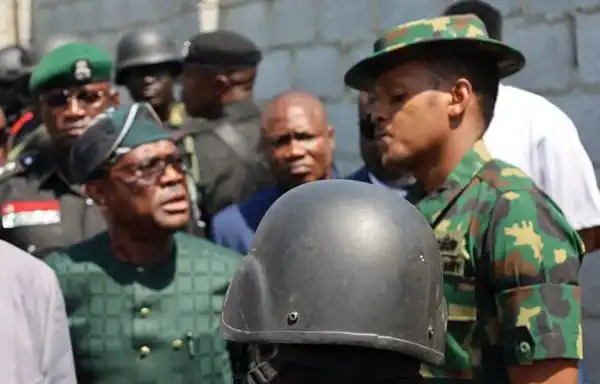
The recent confrontation between Minister Nyesom Wike and Lt. A.M. Yerima, which has gone viral in the Nigerian cyber orbit, has triggered a flurry of commentary, including a bold and forceful essay by one Prof. Sebastine Hon, SAN. According to the learned professor, the young officer “obstructed” the FCT Minister, thereby violating Nigerian law and military discipline.
With utmost respect, however, the professor is irredeemably wrong as his position rests on a series of legal assumptions which, when subjected to calm constitutional scrutiny, including the Nigerian Constitution, the Armed Forces Act, and relevant judicial precedents, cannot stand. Professor Hon’s rhetorical reprimand of Yerima, as forceful as it is, is weakened and deflated under the weight of his troubling misunderstanding and misinterpretation of the law, the Constitution, and the limits of political authority.
I therefore offer this rejoinder – not in hostility, but in the spirit of intellectual engagement with Prof. Hon, which the legal profession is famed for. The core question is straightforward: Did Lt. Yerima breach any law? The correct legal answer is equally straightforward: He did not. He did not for the following reasons:
I. The FCT Minister is not “in loco presidentis” under any law
The learned professor asserts that the FCT Minister stands “in loco the President of Nigeria” when dealing with FCT land. This proposition is preposterous, as it lacks constitutional support. Yes, sections 297(2) and 302 of the 1999 Constitution confer the administration of FCT lands on the Minister. But this does not elevate the Minister to the rank of Commander-in-Chief, rewrite section 130 of the Constitution, or place the Armed Forces under his personal command.
If we accept the professor’s theory, it would follow that Nyesom Wike may issue operational directives to the Army, Navy, and Air Force, may command military deployments, and may exercise physical coercive power over any citizen on FCT land. Clearly, that cannot be Nigeria’s law. Administrative delegation is not a constitutional substitution. And to equate the Minister with the Commander-in-Chief is not only incorrect, it is institutionally dangerous.
II. Delegated land powers do not grant a minister instant physical access
With respect, the professor collapses administrative authority into physical dominion. The professor’s argument rests heavily on sections 297(2) and 302 of the Constitution of the Federal Republic of Nigeria 1999 (as amended). But these sections merely vest all land in the Federal Capital Territory in the Federal Government, and delegate administrative powers over land to the FCT Minister. The fact that the Minister administers FCT land does not mean Nyesom Wike can enter any land at will, confront any occupant, bypass documentation, or demand immediate compliance without notice. The Minister’s power is administrative, not personal. Sections 297–302 do not grant on-the-spot entry rights.
The Land Use Act (applicable via s. 297 CFRN) requires a written revocation, the issuance of notices, service on the occupier, and proper administrative procedure. Nyesom Wike cannot perform these statutory functions by merely appearing at a gate and raising his croaky voice. Authority in law is exercised through documents, not declarations. Land administration under the FCT Act, the Land Use Act, and associated regulations requires written notices, revocation documents, service of process, registration, and survey plans – not a ninja storm and verbal demands at a gate. To treat ministerial petulance and rascality as a constitutional authority is legally inaccurate. This is a property-access dispute, not a constitutional crisis.
III. The Supreme Court cases cited and relied on by Professor Hon do not apply to this situation
Prof. Hon invoked two Supreme Court authorities:
1. Onunze v. State (2023) 8 NWLR (Pt. 1885) 61, and
2. NAF v. James (2002) 18 NWLR (Pt. 798) 295.
However, these cases concern manifestly illegal orders involving torture, unlawful killings, and the duty of military or police officers to reject blatantly unlawful commands. So, with respect, there is no correlation with the present situation. In Onunze, Ogunwumiju, JSC, emphasized that officers are not bound to obey orders that are “palpably illegal or manifestly unjust.” But Yerima was not given any illegal order, and he himself did not execute any illegal act: he merely maintained a position on a disputed land until verification. So, at worst, Yerima hesitated. At best, he exercised prudence.
In NAF v. James, the Supreme Court held that soldiers must obey lawful orders, but they are personally responsible for unlawful acts committed in the course of service. Again, no such unlawful act occurred here. Asking a Minister for verification is neither torture, violence, nor disobedience to lawful orders. The professor’s reliance on these cases is doctrinally misplaced. These cases concern the duty of an officer not to obey illegal orders, not the fictional duty to follow Nyesom Wike’s undocumented, on-the-spot, verbal demands.
IV. No law criminalizes asking a public official: “Sir, what is your authority here?”
Nyesom Wike was not performing any “statutory public duty” at the time of the infamous encounter. For an offence of obstructing a public officer under the Penal Code applicable to the FCT, see sections 148 and 149. A public officer must be lawfully performing a public duty, and the accused must willfully obstruct that duty. But Wike was not executing any written statutory function at that moment; he was not acting under a court order, eviction order, acquisition notice, demolition directive, or revocation document, and nothing suggests an urgent duty requiring personal physical entry. Therefore, the ingredients of obstruction were absent from the outset.
If the learned professor’s view were correct, then every gateman in Abuja, every private security guard, every citizen protecting their property would be guilty of “obstruction” whenever a powerful official arrives. This concept is unknown to Nigerian criminal jurisprudence.
To be very clear, let me reiterate. Under sections 148–149 of the Penal Code (FCT), obstruction requires: (1) a legally defined public duty being performed, and (2) willful interference with such duty. Nyesom Wike was performing no such statutory duty at that time. There was no demolition order, no revocation document, no writ of possession, nothing. Therefore, nothing existed for Officer Yerima to “obstruct.”
V. Nothing in Nigerian law criminalizes asking a public officer for identification or clarification.
The entire country functions on this principle daily. Police checkpoints ask for identity, customs officers ask for documents, FRSC officers ask for papers, and private security officers ask for authorization. Even judges demand to see processes before granting an audience. There is no law, statutory or judicial, requiring a military officer to step aside instantly and unquestioningly whenever a Minister demands access. Nigeria is not a feudal monarchy; it is a constitutional democracy. A citizen–uniformed or not–has every right to ask: “Sir, under what authority are you entering?” That is not “obstruction.” It is the rule of law in action. He’s literally doing what Nigerians do every day when someone says, “This is government land!” They reply: “Bring your papers.”
VI. Officer Yerima may have been acting in a private capacity, not as a state agent. Therefore, the Armed Forces Act does not apply.
If Lt. Yerima was not officially deployed, but was performing private guard duties, which all available information suggests he was, then he was not acting as a state agent, and he cannot be subject to section 114 of the Armed Forces Act, which concerns civil offences committed by military personnel in the course of official duty.
A military officer acting in a private capacity is not under the chain of command at that moment, and no statute prohibits him from guarding private property. Thus, the threat of court-martial collapses as the military’s disciplinary jurisdiction is doubtful. A private citizen – even if a soldier – has a right to guard property and verify identities. His uniform does not deprive him of his civil rights.
VII. Civil authority must not be confused with civil arrogance
The professor frames this as a defense of civil authority. But what he is really defending is civil arrogance. Civil authority means rule of law, not rule of volume or rule of proximity to Aso Rock. Having framed it as a defense of civil authority, the learned professor expresses fears of a “reign of terror” by uniformed men if Lt. Yerima is not punished. With respect to my learned friend, history teaches quite the opposite lesson. Democracy collapses not when soldiers ask questions, but when public officials demand obedience without process. The actual danger lies in expanding executive power beyond statutory limits, encouraging official rascals like Nyesom Wike to bypass legal procedures, and normalizing instant compliance based on rank or personality.
Nigeria cannot afford a theory of law and governance in which process yields to ego. Our experience with military dictatorships should make us vigilant against any doctrine that expands the power of a political officeholder beyond the legal limits of statutory process. Civil authority is not the same as civil impunity. Civil authority is authority grounded in process, not persona. Authority is exercised through documents, not decibels. Nigeria has suffered from the idea that public officers command obedience by personality rather than by law. That mindset crippled institutions for decades.
VIII. Conclusion: If law – not status – guided us, Lt. Yerima acted within the bounds of law
With profound respect to Prof. Hon, SAN, his argument, though eloquently framed, stretches constitutional logic beyond its natural limits. Lt. Yerima violated no statute, breached no constitutional duty, disobeyed no lawful order, and committed no act of insubordination. No section of the Nigerian Constitution, no provision of the Land Use Act, no rule of the Armed Forces Act, no Supreme Court precedent, and no criminal statute establishes that Lt. Yerima committed any offence.
What he did was simple, reasonable, and lawful. He simply did what any prudent Nigerian–uniformed or civilian–would do in the face of a disputed land entrance. He maintained his post. He sought clarification. He waited for verification. This is not insubordination. It is prudence, and in some circumstances, it is duty. That is not mutiny; it is responsibility. That is not obstruction; it is caution. That is not illegality; it is common sense.
And in a democracy governed by law, common sense must never be treated as a crime. In a constitutional democracy, even Ministers must submit to the process. Authority must be legal, not personal. Power must be regulated, not performed. And if asking “Sir, can you identify your authority?” becomes a crime, then Nigeria has much bigger problems than a confrontation at a gate. That is not democracy. That is feudalism with an executive title.
Dr. Vitus Ozoke is a lawyer, human rights activist, and public affairs analyst based in the United States. He writes on politics, governance, and the moral costs of leadership failure in Africa.