Africa
President Tinubu Could Be Asking: Why Is My IGP Fighting Sowore Instead of Focusing on Security?, by John Egbeazien Oshodi

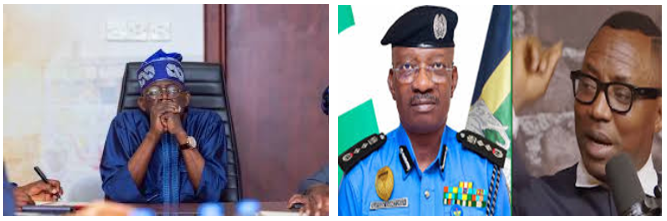
Inspector General Kayode Adeolu Egbetokun, you are a civil servant in the truest sense—a custodian of law and order, and a leader entrusted with the immense responsibility of safeguarding Nigeria. This role demands focus, restraint, and an unwavering commitment to justice. It is not a position meant for personal battles, distractions, or unnecessary engagements in legal controversies. You are not a politician managing rhetoric, nor are you a prosecutor seeking personal vendettas. Your role is to protect, to serve, and to lead.
Yet, this ongoing conflict with activist Omoyele Sowore raises a critical question—one that President Bola Ahmed Tinubu himself could be asking: Why is my Inspector General entangled in a legal fight with a political activist when the nation faces dire security challenges? At a time when Nigeria is grappling with complex and urgent issues requiring your undivided attention, this situation risks detracting from your primary mission. Leadership, particularly in such a critical role, demands the ability to rise above distractions and focus on the broader purpose of securing and stabilizing the nation.
The ongoing matter with Omoyele Sowore does not align with the standards of leadership expected of your position or the principles of modern policing. Sowore’s words, no matter how provocative, do not define you. Allowing this legal dispute to continue detracts from the critical responsibilities you shoulder. Leadership, particularly in a nation like Nigeria, must rise above such distractions. Your focus should remain on the broader mission of reforming the police force, restoring public trust, and addressing the pressing security needs of the country.
President Bola Ahmed Tinubu, the man who appointed you, has endured far worse provocations throughout his career. He has faced relentless criticism, public ridicule, and political opposition, yet he remained focused on his goals. Tinubu once famously stated, “I don’t need social media anymore. They abused the hell out of me. If I read it, I will have high blood pressure and I get angry, so I don’t read it.” His resilience, his ability to ignore distractions, and his focus on the bigger picture are the qualities that allowed him to rise to the highest office in the land. How does President Tinubu perceive this matter? Does he see an Inspector General committed to tackling Nigeria’s urgent security challenges and advancing police reforms? Or does he see a leader distracted by personal grievances and a legal fight with a political activist that adds no value to law enforcement?
This issue with Sowore has also revealed deeper systemic flaws within the Nigeria Police Force. Why is the police still setting bail conditions? This practice is a colonial-era relic—outdated and incompatible with modern law enforcement. In democracies across the world, bail is determined by the judiciary, not law enforcement. Continuing this practice raises serious concerns about the role and priorities of the Nigeria Police Force.
The bail conditions imposed on Sowore—demanding a Level 16 civil servant as a surety and property worth ₦100 million—are not only impractical but disconnected from the realities of Nigeria. How many Level 16 civil servants own property worth ₦100 million? These conditions, rather than fostering confidence in law enforcement, erode public trust in the very institution you lead.
Femi Falana (SAN) has rightfully pointed out that these bail conditions are not only impractical but illegal. He cited the Court of Appeal’s ruling in Dasuki v. Director-General, SSS (2020), which declared such conditions unconstitutional. Insisting on these outdated practices paints the NPF as an institution disconnected from its duty to serve the people. It is time for the Nigeria Police Force, under your leadership, to align itself with global policing standards. Bail conditions should be left to the judiciary. The police’s role should remain clear: to prevent crime, protect lives, and ensure justice.
Your global counterparts in advanced democracies approach their roles with strict professionalism, impartiality, and service-oriented policing. In countries like the United Kingdom, Germany, and Canada, police do not set bail conditions, engage in political disputes, or waste resources on legal battles that do not improve public safety. Their focus remains on crime prevention, community engagement, and public trust.
Inspector General, you have an opportunity to redefine policing in Nigeria. Dropping this unnecessary case with Sowore and moving away from colonial-era practices will demonstrate that the Nigeria Police Force is committed to justice, fairness, and modern law enforcement. Leadership is about knowing when to focus on long-term reforms rather than short-term distractions.
Nigeria faces urgent challenges that demand your full and undivided attention. Rising insecurity, organized crime, economic instability, and declining public trust in law enforcement require decisive and visionary leadership from the Nigeria Police Force. Engaging in a legal battle with Sowore—a case that has now become a global debate on free speech and human rights—distracts from the critical security work you should be focused on.
Instead of continuing with a legal dispute that benefits no one, you should be leading efforts to reform the police force, eliminate corruption within its ranks, and restore public trust. These are the actions that will define your leadership, not a court case against a political activist.
You are not “illegal,” “wicked,” or “fraudulent.” These are just words that will fade over time. What will remain is your legacy—the legacy of a leader who rose above distractions, prioritized reform, and left the Nigeria Police Force stronger and more respected.
Inspector General, you have the opportunity to lead by example. Let this matter with Sowore rest. Reform the system to ensure that the police no longer set bail conditions. Advocate for a decentralized policing structure that empowers communities and aligns with modern democratic principles. Show Nigerians and the world that the NPF is an institution of integrity, professionalism, and fairness.
The world is watching. President Tinubu is watching. Nigerians are watching. They are looking to you to demonstrate wisdom, restraint, and focus. This is a defining moment for your leadership, for the Nigeria Police Force, and for the nation.
Rise above the noise. Focus on the bigger picture. Reform the system. Let this matter with Sowore fade into history as a lesson in how true leadership prioritizes progress over distractions.
Nigeria needs security, stability, and police improvement. Lead the way. Let your legacy be one of trust, progress, and reform.

Professor John Egbeazien Oshodi is a distinguished American psychologist, educator, and author, known for his expertise in cross-cultural psychology, forensic/clinical psychology, police and prison science, and social justice. Born in Uromi, Edo State, Nigeria, he is the son of a father who served in the Nigeria Police Force for 37 years.
Oshodi has made significant contributions to forensic psychology, notably introducing it into Nigeria in 2011 through the National Universities Commission (NUC) and at Nasarawa State University. His academic career spans several institutions, including Florida Memorial University, Florida International University, Broward College, and Nova Southeastern University.
He currently serves as a government consultant for forensic-clinical psychological services in the USA, while practicing as a clinical and forensic psychologist. He also holds virtual faculty roles at Walden University, Weldios University, and ISCOM University.
In addition to his academic and professional work, Professor Oshodi has authored numerous publications and public opinion pieces on African governance challenges. He is the founder of the Psychoafricalysis theory in psychology, which has contributed to the field’s development.
Professor Oshodi’s work continues to inspire scholars and practitioners worldwide. He is a former Secretary-General of the Nigeria Psychological Association (NPA), and his contributions have had a lasting impact on both psychology and social justice discourse in Africa.