Africa
Russia-Zimbabwe: An Analytical Review -By Kestér Kenn Klomegâh
It is necessary to act speedily and concretely in today’s polycentric world. Speaker of the Parliament of the Republic of Zimbabwe, Jacob Mudenda, noted back in March 2023, that several mutual visits have been useful in terms of developing diplomacy. Speaker Jacob Mudenda explicitly said “participation in the conferences and bilateral meetings is an opportunity to discuss many issues, compare positions, develop solutions and give impetus to bilateral cooperation, but it is important to turn words into concrete actions.”

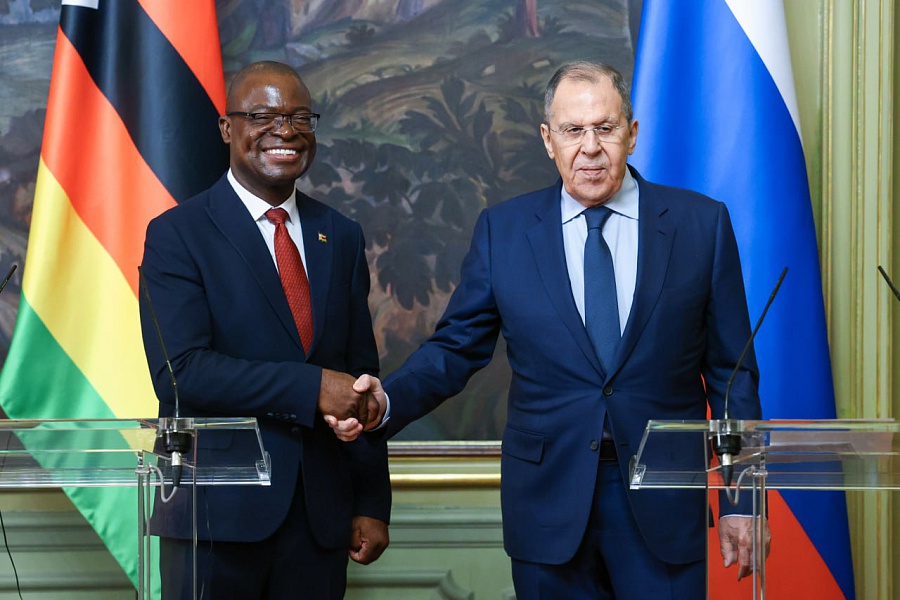
Russia and Zimbabwe have been interacting over the past years. The latest historic meeting held on 6th March 2025, full of diplomatic symbolism, between Foreign Minister, Sergey Lavrov, and Zimbabwean Minister of Foreign Affairs and International Trade, Amon Murwira, undoubtedly signified the importance of continuing close interaction between the two countries. It was the first for Murwira after his appointment, in October 2024, as Zimbabwe’s Foreign Minister and International Trade.
Historically the previous foreign ministers have laid the groundwork for the bilateral cooperation, advancing the policy to the benefit of the peoples of Russia and Zimbabwe. Amid new geopolitical environment, Amon Murwira as the new Foreign Minister and International Trade has the responsibility to enhance relations at various levels. In addition, there are many other bilateral and multilateral topics to address, given the importance of processes in southern African region and on the international stage, which simultaneously influence the development of both in Russia and Zimbabwe, and in a wide context, in developing Russia’s partnership with Africa.
During the joint media conference, after official productive negotiations behind closed-doors, Sergey Lavrov emphasised the paramount importance of the relations between Russia and Zimbabwe, which are rooted in the principles of equality and mutual respect. As expected, Lavrov made reference to President Emmerson Mnangagwa’s invariable commitment to deepening partnership based on agreements reached during his meetings with President Vladimir Putin, including on the sidelines of the St Petersburg International Economic Forum in June 2024.
Current bilateral status and southern Africa
With this background, Lavrov replayed the comprehensive bilateral agenda, including strengthening trade and economic cooperation. Additional steps that were agreed upon to identify promising areas for joint engagement, particularly in geological exploration, mineral resource development, nuclear energy, agriculture, space technology, and information and communications technologies.
Further insights into the bilateral relations show that cultural cooperation also boasts rich traditions. Annually, Russia allocates 125 scholarships for Zimbabwean citizens to study at Russian universities. As demand is clearly evident, Russia is, however, prepared to increase this quota. The St Petersburg State University project, the Centre for Open Education in Zimbabwe, is operational, with over 500 individuals enrolled in online Russian language courses – this figure is likely to grow in future.
During the media conference, it was emphasized that regional collaboration has shown promising trajectories. There are advancements in Zimbabwe’s relations with Tatarstan and the Moscow Region. A cooperation agreement is in place between the Government of the Sverdlovsk Region and the Government of the Midlands Province concerning international and foreign economic relations in trade and economic, scientific and technical, cultural, and social and humanitarian spheres.
Russia’s focus has also been on conflicts across the African continent, including those in the Central African Republic, the Democratic Republic of the Congo, Mali, Somalia, and the Great Lakes region of Africa. Zimbabwe, being a member of the Southern African Development Community (SADC), has been instrumental in providing support and resolving the crisis in the Democratic Republic of the Congo. Zimbabwe currently holds the chairmanship of this Southern African Development Community (SADC), with President Emmerson Mnangagwa personally leading active mediation efforts.
As a result, Russia renewed to supportive efforts in promoting stabilisation and conflict resolution across Africa. Through bilateral cooperation, Russia will strengthen the combat capabilities of national armed forces, train military personnel, and reinforce security and law enforcement agencies in Zimbabwe and southern Africa. This primarily aims at boosting the capacity of African partners to combat terrorism, drug trafficking, organised crime, and other forms of criminal activity on their territories.
Results of previous policy implementation
In a quick review, engagement in foreign relations have to drive economic development, support sustainable growth and enhance the level of social life of people. At this point, highlighting Russia-Zimbabwean partnerships have its own critical shortfalls and negative results. Like many African countries, Zimbabwe’s economy needs sustainable resuscitation. In spite of geopolitical tensions and its related dynamics, Zimbabwe has been looking for foreign investment in installing its energy, building infrastructure, modernizing agriculture and industry – foreign investors who could offer the necessary boost to employment-generating sectors.
Local Russian media reports resonated widely in the region, praised Russia-Zimbabwean relations dated from Zimbabwe’s struggle for political independence through its headway against western sanctions, and with Russia’s pledge and support for Zimbabwe to ascend into BRICS (Brazil, Russia, India, China and South Africa), an informal association which guarantees building an inclusive, a more fairer world especially for developing countries. BRICS currently has 13 partner states attached, among them are three (3) African countries including Nigeria and Uganda. BRICS was founded in 2006 by Russia, Brazil, India and China, with South Africa joining in 2010. In January 2024, it expanded to include Egypt, Ethiopia, Iran, Saudi Arabia, and the United Arab Emirates.
In the context of the rapidly changes in the world, majority of African States are publicly shrugging off relations with the Western and European world, alternatively settling for better beneficial economic cooperation. But in practical reality there are settling for loans and forms of credits from International Monetary Fund and the World Bank. African leaders considered their commitment to leveraging to these foreign financial institutions, in the absence of BRICS New Development Bank’s inability and incapacity to support development aspirations. Since its establishment ten years ago, BRICS Bank has been invisible in Africa, except in Ethiopia, Egypt and South Africa. Notwithstanding that, Algeria last year opted to become a share-holder in BRICS Bank, which was established in 2015.
For the NDB, its key focus is to forge economic partnerships within BRICS, and beyond that to facilitate access to diverse markets, enhance trade and investment opportunities across emerging economies. Its reports say it will adopt a flexible approach to financing developing world including Africa, and support its long-term development goals.
Zimbabwe has expressed the desire to joing BRICS. According to reports, Zimbabwe may become a country, through which Russia will expand its economic cooperation with Africa. During the snapshot visit, officials from the Zimbabwe’s Trade Development and Promotion Organization (ZimTrade) signed a memorandum of understanding (MoU) with Delovaya Rossiya (Business Russia) Association. CEO of ZimTrade Allan Majuru expressed confidence that the cooperation with Delovaya Rossiya would help increase direct foreign investment in Zimbabwe. This MoU enables Russian companies to contribute their expertise while Zimbabweans – to present their possibilities and define areas of cooperation with potential Russian partners.
Russia’s chequered achievements in Zimbabwe
Several reports confirmed that Russians have abandoned the lucrative platinum project contract that was signed for $3 billion in September 2014, the Darwendale platinum mine in the sun-scorched location about 50 km northwest of Harare, the Zimbabwean capital. Foreign Minister Sergey Lavrov launched the $3 billion project back in 2014, after years of negotiations, with the hope of raising its economic profile in Zimbabwe. The project involved a consortium consisting of the Rostekhnologii State Corporation, Vneshekonombank and Vi Holding in a joint venture with some private Zimbabwe investors as well as the Zimbabwean government.
Early June 2022, the Speaker of the Federation Council of the Russian Federation, Valentina Matviyenko, headed a group of Russian senators on a reciprocal inter-parliamentary visit to Harare, Zimbabwe. The delegation delivered a humanitarian aid to the Angels of Hope Foundation ran by the First Lady, Auxilia Mnangagwa in Harare. In 2023, President Vladimir Putin despatched tonnes of grains (wheat) under “supply at no-cost” to the people of Zimbabwe. Besides Zimbabwe, other African countries – Burkina Faso, Central African Republic, Eritrea, Mali, Somalia and Kenya benefited from this humanitarian aid to these African countries. (For further detailed information on this, read the transcript on the Kremlin’s website)
While Russia offered free grains and free food, its neighbour Belarus, in January 2023, handed over in a special ceremony Belarusian agricultural vehicles, tractors and equipment. President Alexander Lukashenko visited Zimbabwe, Putin has not. Zimbabwe and Belarus agreed on assembling 3000 tractors. Both have further agreed to establish a mechanization programme for the farming and timber industries.
On the sidelines of an investment summit in St. Petersburg, in June 2024, President Emmerson Mnangagwa asked Russian President Vladimir Putin to step arms and military weapon supply to the country, allegedly explained that the West had shifted its support from Zimbabwe to Zambia, consolidating their influence through substantial security and financial assistance. “The United States is making us feel lonely,” Mnangagwa remarked, indicating a perceived encirclement by Western powers.
Prior to Mnangagwa taking his turn, Putin said at negotiations with Zimbabwean President Emmerson Mnangagwa that Russia’s presence in Zimbabwe typically symbolizes the overall interest of the African continent in the development of relations with the Russian Federation. Putin further recalled several agreements that were expected to stipulate active bilateral cooperation.
Russia-Zimbabwe: Points of correction
Until now, both Russia and Zimbabwe cautiously contemplate the possible way forward. On one hand, Zimbabwe waited for potential Russian investors. On the other hand, Russian authorities have been sustaining policy initiatives mainly renewing and repeating what were previous discussed and agreed, in fact expected mutual economic paradigms were signed into solid bilateral agreements. Behind official reports, Zimbabwe signalized that Russia has to sanitize the policy initiatives, demonstrate in practical terms the impact of its geopolitical influence. In other words, time is already up to take serious action on the wide-range ‘rose-painted’ policy statements and final bilateral decisions.
It is necessary to act speedily and concretely in today’s polycentric world. Speaker of the Parliament of the Republic of Zimbabwe, Jacob Mudenda, noted back in March 2023, that several mutual visits have been useful in terms of developing diplomacy. Speaker Jacob Mudenda explicitly said “participation in the conferences and bilateral meetings is an opportunity to discuss many issues, compare positions, develop solutions and give impetus to bilateral cooperation, but it is important to turn words into concrete actions.”
Speaker Jacob Mudenda argued that it was distinctively evident that Moscow, over the past few years, turned over a new chapter to re-activate relations with Africa. But, Russia’s influence might not take roots anytime soon if bilateral agreements and declarations are not vigorously and promptly implemented. Such outstanding agreements, not only with Zimbabwe, but also with many African countries. It includes those from the first Russia-Africa Summit, and to show unflinching commitment to completely implement the results of June 2023 second Russia-Africa Summit held in St. Petersburg and the first Ministerial Conference of the November 2024 Russia-Africa Partnership Forum in Sochi.
Zimbabwe’s political landscape still remains volatile. Russia-Zimbabwe relations were established a long time ago when it was struggling for political independence which it finally gained on 18th April 1980. Zimbabwe, with a population roughly 15 million people, is a landlocked country in southern Africa. In southern African region, it is the biggest trading partner of South Africa. Zimbabwe is one of the members of the Southern African Development Community (SADC).