Africa
Stop Blaming Journalists For Everything: They’re Not Policemen, They’re Just Messengers -By Isaac Asabor
Against the backdrop of the foregoing, it is not out of place to opine that to scapegoat the journalist is to miss the point. If Nigeria is to move forward, every institution must be held accountable for its role, and every citizen must learn to ask the right questions. The journalist is not your enemy. He is simply the messenger.

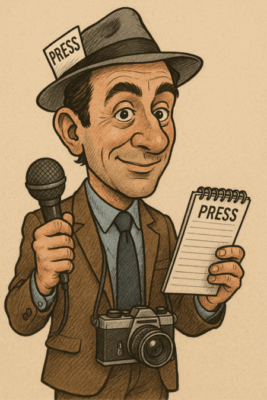
In a society where the value of professional roles is increasingly misunderstood or deliberately misrepresented, the journalist has ironically become both the observer and the scapegoat. This scapegoating is not just wrong, it is dangerous. It puts undue pressure on members of the Fourth Estate and distracts from the real responsibilities of those who hold power and wield influence over systems and institutions.
Recently, at an anti-corruption event organized by an NGO in Ikeja, Lagos, the discourse that should have focused on the solutions to the endemic problem of corruption in Nigeria took a rather curious turn. One would have expected rigorous policy suggestions or robust criticism of political impunity. Instead, fingers were pointed, at journalists. According to most speakers at the event, the media is not doing enough to expose corrupt politicians. That sweeping generalization is not only unfair but also reflective of a deep-rooted misunderstanding of the journalist’s role in society.
It did not end there. A similar experience was echoed when a politician who lost an election lamented that if the media had properly covered the election, he would not have been rigged out. This, too, is misguided. Then, there was the case of a journalist seeking accommodation in Lagos. Upon discovering his profession, the landlord and caretaker suddenly developed cold feet, treating him as though he were a government agent or undercover cop. In yet another baffling case, area boys in Surulere once accused a journalist of tipping off the police about their activities during a raid. The list of misconceptions is endless.
These incidents, when pieced together, point to a disturbing trend: many Nigerians see journalists not as professionals playing a crucial societal role, but as enemies of progress, spies, or scapegoats. It is high time this damaging narrative was corrected.
Let us be clear: journalists are not law enforcement officers. They don’t carry guns or wear badges. Their strength lies in the power of the pen, and their primary tool is information. At their core, journalists are tasked with informing, educating, and sometimes entertaining the public. But more critically, they exist to hold power to account. The press serves to report events truthfully, give voice to the voiceless, and shine a light on issues that might otherwise be ignored or deliberately buried.
In fact, the press is the only profession recognized by name in most democratic constitutions. In Nigeria, Section 22 of the 1999 Constitution mandates the press to “uphold the responsibility and accountability of the government to the people.” That mandate is not a police warrant. It does not give journalists arrest powers, neither does it allow them to prosecute criminals. Their duty stops at uncovering and reporting facts.
What people must understand is that journalism is not activism, nor is it state surveillance. It is the work of ensuring that society remains informed and aware. If a journalist investigates corruption and reports it, it is the duty of anti-graft agencies like EFCC and ICPC to take it from there, not the journalist’s responsibility to carry out arrests or legal enforcement.
A large part of the problem stems from ignorance and the media’s increasing visibility. Because journalists are often on the frontlines, at press conferences, at scenes of crimes, in community events, people assume they wield more power than they do. But access does not equal control.
There is also the issue of sensationalism in some sections of the media, which has sadly damaged the image of journalists. Tabloid journalism, clickbait reporting, and unverified content shared through social media platforms have blurred the line between professional journalists and opportunistic content creators. As a result, the public often lumps all media workers into one confusing category.
However, to judge an entire profession based on the missteps of a few is not only unjust but intellectually lazy.
Against the backdrop of the foregoing unassailable facts, it suffices in this context to opine that Journalists are victims, and not villains. Ironically, the same people who accuse journalists of not doing their job are often silent when journalists are harassed, attacked, or even killed for doing their work. Globally, journalists risk their lives to bring the truth to light. In Nigeria, journalists have been detained, brutalized, and threatened. The hazards of the profession are many, and they cut across poor remuneration, job insecurity, and political intimidation to name a few.
Consider the case of journalists covering conflicts, elections, or court proceedings. They are often restricted, harassed, or denied access. Despite all these, they are still expected to deliver perfect and in-depth coverage. When things go wrong, they are the first to be blamed. This kind of environment breeds fear and discourages thorough investigative journalism.
In you ask this writer why he thinks Journalists should not be the fall guys, he would not hesitate to inform you that blaming journalists for societal failures is an act of cowardice. It is easy to turn the spotlight away from politicians who embezzle public funds or security agencies that fail to do their jobs by shifting the blame to journalists. But that does nothing to solve the problem.
If a politician is rigged out in an election, the responsibility lies with INEC, security operatives, and possibly the courts. The journalist can only report on the transparency, or lack thereof, of the process. If a community is being ravaged by crime and the people suffer, it is the duty of law enforcement to act on verified reports, not journalists to play detective.
The journalist is the mirror of society. If you do not like what you see in the mirror, breaking it will not change your appearance.
In fact, there is an urgent need to demystify journalism. Media literacy must become a national priority. Schools should teach the basics of media functions. Civil society should engage in awareness campaigns. And government institutions should stop treating journalists like adversaries.
Media houses also have a responsibility. Journalists must consistently uphold the ethics of the profession: fairness, balance, truthfulness, and accuracy. Where mistakes occur, corrections must be made promptly. Trust, once lost, takes time to rebuild.
Moreover, journalists must continue to document their work and be vocal about the dangers they face. They must remind the public that their job is to serve society by being watchdogs, not attack dogs, and certainly not scapegoats.
They say “the pen is mightier than the sword,” but that does not mean journalists are warriors to be blamed for everything wrong in society. A pen can only do so much in a country where power hides behind silence, corruption, or brute force.
For the sake of clarity, silence protects power by creating a culture where people are either too afraid or too indifferent to speak up. When no one talks about injustice or demands answers, those in power feel safe to do whatever they want without scrutiny. It makes it harder for journalists to dig out the truth because even the victims and insiders who know what is happening prefer to keep quiet out of fear, loyalty, or personal gain.
Not only does silence protects power, corruption weakens journalism by blocking access to information, intimidating the press, and sometimes even buying journalists off. In corrupt systems, institutions that are supposed to support free press, like the police, courts, and media regulators, are often tools in the hands of the powerful. Instead of helping journalists expose the truth, they frustrate investigations or punish those who dare to speak up.
Despite these tough conditions, journalists can overcome these challenges by building strong networks, relying on facts, working with independent watchdogs, and using digital tools to protect themselves and their stories. Courage, collaboration, and public support also go a long way in keeping journalism alive in difficult environments.
So, while the pen holds great power, it cannot fight alone. It needs a society that values truth, demands accountability, and protects the people who dare to write it.
Against the backdrop of the foregoing, it is not out of place to opine that to scapegoat the journalist is to miss the point. If Nigeria is to move forward, every institution must be held accountable for its role, and every citizen must learn to ask the right questions. The journalist is not your enemy. He is simply the messenger.
So next time you see a journalist, do not look at him like a CID, spy, “Amebo” or political tool. Look at him as what he is, a custodian of truth, and one of the last lines of defense between the people and tyranny.