Politics
The 2027 Realignment: Why an Obi–Kwankwaso Coalition Is Nigeria’s Most Credible Path to Political Change -By Jeff Okoroafor
An analysis of why an Obi–Kwankwaso alliance could reshape Nigeria’s 2027 elections, offering a credible alternative to the current political order.

Nigeria’s political future is often described in the language of inevitability: incumbency is power, structures are decisive, and opposition movements are temporary disruptions. Yet that framing is increasingly out of step with the country’s evolving electoral reality.
The 2023 presidential election quietly dismantled that assumption. Bola Ahmed Tinubu of the All Progressives Congress won with about 8.79 million votes, yet the combined votes of Peter Obi and Atiku Abubakar exceeded 14 million. The message was not ambiguity—it was aggregation failure. Nigeria did not reject change; it split it.
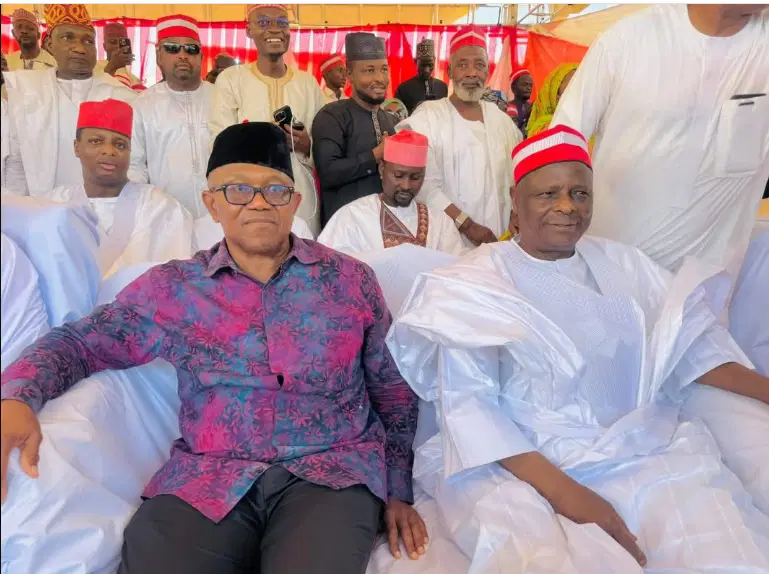
That fragmentation is precisely what the emerging alignment between Peter Obi and Rabiu Musa Kwankwaso resolves. It is not a speculative political experiment. It is the most coherent electoral synthesis of Nigeria’s current political geography.
Obi’s rise has already redefined what is electorally possible in Nigeria. In a system historically dominated by party machinery, he built a nationwide movement anchored in urban youth, the diaspora-influenced middle class, and a digitally mobilized electorate that defied traditional structures. His victory in Lagos State in 2023 remains one of the most symbolically significant disruptions in modern Nigerian politics, demonstrating that voter sentiment has begun to operate independently of entrenched party control.
Kwankwaso brings a different but equally decisive force. His political network in Kano represents one of the most disciplined grassroots structures in the country, rooted in years of localized political organization and mass appeal across the North-West. It is not a theoretical bloc; it is an electoral machine with proven capacity to deliver millions of votes in concentrated form.
Individually, each represents a partial map of Nigeria’s electorate. Together, they form something far more consequential: a national coalition that mirrors the country’s true electoral divisions rather than the artificial fragmentation that has defined recent elections.
The importance of this alignment becomes clearer when viewed against Nigeria’s electoral arithmetic. The ruling All Progressives Congress retains institutional advantages through its control of state governors and federal machinery. But elections are not won in abstraction; they are won through votes cast, counted, and consolidated across regions. The opposition’s central weakness in 2023 was not lack of support but the absence of a unified structure to translate that support into victory.
That structural gap disappears in a unified Obi–Kwankwaso ticket. It consolidates the South-East and significant portions of the South-West with a dominant Northern bloc anchored in Kano. It neutralizes the geographic fragmentation that has historically ensured ruling-party victories despite narrow margins of national support.
More importantly, it reflects a deeper shift in Nigerian politics that the 2023 election already revealed. The electorate is younger, more mobile, more digitally connected, and less emotionally tied to legacy party identities than at any point since the return to democracy. That shift has weakened the predictive power of traditional political structures and elevated the importance of message coherence, credibility, and national reach.
The assumption that incumbency guarantees permanence has already been tested—and it is no longer absolute. Nigerian political history shows that once opposition forces achieve coordination rather than coexistence, electoral outcomes change decisively. The real obstacle in past cycles has never been popularity; it has been fragmentation.
A unified Obi–Kwankwaso platform removes that obstacle entirely.
What emerges is not a symbolic alliance but a complete electoral counter-architecture. It combines urban momentum with rural penetration, youth mobilization with established grassroots networks, and regional strength with national appeal. In a political environment where no single candidate can independently dominate Nigeria’s complexity, this synthesis is not just strategic—it is decisive.
The 2027 election, viewed through this lens, is not an open-ended contest. It is the consolidation of a new political reality already signaled in 2023: Nigeria’s electorate is larger than any single machine, and once unified, its direction is unmistakable.
In that reality, an Obi–Kwankwaso alignment does not merely compete. It redefines the balance of power in Nigerian democracy.

Jeff Okoroafor
Jeff Okoroafor is a social accountability advocate and a political commentator focused on governance, accountability, and social justice in West Africa.