Africa
When the Giant Falls: Locked Out of the World — Nigeria’s Travel Ban and the Global Verdict on Corruption and Institutional Decay -By Psychologist John Egbeazien Oshodi
This moment is painful—perhaps one of the most humiliating in our recent history—but pain can serve two purposes: it can bury us, or it can break us open. National trauma can trap a country in anger and self-pity, or it can force a reckoning that we have postponed for too long. The danger is denial; the opportunity is transformation. For decades, we have treated corruption as a financial crime alone, measured only in stolen budgets and missing funds. But corruption is far more insidious—it is a systemic cancer that eats into our security by weakening our borders, corrodes our identity by distorting our values, and threatens our future by sabotaging the very institutions meant to protect citizens.

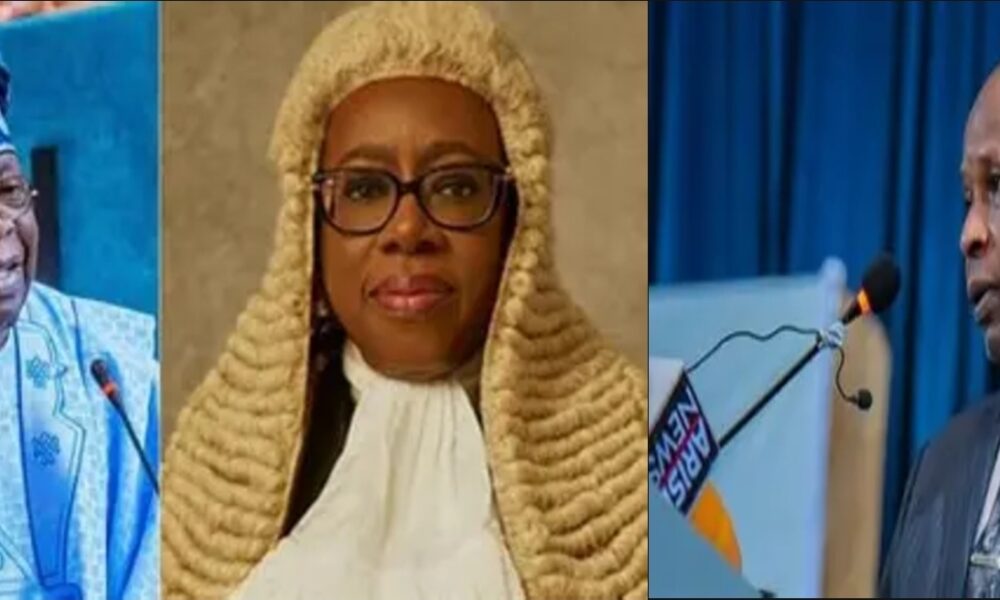
A National Shock: When the Giant of Africa Faces Global Rejection
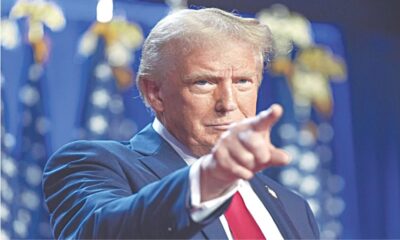
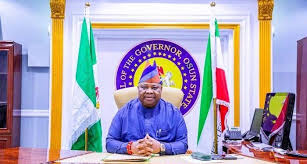
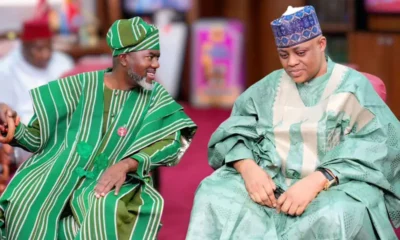
When the images of President Bola Tinubu, Chief Justice Kudirat Kekere-Ekun, and Attorney-General Lateef Fagbemi sit beneath this title, they do more than decorate a page—they symbolize the three pillars that should safeguard a nation in crisis: executive leadership, judicial integrity, and legal stewardship. Yet today, those very institutions stand at the center of a global fallout that Nigeria can no longer deny.
The news of the 2026 U.S. Travel Ban has struck Nigerians like a sudden cold wind, cutting through decades of denial and patriotic bravado. For years, corruption, insecurity, and institutional paralysis were trivialized—reduced to table-talk complaints, comic relief on radio shows, and background noise beneath football commentary. Those failures were treated as irritations rather than emergencies. But today, those same failures have crossed international borders and returned as closed consulate doors, restricted visas, and global suspicion.
The psychological pain lies in the contrast. Nigeria called itself the Giant of Africa—boasting population, oil reserves, diplomatic weight, peacekeeping history—while many smaller African nations, once dismissed as “lesser,” now stand outside the travel ban list with cleaner reputations, more credible systems, and greater international trust. A nation that has mocked others now watches those same countries move freely in spaces where we are now questioned, doubted, and restricted.
This is no longer a diplomatic embarrassment—it is a rupture of national identity and a collapse of our collective self-image. It forces a reckoning with an uncomfortable truth: size without institutions is fragility; wealth without accountability is volatility; influence without integrity is illusion. The travel ban is not simply an external judgment—it is a mirror reflecting internal decay.
When a nation that claims leadership in Africa finds itself grouped among states labeled unstable and high-risk, the blow is not just political—it is psychological. It shatters the ego of a country that has been taught to believe it was too large to fail, too important to be ignored, and too strategic to be isolated.
Here, the images matter. The President represents political will—the choices that guide state security and governance. The Chief Justice represents the judiciary—the institution that should enforce accountability and uphold rule of law. The Attorney-General represents the legal conscience of the nation—the custodian of constitutional standards.
And when these pillars falter, the nation falls—not in landmass, but in legitimacy. A giant in rhetoric who is treated as a liability at global borders is not a giant at all—it is a body weakened by decades of unaddressed decay, mismanaged institutions, and misplaced priorities.
Collective Trauma and Collective Clarity: Where Shock Must Become Insight
As a psychologist, I see in our public reactions the signs of a nation in Collective Trauma—anxiety at the global backlash, anger at perceived foreign disrespect, helplessness at closed doors, and disbelief that this could happen to us. But trauma without insight becomes paralysis. Collective Clarity requires admitting that the world is not responding to isolated terrorist incidents—it is responding to institutional rot. And this rot did not arise from ignorance; it was engineered and sustained by leaders who knew what was right but chose what was easy, what was selfish, and what was profitable.
For decades, shameless political elites treated government institutions not as public trusts but as personal estates—ministries became inheritance, security agencies became private mercenaries, courts became bargaining halls, and public offices became cash machines. They knew the laws, yet broke them. They understood the consequences, yet ignored them. They recognized the global standards, yet rejected them. The travel ban is not the world attacking us; it is the world reacting to what we have refused to confront: a leadership class that weaponized its own institutions for personal gain, sabotaged accountability, and hollowed out the very systems meant to protect the nation.
For real transformation, we must acknowledge a painful truth: the crisis originated within, not without. Our humiliation is not born of foreign hostility, but of domestic betrayal. Until we confront the internal saboteurs of our progress—those who rule, not lead; who exploit, not build; who know better, yet do worse—no external sympathy or diplomacy will restore the respect we have lost.
Institutional Neglect and the Chain of Collapse
The U.S. proclamation is diagnostic rather than purely punitive. When the United States cites radical groups, intelligence failures, and unreliable identity systems, it is naming the consequences of neglect. The chain is unbroken and terrifyingly logical: when security funds disappear, intelligence breaks down; when intelligence breaks down, insurgency rises; when insurgency rises, international trust collapses. And trust, once broken, becomes the most difficult currency to rebuild.
But here is the deeper and more uncomfortable truth: corruption is not only about stolen money. It also lives in non-monetary corruption—the distortions of values, institutions, and basic civic ethics. It thrives in the failed policing system that prioritizes extortion over protection. It flourishes in the politicized judiciary that bends to power, not justice. It deepens through a captured print media that edits truth to favor the powerful, suppressing stories of insecurity, mass killings, and human suffering to preserve political relationships.
This form of corruption destroys more than budgets—it destroys trust, fairness, and national cohesion. It breeds environments where kidnapping becomes currency, where banditry becomes employment, where embezzlement becomes strategy, where inequality becomes destiny, and where injustice becomes ordinary. The end result is a nation where fear governs movement, crime governs ambition, and helplessness governs belief.
The Irony of the Elite: When the Architects of Failure Become Prisoners of Their Own Design
For decades, Nigeria’s leaders shielded themselves from national decay. They didn’t need working hospitals—they had London. They didn’t need secure schools—they had Boston. They didn’t fear crime—they traveled with convoys. They didn’t need working police—they hired private security. They didn’t need accountability—they owned the media megaphone.
But the travel ban has shattered the illusion that wealth and power can insulate one from national rot. The international community is now saying: if Nigeria cannot secure itself, others will secure themselves from Nigeria. Elite immunity is fading. Their children’s schools, medical trips, and offshore assets are now entangled in the very dysfunction they engineered.
The innocent suffer first. The guilty suffer later.
But the true injustice is that the innocent suffered at all.
Silence as Denial: The Ruling Party’s Psychological Retreat
Since the announcement, the ruling party has offered no transparent explanation or practical roadmap. Psychologically, this silence is avoidance—not strategy. They cannot speak because the ban exposes their vulnerability. They cannot protest because the ban reflects their record. And they cannot deny because the consequences are now personal.
Their decades-long belief that exile was always an option is collapsing. The world is closing its doors—not only to our citizens, but to our leaders. When America shifts, Europe adjusts. When Europe adjusts, Canada and Australia calibrate. Travel bans spread as easily as global fear.
The Collapse of the “Great Man” Myth and Systemic Illusion
For too long, we placed our faith in the myth of the Great Man—the comforting illusion that one strong, charismatic leader would rise above the chaos and rescue us, without institutions, without transparency, without accountability. We turned politics into personality worship. We defended individuals instead of defending standards. We argued over which “savior” was better, instead of asking whether our systems worked at all. But no single hero can secure a nation where police serve politics, not people; where courts serve elites, not justice; where the media serves power, not truth. In such a landscape, even a well-intentioned leader becomes trapped in a corrupt machinery, and a bad leader becomes a weapon in its hands. A country that depends on one person is a country permanently on the brink, because the day that person falls ill, is compromised, grows tired, or leaves office, everything collapses with them. Real stability does not come from a man on a podium; it comes from institutions that work whether he is there or not.
Institutions—not individuals—are the true engines of development. Independent courts, professional police, accountable parliaments, credible electoral bodies, honest media, and functioning civil registries do not make noise, but they make progress possible. They protect citizens from the moods of rulers. They outlive elections, outlast personalities, and outshine propaganda. Until we stop searching for a single Great Man and start insisting on great systems, we will keep repeating the same cycle: excitement, disappointment, crisis, and blame. The future we want will not be built on a chest-beating leader—it will be built on institutions that cannot be bought, bent, or bullied.
A Therapeutic Conclusion: We Must Choose to Do Better
This moment is painful—perhaps one of the most humiliating in our recent history—but pain can serve two purposes: it can bury us, or it can break us open. National trauma can trap a country in anger and self-pity, or it can force a reckoning that we have postponed for too long. The danger is denial; the opportunity is transformation. For decades, we have treated corruption as a financial crime alone, measured only in stolen budgets and missing funds. But corruption is far more insidious—it is a systemic cancer that eats into our security by weakening our borders, corrodes our identity by distorting our values, and threatens our future by sabotaging the very institutions meant to protect citizens. It is corruption when policing is militarized against the poor but paralyzed against the powerful. It is corruption when the judiciary delivers verdicts not based on law, but on loyalty. It is corruption when the media becomes a megaphone for the ruling class while silencing the nation’s wounds.
So yes, this moment is painful—but it is also deeply revealing. A country does not land on a global travel ban overnight. It arrives there through decades of normalized dysfunction: bribery as culture, impunity as privilege, insecurity as routine, and public power treated as private inheritance. And now the world has responded. The mirror has been placed before us. We cannot cover it. We cannot look away. We cannot pretend. The humiliation stings because it exposes who we have become—and who we refused to stop becoming.
But here is the path forward: if we confront what we are, we can become what we should be. The way out is not in slogans or scapegoats, but in rebuilding. We must depoliticize the police so they serve citizens, not rulers. We must free the judiciary from executive grip so justice can breathe again. We must dismantle the marriage between media and power so truth can return to national discourse. We must restore civil service based on merit, not godfatherism. And we must rebuild institutions that stand not on the will of one man, but on the rule of law.
We must do better—
not because America commands it,
but because Nigerians deserve it;
because children deserve a nation where dignity is not stamped out at an embassy window;
and because the world will only respect us once we respect ourselves.
Change remains possible. Respect is not lost forever. The future is not closed.
But this moment demands honesty, not excuses; courage, not denial; reform, not rhetoric.
The travel ban should not be the end of our pride—
it should be the beginning of our awakening.
Only if we choose to rise—not just react—can we rebuild a nation worthy of global trust and internal dignity.
About the Author
Prof. John Egbeazien Oshodi is an American psychologist and educator with expertise in forensic, legal, clinical, and cross-cultural psychology, including public ethical policy, policing, and prison science. A native of Uromi, Edo State, Nigeria, and son of a 37-year veteran of the Nigeria Police Force, he has long worked at the intersection of psychology, justice, and governance. In 2011, he helped introduce advanced forensic psychology to Nigeria through the National Universities Commission and Nasarawa State University, where he served as Associate Professor of Psychology.
He teaches in the Doctorate in Clinical and School Psychology at Nova Southeastern University; the Doctorate Clinical Psychology, BS Psychology, and BS Tempo Criminal Justice programs at Walden University; and lectures virtually in Management and Leadership Studies at Weldios University and ISCOM University. He is also the President and Chief Psychologist at the Oshodi Foundation, Center for Psychological and Forensic Services, United States.
Prof. Oshodi is a Black Republican in the United States but belongs to no political party in Nigeria—his work is guided solely by justice, good governance, democracy, and Africa’s development. He is the founder of Psychoafricalysis (Psychoafricalytic Psychology), a culturally grounded framework that integrates African sociocultural realities, historical awareness, and future-oriented identity. He has authored more than 500 articles, multiple books, and numerous peer-reviewed works on Africentric psychology, higher education reform, forensic and correctional psychology, African democracy, and decolonized models of clinical and community engagement.