National Issues
When Waste Becomes Livelihood: The Cost of an Unstructured Recycling System -By Martha Adamu
The absence of a structured waste recycling system reflects broader challenges in governance, planning, and social responsibility. While informal systems attempt to fill the gap, they are neither sufficient nor sustainable.
A functional recycling system is not a luxury but a necessity one that ensures public health, environmental protection, and national development. For Nigeria to achieve sustainable progress, urgent and coordinated action must be taken to transform waste from a burden into a managed resource.

In many urban centers across Nigeria, the absence of a structured waste recycling system is not merely an environmental issue, it is a pressing socio-economic and public health concern. As cities expand rapidly, the systems required to manage waste sustainably have not kept pace, leaving significant gaps that affect both the environment and human well-being. Years ago, I witnessed a disturbing incident that clearly illustrates the human cost of poor waste management systems. I saw a group of young children inside a waste dump, searching through piles of refuse for plastic materials and other items they could collect, sell, and earn a small amount of money. For them, what should have been a place of danger had become a means of survival.
These children worked without any form of protection. One particular child stood out he was barefoot, either because he had no shoes or because they had worn out. The dumpsite itself was located close to a public area, making it easily accessible but also extremely unsafe. As the children moved through the waste, stepping on sharp and hazardous objects, the risks were evident.
At some point, the barefoot child accidentally stepped on a sharp object hidden within the waste. He lost his balance and fell. Immediately, he sustained a deep injury to his foot, and blood began to flow heavily. The situation was alarming, yet it reflected the everyday reality faced by many children who are exposed to such environments due to poverty and lack of proper waste management systems and dangers of placing waste disposal sites near public.
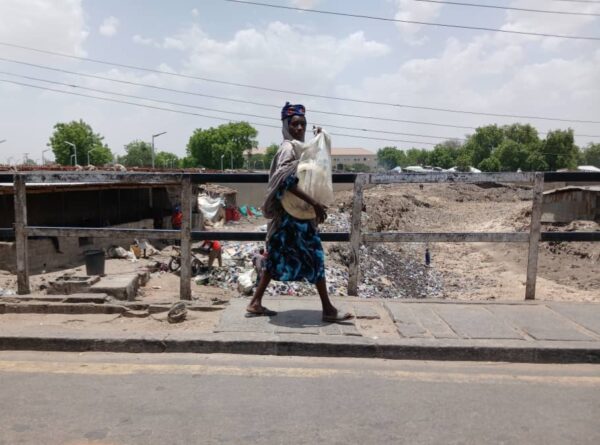
The image, shows a woman walks purposefully, carrying a heavy sack, her posture suggests routine, this is not a one-time act but part of her daily survival. Behind her, under the bridge, there is a visible accumulation of waste, forming what appears to be an informal dumpsite. Scattered debris, plastic, and refuse dominate the landscape, indicating poor waste management systems.
A Landscape of Neglect
The persistence of unmanaged waste in urban areas reflects a breakdown in organized waste collection and disposal systems. In cities such as Kano, Maiduguri, and Lagos, rapid urbanization has placed immense pressure on sanitation infrastructure. In many districts, municipal waste systems are either underfunded, inefficient, or entirely absent.
Without consistent waste collection services or designated recycling facilities, refuse accumulates in unauthorized areas such as drainage channels, roadside spaces, and vacant land. Over time, these areas evolve into informal dumpsites, creating environmental hazards and undermining the quality of urban life.
The Rise of the Informal Recycling Economy
In response to systemic gaps, an informal waste economy has emerged. Thousands of individuals rely on the collection and resale of recyclable materials, such as plastics, scrap metals, and paper as a means of survival.
This informal sector plays a complex role:
It contributes to waste reduction by recovering recyclable materials.
It provides a source of income for economically marginalized populations.
However, it exposes workers to unsafe conditions, including contact with hazardous substances and physical risks.
Despite its contributions, the sector operates without formal recognition, regulation, or adequate protection for workers, highlighting the failure of institutional systems to address both environmental and social needs.
Public health implications
Unstructured waste disposal significantly threatens public health. Accumulated waste creates conditions conducive to the spread of diseases such as malaria and cholera. Stagnant water trapped within waste materials serves as breeding grounds for mosquitoes, while contaminated water sources facilitate the transmission of waterborne diseases.
Air pollution is another major concern. The decomposition of organic waste releases harmful gases into the atmosphere, affecting air quality and increasing the risk of respiratory illnesses. In densely populated areas, prolonged exposure to such conditions can lead to serious health complications, particularly among vulnerable groups such as children and the elderly.
Environmental Degradation
The environmental impact of poor waste management is extensive. Non-biodegradable materials, particularly plastics, clog drainage systems and contribute to flooding during rainy seasons. Soil and water contamination further disrupt ecosystems, affecting both biodiversity and agricultural productivity.
Additionally, the visual presence of unmanaged waste degrades the aesthetic quality of urban environments. It creates an impression of neglect, making the environment appear poor and underdeveloped, thereby reducing the perceived quality of a technologically advancing and well-managed society.
Systemic Challenges
Several structural factors contribute to the persistence of unstructured recycling systems, particularly in Northern Nigeria:
• Insufficient funding for waste management infrastructure
• Limited public awareness regarding waste segregation and recycling practices
• Weak enforcement of environmental regulations
• Rapid population growth without corresponding urban planning
These challenges collectively widen the gap between waste generation and effective management, leaving communities to cope with the consequences.
A Call for Structured Intervention
Addressing the issue requires a comprehensive and coordinated approach:
1. Government Investment
There is a need for increased funding in waste management infrastructure, including the establishment of recycling plants and efficient waste collection systems.
2. Public Awareness Campaigns
Educating citizens on proper waste disposal and segregation is essential for reducing the volume of unmanaged waste.
3. Integration of Informal Workers
Informal waste collectors should be incorporated into formal systems, with access to training, protective equipment, and fair compensation.
4. Private Sector Participation
Businesses should be encouraged to invest in recycling initiatives and adopt environmentally sustainable practices.
5. Controlled Waste Disposal
Waste should be transported to designated and controlled locations, such as isolated landfill sites or areas far from public spaces, to minimize health risks and environmental impact on communities.
Conclusion:
The absence of a structured waste recycling system reflects broader challenges in governance, planning, and social responsibility. While informal systems attempt to fill the gap, they are neither sufficient nor sustainable.
A functional recycling system is not a luxury but a necessity one that ensures public health, environmental protection, and national development. For Nigeria to achieve sustainable progress, urgent and coordinated action must be taken to transform waste from a burden into a managed resource.