
Africa
Why Nigeria Must Handle Trump’s Threat Diplomatically, And With Caution -By Isaac Asabor
At the international level, Nigeria must balance firmness with engagement, rejecting interference but welcoming technical cooperation where needed. Smart diplomacy means using every tool available to protect the nation’s interests while preserving credibility abroad.

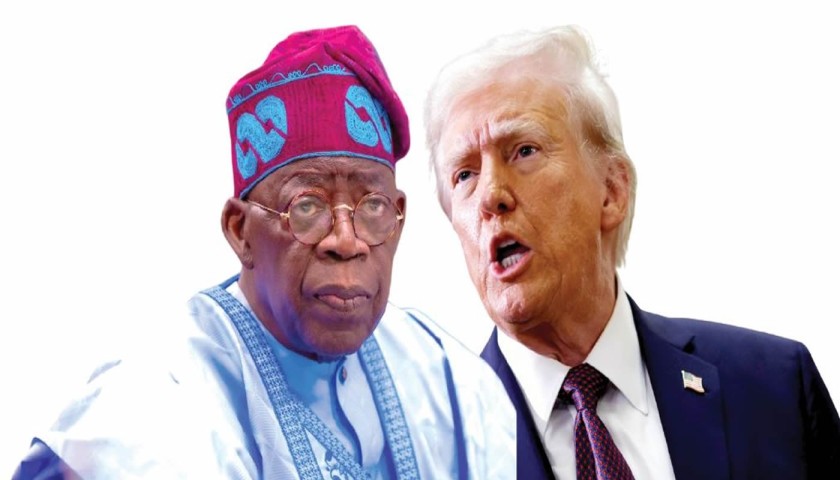
In recent days, the international spotlight has shone once again on Nigeria, not because of a breakthrough in governance or a successful anticorruption drive, but because of a combustible exchange that threatens to inflame tensions at home and complicate an already fragile national fabric. The immediate provocation was a public statement by U.S. President Donald J. Trump threatening to “send soldiers” to Nigeria to address alleged killings of Christians.
Predictably, that external provocation met with a fierce, and sometimes inflammatory, response from members of Nigeria’s political and social elite, statements that are worth interrogating, not just for their rhetoric but for their potential consequences.
There is a tempting clarity to such exchanges. Outsiders make a provocative claim, and elite defenders of national sovereignty rise to the occasion to rebuke foreign interference. Patriotism is understandable; no responsible leader can allow their nation’s image to be besmirched without responding. But there is a difference between ‘responding diplomatically’ and ‘reacting emotionally’. Too many of Nigeria’s public figures, politicians, clerics, and commentators alike, have taken the latter route, trading sober analysis for alarmist hyperbole and identity politics that risk deepening internal divisions.
History leaves little room for doubt: no country that America has interfered with has emerged stronger. The U.S. may claim to promote democracy and human rights, but its global record tells a harsher truth.
Iraq was invaded under false pretenses in 2003; two decades later, it remains fractured and unstable. Libya, once united under Gaddafi’s authoritarian but functional rule, collapsed into a failed state after a U.S.-backed intervention. Afghanistan suffered two decades of occupation, only for the Taliban to reclaim power the moment American troops withdrew. Even Latin America still bears the scars of Washington’s interventions, from the coup in Chile to economic strangulation in Venezuela and Cuba.
The lesson is clear: America’s “help” often leaves chaos in its wake. And that is precisely why Nigeria must respond to Trump’s saber-rattling not with emotional bluster, but with cautious, calculated diplomacy.
Nigeria is a nation of breathtaking diversity, and dangerous fragility. With over 200 million people, hundreds of ethnic groups, and an even split between Christians and Muslims, the country’s balance is delicate. Violence here is not monolithic: from insurgency in the northeast to banditry in the northwest and separatist agitation in the southeast, each crisis has its own local logic.
Into this volatile mix, a foreign leader suggesting military intervention, seriously or not, acts like a spark near a powder keg. Nigeria has every right to reject such a suggestion firmly, but it must do so ‘diplomatically’, with precision and restraint. What the country cannot afford is to let Trump’s provocation spiral into reckless rhetoric that inflames internal divisions or invites external misreading.
Unfortunately, many Nigerian elites have simplified the issue into lazy binaries “Christians versus Muslims,” “North versus South,” “Nigerians versus foreigners.” That is not patriotism; it is political immaturity disguised as nationalism.
Public figures must understand that every word they utter in times of tension carries weight. Reckless statements from pulpits, podiums, or social media amplify insecurity and spread distrust. Nigeria’s history offers grim reminders, from the 1966 pogroms to recent cycles of reprisal killings, of how dangerous rhetoric can turn deadly.
This is precisely why ‘diplomacy and caution’ must not only guide the state’s official foreign policy but also shape the tone of its domestic discourse.
No nation should tolerate a foreign leader’s threat of military action. Nigeria’s sovereignty must be defended, but sensibly. Defending sovereignty does not mean turning every foreign comment into a shouting contest.
The Ministry of Foreign Affairs should quietly but firmly engage Washington, making it clear that Nigeria will not tolerate threats while reaffirming its willingness to cooperate on human rights, security, and religious freedom. That is how responsible nations assert dignity, through quiet strength, not public hysteria. Against the backdrop of the foregoing view, it is gladden to note that President Bola Tinubu is set to conclude the appointment of ambassadors to Nigeria’s foreign missions worldwide after months of diplomatic gaps and growing pressure over the country’s absence of envoys abroad.
If Nigerian elites want to silence critics abroad, they must fix the dysfunctions that feed those criticisms at home. The insecurity, corruption, and impunity that persist across Nigeria are what give weight to Trump’s words in the first place.
Instead of empty outrage, elites should push for genuine reforms: accountability within the security forces, credible investigations into human rights abuses, and a justice system that works. Every time Nigeria evades introspection, it strengthens the hand of those who see the country as incapable of self-correction.
Responsible leadership demands emotional discipline. Leaders must resist the temptation to grandstand. They must distinguish verified facts from propaganda and resist framing every crisis in religious or ethnic terms.
At the international level, Nigeria must balance firmness with engagement, rejecting interference but welcoming technical cooperation where needed. Smart diplomacy means using every tool available to protect the nation’s interests while preserving credibility abroad.
It also means curbing misinformation at home. Nigeria’s government and civil society must invest in civic education, peace building, and media literacy to prevent manipulation and promote national cohesion.
The Trump episode offers a hard truth: noise is not strategy, and nationalism is not governance. America’s meddling has left too many nations broken; Nigeria must not be the next casualty of emotional reaction or political miscalculation.
Foreign provocation is dangerous, but domestic recklessness is deadlier. Nigeria’s response must therefore be anchored in two guiding principles: ‘diplomacy and caution.’
In moments of tension, words are as consequential as actions. Leaders who truly love Nigeria must replace outrage with foresight, emotion with intelligence, and posturing with policy. Only then can the nation rise above provocation and prove that maturity, not muscle, is the real mark of sovereignty.


















You must be logged in to post a comment Login