Africa
Wike, Respect Is Earned — Not Demanded -By Isaac Asabor
In the final analysis, this latest confrontation should serve as a cautionary tale, not just for Wike but also for every public servant in Nigeria. The trappings of power are fleeting, but the memory of one’s conduct lingers. If Wike truly wishes to be remembered as a reformer rather than a bully, he must begin by embodying the virtues that sustain true leadership, humility, restraint, and respect.

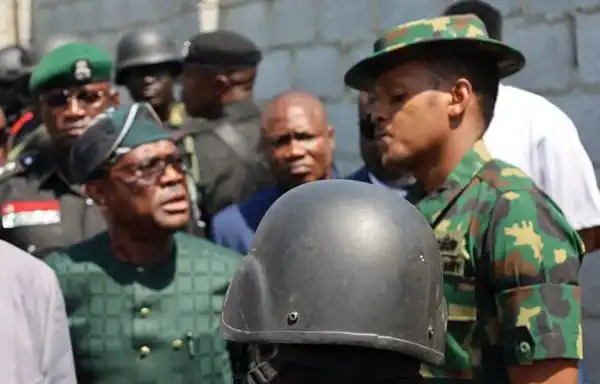
The viral exchange between Nyesom Wike, the Minister of the Federal Capital Territory (FCT), and a military officer in Abuja today has once again thrown up a fundamental question about power, authority, and the culture of respect in Nigeria’s public space. The incident, which drew instant reactions online, was not merely about a verbal disagreement between a minister and a soldier; it was a telling reflection of how public office is often misunderstood and abused by those who wield it.
From every indication, what transpired was a classic case of misplaced entitlement. Wike, visibly agitated, sought to compel obedience from a military officer who was, by all standards, performing his duty within the boundaries of his command structure. The officer’s refusal to yield to Wike’s directives was not an act of insolence; it was a demonstration of discipline, professionalism, and fidelity to the established chain of command.
In the military, obedience is sacred, but it is also structured. Soldiers are trained to take orders from their immediate superiors, not from passing politicians or public officials who may fancy themselves as all-powerful. The hierarchy in the armed forces is not arbitrary; it is an institutional safeguard against disorder, abuse, and confusion. Therefore, when Wike attempted to extract deference by virtue of his position as minister, he was asking the officer to violate one of the most fundamental principles of military service, loyalty to one’s immediate commander.
To the discerning observer, what played out today was more than a momentary misunderstanding. It underscored a deeper problem with the mindset of some Nigerian political elites; a mindset that equates authority with domination, and public service with personal exaltation. Wike’s approach to governance, both as a former governor and now as FCT minister, has consistently been laced with aggression and theatrics. His leadership style thrives on confrontation and spectacle, often at the expense of decorum and mutual respect.
However, public service, at its core, demands humility. It demands recognition that every role, from the soldier at the checkpoint to the minister in the office, contributes to the same national machinery. True leadership is not about shouting orders or brandishing titles; it is about earning respect through fairness, empathy, and restraint.
Unfortunately, Wike has, repeatedly, mistaken fear for respect. He appears to believe that authority must be projected through loudness, rather than exercised through quiet strength. However, the truth remains that respect, especially in the public space, is never imposed, it is earned through conduct. Nigerians have seen enough of leaders who demand subservience but show little courtesy to those below them.
It is worth recalling that this is not Wike’s first public clash with security personnel. Many will remember the 2020 incident involving a Department of State Services (DSS) officer during an attempted arrest of Dr. Joy Nunieh, the then Managing Director of the Niger Delta Development Commission (NDDC), in Port Harcourt. Wike stormed her residence in dramatic fashion, claiming to “rescue” her from alleged illegal arrest. Nevertheless, in his characteristic bravado, he clashed with security agents in a manner that blurred the lines between lawful intervention and political showmanship. That episode, much like today’s, left Nigerians divided, not because of the legality of his actions, but because of the unnecessary hostility and theatrics that accompanied them.
If Wike truly desires to be respected as a public officer, then he must begin by respecting the institutions that make governance possible. Every soldier, police officer, civil servant, or cleaner on duty represents the face of government at some level. To demean them is to undermine the system itself. The arrogance that often accompanies power in Nigeria has done untold damage to the social fabric, eroding public trust and deepening the disconnect between the governed and those who govern.
A military officer at a checkpoint or on assignment is not an errand boy for politicians. His loyalty is to the Nigerian state, not to an individual in office. The constitution and the internal regulations of the military are explicit about this. Even the President, as Commander-in-Chief, gives orders through proper channels, not by casually barking commands at officers in the field. It was, therefore, unreasonable for Wike to expect instant compliance simply because of his ministerial position.
Wike’s temperament, no doubt, is both his strength and his weakness. He is known to be decisive, assertive, and bold, qualities that, when rightly deployed, can drive reform and discipline. However, when those same qualities slip into arrogance and intolerance, they become liabilities. The Abuja altercation reveals a recurring pattern of unchecked aggression, one that does not align with the decorum expected of a federal minister.
This same abrasive streak was evident during his tenure as governor of Rivers State, when he was caught on camera speaking harshly and dismissively to a traditional ruler in public, chastising the monarch for allegedly failing to stand up to greet him. That episode, widely condemned at the time, exposed Wike’s habitual disregard for decorum and respect for institutions that symbolize cultural authority. It was a moment that stripped away the veneer of political bravado and revealed an unsettling arrogance that often undermines his otherwise forceful leadership style.
Given the foregoing backdrop, it is germane to opine that public officials must understand that governance is not a battleground of ego. Power is transient, and the same people one looks down upon today might hold the key to one’s legacy tomorrow. A military officer, for instance, may not have political clout, but he embodies the principles of order and discipline, values that public officers like Wike ought to emulate.
There is also a moral dimension to this debate. Respect is one of the few currencies that still command value in public service. It builds cooperation, enhances efficiency, and fosters peace. When leaders show respect for those performing their duties, they strengthen the moral authority of their own offices. However, when they resort to intimidation and public embarrassment, they erode that authority and expose their insecurity.
The irony is that Wike himself constantly demands respect from subordinates, colleagues, and even political rivals. Yet, respect cannot exist in a vacuum. It is reciprocal, a two-way street that requires mutual recognition of worth. To demand it while denying it to others is hypocrisy.
The office of the FCT Minister is a prestigious one. It carries enormous responsibility, not just in managing Nigeria’s capital city, but also in symbolizing order, civility, and leadership at the heart of the nation. When the occupant of that office publicly berates a soldier or any security officer, it sends the wrong message. It portrays the minister as impulsive, authoritarian, and disrespectful of institutions, traits that do not inspire confidence in a democracy already struggling under the weight of impunity.
As Nigerians continue to discuss today’s episode, one hopes Wike will reflect deeply on what it means to lead. Leadership is not about commanding obedience through fear. It is about inspiring cooperation through respect. The very idea of governance collapses when power becomes performative, when officeholders see every encounter as an opportunity to assert dominance rather than serve.
Wike must learn to pause before he pounces, to reflect before he reacts, and to respect before he demands respect. A leader who cannot control his temper in public will always find himself at odds with the very people he is meant to inspire.
In the final analysis, this latest confrontation should serve as a cautionary tale, not just for Wike but also for every public servant in Nigeria. The trappings of power are fleeting, but the memory of one’s conduct lingers. If Wike truly wishes to be remembered as a reformer rather than a bully, he must begin by embodying the virtues that sustain true leadership, humility, restraint, and respect.
Respect, after all, is reciprocal. In addition, for a man in Wike’s position, respecting others, especially those who serve under difficult conditions, is not just a moral duty but a political necessity. If he cannot respect people, he should at least respect the office he occupies. For in doing so, he preserves not just his dignity, but that of the government he represents.