
Opinion
Constitution and Democracy -By Tomy Michael
The public also bears the responsibility of safeguarding democracy against regression. Claiming fundamental rights must be accompanied by the fulfillment of fundamental obligations; citizens should not simply demand rights but also meet their duties to ensure a balanced outcome. The 1945 Constitution of the Republic of Indonesia stands as the ultimate reference, embodying the source of sovereignty that must be upheld.

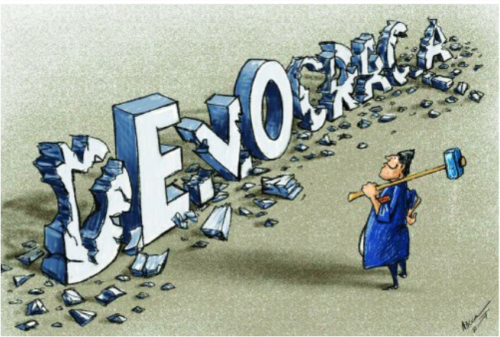
The Unitary State of the Republic of Indonesia implements a democratic form of government as enshrined in the 1945 Constitution of the Republic of Indonesia (UUD NRI 1945). This implies that the Constitution represents a compact between the people and the authorities to address shared challenges—challenges rooted in the principle that sovereignty resides with the people and is exercised in accordance with the Constitution. The essence of a democracy lies not merely in the written codification of the rights and obligations of both parties, but in their actual implementation to prevent arbitrary actions.
Although Indonesia conducts direct general elections and acknowledges the Athenian model of the 5th century BCE—where citizens participated directly in decision-making via the *ekklesia*, allowing every male citizen to cast a vote—the actual practice often fails to uphold the true spirit of elections. Often, the process serves merely to satisfy formal legal requirements, while underlying issues persist: restrictions on freedom of expression, pressure exerted on vulnerable groups, and significant obstacles to the fulfillment of constitutional rights.
Article 28E, paragraph (3) of the 1945 Constitution stipulates that “everyone has the right to freedom of association, assembly, and expression,” establishing that this inherent human freedom is to be protected by the state. Furthermore, Article 28F states that “everyone has the right to communicate and obtain information for personal and social development, and the right to seek, obtain, possess, store, process, and convey information using any available channel.” This article supports the free flow of communication, thereby facilitating the proper functioning of democracy.
The state ought to safeguard these freedoms rather than restrict or suppress them by rejecting fundamental human inclinations. In constitutional practice, however, these freedoms frequently face problematic restrictions. Criticism of government policy is often perceived as a threat to political stability or public order. Within the framework of democracy, criticism represents a form of state-society dialectic wherein public ignorance constitutes an issue the state must address, and vice versa. The stifling of democracy does not always occur overtly through repressive measures; at times, it is also influenced by artificial intelligence. For instance, algorithms generated by artificial intelligence can produce impacts that are sometimes beyond state control or that serve as a pretext for justification.
In modern democracies, restrictions on freedom are often legally imposed through regulations, administrative policies, or specific legal instruments. This trend undermines civil society and poses a danger to the democratic rule of law. Under the rule of law, state power must be constrained by law and subject to public oversight. Public criticism is a vital component of the checks and balances essential to democracy; when such criticism is curtailed, power risks operating without adequate control. Consequently, the space for public participation shrinks, allowing the government to act dominantly without effective supervision.
Restrictions on freedom are frequently justified in the name of national stability or public order. Yet, democracy requires a space for debate, and differing opinions are an indispensable part of political life. During the “Guided Democracy” era, power was concentrated in the presidency, and political freedoms were significantly curtailed. A similar pattern emerged during the “New Order” era, characterized by political stability that shifted according to the ruler’s will. Even the digital era—which ought to expand freedom of expression—presents new challenges for democracy.
Social media has become a new public arena for citizens to voice criticism and political aspirations, though it is also influenced by algorithms and the presence of anonymous accounts. Furthermore, access to the digital realm remains uneven across regions due to disparities in internet infrastructure. Online public expression can be monitored, subjected to legal action, or even restricted through specific policies. This situation demonstrates that technological advancement does not automatically strengthen democracy if the state employs technology as an instrument to control the populace.
From the perspective of constitutional law, this situation reveals a tension between state power and citizens’ freedoms. It is important to note that the state is obligated to ensure security and public order for all citizens while upholding constitutional rights. Arbitrary restrictions violate the principles of the rule of law and constitutionalism. Furthermore, weak oversight of power also increases the risk of silencing democracy.
In a constitutional democracy, the media, intellectuals, and civil society play a vital role in overseeing the conduct of government. However, when these institutions face excessive pressure, the democratic system of checks and balances fails to function optimally. Consequently, executive power becomes overly dominant, and the space for democracy shrinks. Therefore, strengthening constitutional democracy is crucial for Indonesia; we must not remain a developing nation indefinitely.
Modern state principles must be integral to the evolution of democracy. This is essential because democracy itself—much like theocracy, where tracing divine authority can be difficult—can be viewed negatively if not properly grounded. Democracy should not be understood merely as a matter of electoral procedures or the periodic transfer of power. It must be realized through the tangible protection of civil liberties, respect for criticism, and an open public sphere. The government must recognize that criticism is not a threat to the state but rather a form of citizen participation in democratic life.
The public also bears the responsibility of safeguarding democracy against regression. Claiming fundamental rights must be accompanied by the fulfillment of fundamental obligations; citizens should not simply demand rights but also meet their duties to ensure a balanced outcome. The 1945 Constitution of the Republic of Indonesia stands as the ultimate reference, embodying the source of sovereignty that must be upheld. The state is not a metaphysical abstraction but a tangible entity capable of resolving the challenges it faces.
Tomy Michael
Faculty of Law, Universitas 17 Agustus 1945 Surabaya
tomy@untag-sby.ac.id



























You must be logged in to post a comment Login