Africa
Expediency Of Wearing Demolition Exercises In Lagos A Human Face -By Isaac Asabor
Humanity is not weakness. Compassion is not inefficiency. Lagos can enforce its laws and still protect lives. It can pursue development without trampling dignity. Until it does, every demolition will echo not just with falling concrete, but with the unanswered cries of those who paid the ultimate price for a city’s ambition.

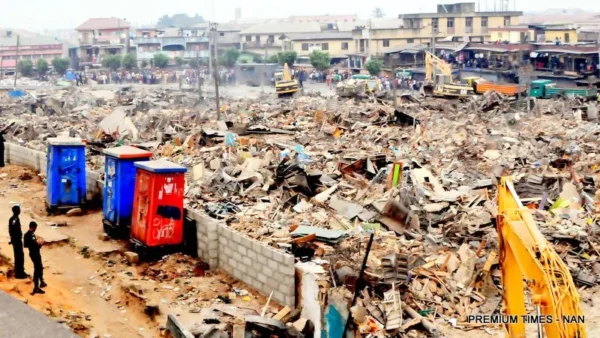
There is a sound that follows the demolition of a home, and it is far more haunting than the roar of excavators or the crash of collapsing concrete. It is the sound of lives unraveling in real time: the piercing cries of mothers searching for missing children, the mute shock of elderly men watching decades of toil reduced to rubble, and the bewildered questions of children who cannot grasp why the place they called home has suddenly become a crime scene. In Lagos, that sound has become disturbingly familiar, and tragically lethal.
Lagos is a city in a hurry. It builds fast, enforces fast, demolishes fast. It prides itself on being Africa’s commercial heartbeat, a megacity racing toward global relevance. Yet in this relentless pursuit of modernity, something fundamental is routinely sacrificed: the humanity of the people who inhabit spaces suddenly branded as “illegal,” “unsafe,” or obstructing the “right of way.” Demolition, in Lagos, has evolved into a blunt policy instrument, executed with force, justified by paperwork, and stripped almost entirely of empathy.
No reasonable person disputes the necessity of urban planning. No one argues that buildings under high-tension power lines are safe, or that structurally dangerous environments should be ignored. Law, order, and public safety matter. What is deeply contested, however, is the manner of enforcement: the cold, coercive, and often violent approach that treats human beings as afterthoughts, and the devastating human cost that inevitably follows.
Recent demolition exercises in waterfront communities such as Makoko and Iyana-Oworo (Oworonshoki) have exposed this cost in its rawest form. While the Lagos State government maintains that the demolitions were carried out in the interest of public safety, particularly around high-tension power lines, residents, community leaders, and civil society groups paint a far darker picture: one of panic, forceful displacement, and deaths that may never find their way into official records.
In Makoko, between late December 2025 and January 2026, residents and a civil society coalition, the Coalition Against Demolitions, Forced Evictions, Land Grabbing and Displacements in Lagos, allege that at least twelve people lost their lives as demolition activities intensified. These were not abstract numbers. They were infants, teenagers, and elderly citizens whose only crime was living at the intersection of poverty and policy.
Morenikeji Amossou was just three weeks old. She reportedly died amid the chaos as bulldozers moved in and families scrambled desperately to salvage belongings. Epiphany Kpenassou Adingban lived for only five days. Residents say police fired tear gas during enforcement, triggering respiratory distress and convulsions that proved fatal. Another newborn, unnamed in reports, allegedly died while being ferried by canoe after the family’s home had already been destroyed. A child’s first journey in life became her last, not in a hospital, but on open water, fleeing rubble and terror.
The elderly were not spared. Albertine Ojadikluno, a 70-year-old woman, reportedly died from shock and respiratory complications linked to tear gas exposure. Another elderly woman, whose name never entered any official statement, is said to have collapsed and died upon witnessing the destruction of the home she had lived in for decades. These were not criminals. They were not threats to public safety. They were citizens.
Some deaths were quieter, occurring away from television cameras and government press releases. At least three residents reportedly died in boats or makeshift shelters where they sought refuge, overcome by exposure, illness, and the absence of medical care. The demolitions did not merely destroy structures; they dismantled fragile survival systems that kept vulnerable people alive.
In Iyana-Oworo and the wider Oworonshoki axis, the pattern repeated itself with chilling familiarity. Between October and December 2025, demolition exercises were reportedly linked to multiple fatalities. Esther Eniefiok was only 15 years old. Accounts suggest she died from severe emotional distress and panic following the arrival of the Lagos State Task Force and the destruction of her community. She was not crushed by falling walls; she was crushed by fear.
An elderly man known simply as “Baba Aro” reportedly died within 24 hours of the same demolition wave in November 2025. Earlier, in October, reports alleged that a newborn and a five-year-old child died during the initial chaos of clearing waterfront structures. These deaths did not occur in isolation; they unfolded in an atmosphere saturated with force, confusion, and terror.
The Lagos State government has denied knowledge of these specific deaths, insisting that its personnel do not “knowingly kill anybody” and that investigations would be required to establish causes. But for grieving families, official denials offer no comfort. Investigations do not restore lost children. Silence and non-acknowledgment only deepen trauma and entrench distrust.
For those affected, a house is never just a building. It is memory set in concrete, years of labour, saving, and sacrifices. It is where children took their first steps, where families shared meals, where prayers were whispered in the dark. When a bulldozer erases such spaces without compassion, it does not merely destroy property; it uproots lives and fractures entire communities.
Children bear scars long after the dust settles. Education is disrupted. Health deteriorates. Emotional stability is shattered. Yet in the cold lexicon of officialdom, these realities are invisible. The language of demolition is clinical and detached: “illegal structures,” “encroachment,” “non-compliance.” There is no vocabulary for grief.
Even more corrosive is the perception, often reinforced by reality, of selective enforcement. Lagosians routinely observe flagrant planning violations by the wealthy remain untouched, while informal settlements are flattened with ruthless efficiency. This inconsistency fuels resentment and reinforces the belief that demolition is less about safety and more about power.
Wearing demolition a human face does not mean abandoning the law. It means enforcing it with empathy, fairness, and foresight. It begins with honest engagement: clear notices, sustained dialogue with communities, and explanations delivered early, not barked through megaphones on demolition day. It requires realistic timelines that allow families to relocate without panic. It demands genuine resettlement and compensation frameworks that exist beyond glossy press statements.
Demolition should be a last resort, not a reflex. In many cases, regularization, redesign, or phased relocation could achieve safety objectives without mass displacement. Urban planning is not solely about clearing land; it is about managing people humanely.
Lagos must also confront the hypocrisy at the heart of its demolition culture. Many so-called “illegal” structures exist because of systemic failures: corruption in planning approvals, chronic housing shortages, and explosive population growth. Punishing the poor for these failures is not justice; it is a refusal to accept institutional responsibility.
A truly world-class city is not defined only by bridges, flyovers, and skylines. It is judged by how it treats its most vulnerable. Development that leaves babies dead, elders in shock, and teenagers traumatized cannot be sold as progress. That is development stained with blood, even if no one officially acknowledges it.
Humanity is not weakness. Compassion is not inefficiency. Lagos can enforce its laws and still protect lives. It can pursue development without trampling dignity. Until it does, every demolition will echo not just with falling concrete, but with the unanswered cries of those who paid the ultimate price for a city’s ambition.