Africa
Globetrotting Presidents: When Nigeria’s Leaders Prefer The Skies To The Soil -By Isaac Asabor
Ambassadors are appointed to do the handshakes, the negotiations, and the symbolic dinners. Presidents are elected to fix electricity, secure villages, stabilize the naira, and provide jobs. Until Nigerian leaders understand this, Aso Rock will remain less of a seat of power and more of a check-in counter for another needless foreign trip.

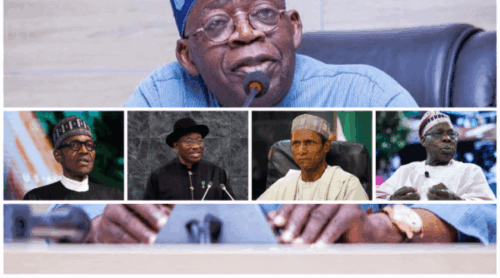
One undeniable truth about Nigeria’s leadership since 1999 is that Aso Rock has become less of a seat of power and more of a departure lounge. From Olusegun Obasanjo through Umaru Musa Yar’Adua, Goodluck Jonathan, Muhammadu Buhari, and now Bola Ahmed Tinubu, the presidency has cultivated a troubling obsession with foreign trips. Sadly, this “culture of globetrotting” continues to deny the country the steady, present leadership it desperately needs.
Since May 29, 2023, President Bola Ahmed Tinubu has spent more than 150 to 180 days abroad, making at least 38 trips to 26 countries. France, in particular, seems to have become a second home, with Tinubu making eight visits there in less than two years, some tagged “private,” others “working,” and a few cloaked in medical discretion.
The travel tab is eye-watering. As gathered, in his first six months alone, over ₦3.4 billion was spent on travel, overshooting the official budget. By 2024, travel costs in foreign exchange allocations ballooned to ₦23 billion. All this, at a time when millions of Nigerians grapple with inflation, insecurity, and rising poverty.
But let us not pretend this is new. Tinubu did not invent the art of globe-hopping presidents, he merely perfected it.
Obasanjo, is no doubt reputed to be the pioneer jet-setter as president. Former President Olusegun Obasanjo who presided over the affairs of Nigeria from 1999 to 2007 was the pioneer of post-military era presidential jet-hopping. In his first term, he was on the road almost every month, chasing debt relief and foreign investment. By the time he left office, Obasanjo had clocked well over 100 foreign trips, earning him criticism for being more comfortable in international conferences than at home dealing with erratic power supply and an oil-dependent economy.
Critics argued then, as now, that Nigeria had embassies and ambassadors capable of sustaining diplomatic conversations. Obasanjo often defended his travels as necessary for rebranding Nigeria after years of military dictatorship. Yes, debt relief eventually came in 2005, but the culture of excessive presidential travel was cemented.
President Umaru Musa Yar’Adua also presided over the affairs of Nigeria from 2007 to 2010 was not so much a globetrotter as he was absent, mostly in Saudi Arabia for extended medical trips. His presidency underscored a different problem: Nigerians were left in the dark about the health and whereabouts of their leader for months. The “doctrine of necessity” that made Goodluck Jonathan Acting President arose from this very vacuum.
Yar’Adua’s frequent medical absences proved one thing: when the president is perpetually abroad, whether for health or diplomacy, governance suffers. Tinubu should have learned from that painful chapter.
President Goodluck Jonathan who was also president from 2010 to 2015, also kept the presidential jets busy. From attending summits in China, France, and South Africa to repeated UN General Assembly trips in New York, Jonathan’s travels were criticized for being heavy on pomp but light on results. In 2013 alone, he embarked on over 20 foreign trips, many of them to woo investors that never came.
Jonathan, like Obasanjo, argued that the trips were necessary to sell Nigeria as a destination for foreign investment. But the reality is that while the president was shaking hands abroad, Boko Haram was tearing communities apart at home. The disconnect between foreign showmanship and domestic crises grew starker.
If Obasanjo built the culture and Jonathan normalized it, Muhammadu Buhari of blessed memory, who presided over the affairs of Nigeria from 2015 to 2023, industrialized it. Buhari was so frequently abroad for medical reasons, particularly in London, that “London Clinic” became a running joke among Nigerians. In fact, between 2015 and 2019, Buhari spent over 170 days abroad on medical trips alone.
In his first term, he visited at least 25 countries, from China to the UAE, South Africa, France, and Germany, ostensibly for security, economy, and anti-corruption discussions. Yet Nigeria remained bogged down by insecurity, dwindling revenues, and unemployment. Buhari’s absences left the country in a state of inertia, with Vice President Yemi Osinbajo occasionally stepping in to give the illusion of leadership.
By the time Buhari exited, Nigerians had grown tired of the presidential fleet’s near-constant take-offs and landings.
President Tinubu inherited this tradition and, instead of breaking it, has doubled down. Unlike Buhari, whose travels were mostly for health, couches his trips in the language of economic diplomacy. He claims to be courting investors in the U.S., France, Saudi Arabia, and the UAE. Yet, two years into his tenure, foreign direct investment remains sluggish, while Nigeria’s debt profile, inflation, and unemployment rise.
More damning is the fact that Nigeria has not had substantive ambassadors in many key countries since 2023, after Tinubu recalled them. If ambassadors are absent and the president is constantly abroad, then who is minding the shop at home?
At this juncture, it is germane to throw a cautionary insight to the problems that are inherent in globetrotting presidencies, and they cut across governance vacuums, diplomatic redundancy, wasted resources and meagre returns. Explanatorily put, when presidents are constantly abroad, crises at home fester. Tinubu was in Europe while over 150 villagers were killed in northern Nigeria in April 2025. His reaction came too late to calm public anger. In a similar vein, Nigeria maintains embassies, ambassadors, and consular staff worldwide. Why should the president act as a glorified ambassador-in-chief when others are already paid to do so?
Also in a similar vein, billions of naira are blown yearly on flights, accommodation, and estacodes. For a country in debt and struggling with foreign exchange shortages, this is irresponsible. And from the perspective of meager returns, it is germane to opine that after decades of foreign trips by presidents, Nigeria still suffers capital flight, investor apathy, and poor global image. The “ROI” (Return on Investment) of these travels is almost invisible.
At this juncture, it is expedient to ask, “What needs to change?” The foregoing question cannot be farfetched as Nigeria’s presidents must learn that statecraft is not measured in air miles. Effective diplomacy is about empowering ambassadors, giving them clear mandates, and holding them accountable. Presidential trips should be rare, strategic, and targeted reserved for major summits, high-level negotiations, or critical bilateral meetings.
Instead, what we have is a presidency addicted to foreign visibility while the nation burns quietly in the background. Tinubu, like his predecessors, seems unable to resist the allure of foreign podiums and photo-ops. Yet Nigerians did not elect him to be a global traveler; they elected him to govern a country on the brink.
From Obasanjo to Jonathan, from Buhari to Tinubu, Nigeria’s leaders have mistaken frequent flying for effective leadership. But a country battling insecurity, poverty, and economic dislocation needs a **home-front commander, not a frequent flier-in-chief.
Ambassadors are appointed to do the handshakes, the negotiations, and the symbolic dinners. Presidents are elected to fix electricity, secure villages, stabilize the naira, and provide jobs. Until Nigerian leaders understand this, Aso Rock will remain less of a seat of power and more of a check-in counter for another needless foreign trip.