
Africa
How Can Fubara Govern With Hijacked Executive Power? -By Isaac Asabor
The survival of Rivers State’s democracy depends on the answer to one blunt question: “How can Fubara perform as governor when he has already been stripped of his executive power?” Until that question is answered, Rivers people remain governed by shadows, not by the man they elected.

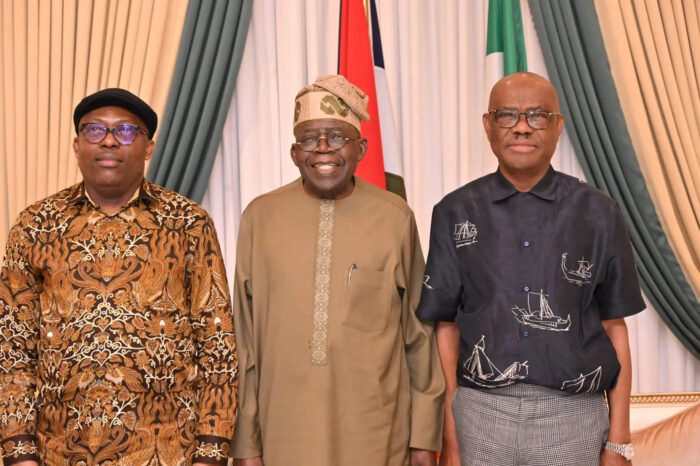
The essence of democracy is balance, between the ballot, the constitution, and the will of the people. Yet, in Rivers State, that balance appears dangerously tilted. Governor Siminalayi Fubara may bear the title of governor, but the question lingers: how can he truly govern when the weight of executive power seems to have been stripped away by forces outside the office he occupies?
The fingerprints of President Bola Tinubu and former Rivers State governor, now FCT Minister, Nyesom Wike, are everywhere in this unfolding drama. Through political maneuverings, backroom deals, and Abuja’s overbearing influence, Fubara finds himself boxed into a corner, a governor in name but not in control. The political script playing out suggests that Rivers is being ruled from two power centres: the Villa and Wike’s camp, while the duly elected governor is reduced to a ceremonial figurehead.
The Rivers political crisis which seemingly turned peaceful recently did not spring up overnight. Fubara, a career civil servant and technocrat, was catapulted into governorship largely under the political sponsorship of Wike. At the time of his emergence, he was widely seen as a loyal protégé, someone who would maintain continuity with Wike’s political dynasty while ensuring stability in the state. But as Nigeria’s political history repeatedly shows, protégés rarely remain loyal once the burdens of governance collide with the overbearing shadow of their benefactors.
It did not take long before tensions emerged between the two men. Wike, who transitioned into the powerful position of Minister of the Federal Capital Territory, continued to hold sway in Rivers politics. His loyalists dominated the state legislature, much of the cabinet, and other strategic structures. Fubara, however, began asserting himself as governor, taking decisions that reportedly unsettled the Wike camp. The clashes escalated until Rivers politics became a theatre of bitter rivalry, with Abuja often stepping in under Tinubu’s watch, not to mediate in fairness, but to keep both men tethered under presidential influence.
The “peace deal” brokered at Aso Rock, where Fubara was pressured into concessions that weakened his authority, is at the heart of today’s question: “Is he still the governor in practice, or has his mandate been auctioned off to political overlords?”
If true, this scenario raises disturbing implications. Democracy ceases to be democracy the moment the people’s mandate is hijacked. Rivers voters did not elect Wike by proxy, nor did they hand Tinubu the keys to their statehouse. They voted for Fubara, expecting leadership, accountability, and vision. Instead, they are served political theatre, a governor whose cabinet has been fractured, whose legislative support has been systematically undermined, and whose decisions appear constantly second-guessed or reversed by external power brokers.
This undermining of executive authority contradicts the constitution, which makes the governor the chief executive of the state. It also undermines the principle of separation of powers, which demands that state governments retain autonomy within the federal structure. By reducing Fubara’s office to a ceremonial seat, Abuja is not just weakening one man; it is eroding Nigeria’s federalism and insulting the democratic choice of Rivers people.
Beyond the presidency’s undue hijacking of Governor Fubara’s executive authority, the reinstated members of the Rivers State House of Assembly have been accused of overzealously intruding into the functions of the executive arm, raising fresh concerns about constitutional balance. Senior Advocate of Nigeria, Ebun-Olu Adegboruwa, speaking on Channels Television on T, cautioned the lawmakers to be circumspect and avoid encroachment, stressing that the principle of separation of powers is clearly enshrined in the Constitution. According to him, the legislature must respect its limits and allow Governor Fubara the space to discharge his mandate without constant interference.
Beyond the politics, the ordinary citizen is paying the price. Rivers State is too strategic to Nigeria to be toyed with in endless power games. Its oil wealth is central to national revenue, and its ports, industries, and human capital make it one of the most important states in the federation. A distracted, weakened, or incapacitated governor cannot drive the development agenda needed to improve roads, schools, healthcare, and infrastructure.
Already, the state is struggling with insecurity, youth unemployment, and the pressure of urbanization. The political paralysis means that pressing economic policies are stalled; governance suffers from inconsistency, and state projects risk being abandoned midway. If Fubara cannot exercise executive control, who answers to the people? And if nobody does, where does that leave Rivers citizens in their quest for better lives?
President Bola Tinubu’s role in the Rivers crisis cannot be ignored. As the nation’s leader, he carries the responsibility of protecting Nigeria’s federal structure. Yet, by intervening in a manner that appears to favor political expediency over constitutionalism, Tinubu risks setting a dangerous precedent. If state governors can be stripped of their powers and subjected to “peace deals” imposed from Aso Rock, then Nigeria is sliding back into the days when the presidency ruled by fiat, and governors were reduced to rubber stamps.
Federalism works only when states enjoy genuine autonomy. Tinubu himself was once a governor who fought battles against federal intrusion under former President Obasanjo. He should remember that what he resisted in Lagos is precisely what is happening in Rivers today. To allow this to continue is to betray not just Fubara but the very idea of statehood in Nigeria.
Nyesom Wike’s influence is equally problematic. Godfatherism has long been a cancer in Nigerian politics, reducing governance to the whims of powerful individuals who see elected offices as personal investments to be controlled from behind the scenes. Wike’s insistence on controlling Rivers after moving to Abuja smacks of political overreach. A true leader who believes in democracy must allow his successor to govern freely, even if differences arise. Anything less is a betrayal of the Rivers people, who should not be punished for voting in a successor Wike helped install.
The danger with godfatherism is that it breeds a climate of fear, dependency, and corruption. A governor under the constant threat of removal or political sabotage is unlikely to govern boldly. Instead, he tiptoes around sensitive issues, makes half-hearted decisions, and devotes more energy to survival than service. This, unfortunately, appears to be the situation in Rivers State today.
At this juncture, it is expedient to ask, “What choices remain for Fubara?” The answer to the forgoing question cannot be farfetched as Governor Fubara faces a defining test. Does he remain a subdued occupant of Government House, reduced to signing papers dictated by others, or does he assert his constitutional mandate and carve out independence for his administration? The first option offers temporary political peace but guarantees that his legacy will be defined as one of weakness. The second option is risky but affirms the democratic will of Rivers people and strengthens the office for future occupants.
History has shown that governors who bow perpetually to godfathers rarely end well. Those who stand firm, however, often earn respect, even if they face turbulence. Fubara must weigh whether he wants to be remembered as a governor who allowed himself to be stripped of power or one who, against all odds, defended the mandate entrusted to him by the electorate.
At this stage, what Rivers State desperately needs is a return to constitutional order. Tinubu must step back from manipulative interventions and respect the independence of state governments. Wike must accept that his time as Rivers governor has ended and allow his successor breathing space. And Fubara himself must rise above timidity and embrace the boldness that leadership demands.
The survival of Rivers State’s democracy depends on the answer to one blunt question: “How can Fubara perform as governor when he has already been stripped of his executive power?” Until that question is answered, Rivers people remain governed by shadows, not by the man they elected.
And if that persists, then Nigeria must admit a painful truth that our democracy is not about the people’s choice, but about the power struggles of political overlords.




















You must be logged in to post a comment Login