
Africa
Hunger Is Real — The Denial By APC Politicians Cannot Erase The Facts -By Isaac Asabor
History will record that in a time of hunger, Nigerians cried out. The question is whether their leaders will continue to deny their suffering, or whether they will finally confront it with honesty and action. One thing is certain: the facts are too stubborn to be erased.

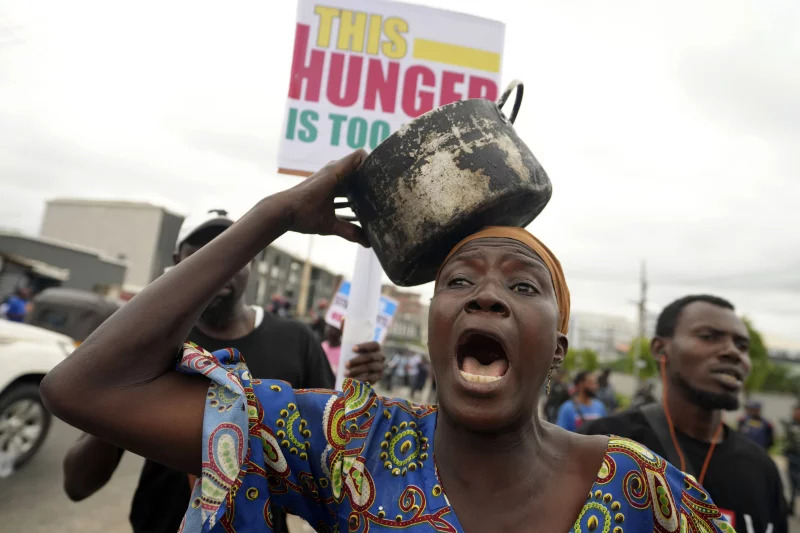
Every morning in Nigeria begins with a simple question for millions of households: Will there be food on the table today? Since May 29, 2023, when the APC administration assumed office, that question has become sharper, more urgent, and for many, the answer has been silence. While countless Nigerians skip meals, swap nutritious staples for cheaper substitutes, or rely entirely on roadside vendors for survival, many in the ruling party continue to downplay the crisis. Some hypocritically dismiss talk of widespread hunger as exaggerated, politically motivated, or a narrative fueled by the opposition. Yet the facts are stubborn. They remain visible in markets, in homes, and in the stomachs of children who now go to bed hungry. Denial, no matter how loudly proclaimed, cannot erase these facts.
The numbers speak for themselves. In May 2024, Reuters reported that food inflation in Nigeria rose to 40.66 percent year-on-year, one of the highest figures recorded in decades. By June 2025, the National Bureau of Statistics reported food inflation at around 38.2 percent. While officials rushed to portray this as a “drop” from May’s peak, the truth is that for ordinary families, the prices of rice, beans, garri, maize, and other staples remained unbearably high. A marginal statistical decline is meaningless when households still spend over 60 percent of their income on food and yet cannot meet their daily nutritional needs. The United Nations and World Food Programme further underlined the crisis by warning that nearly 31 million Nigerians were facing acute food insecurity and would require immediate assistance. These are not the words of political opposition figures but the findings of international agencies that measure hunger by objective standards.
The human testimonies are even more compelling than the statistics. In Lagos, a Buka (local eatery) owner, Mrs. Romoke Fashina, explained how the cost of a plate of eba rose from N1,500 to N2,500 in just a matter of months, while a simple plate of rice jumped from N700 to N1,500. As a result, many of her customers turned to cheaper roadside food vendors, and even she had to adjust her operations to survive. A roadside vendor, Ms. Kelechi Adams, said that her business was under immense pressure because of the daily increments in food items. For her, staying in business meant absorbing losses or hiking prices, both of which threatened her livelihood. Across markets in Lagos, Oyo, Delta, Rivers, Anambra, Abuja, Sokoto, Kano, and Kaduna, traders and consumers alike tell the same story: no real relief in the prices of food staples despite official pronouncements of improvement. For many families, meat has disappeared from the table, replaced with smaller portions of vegetables or cheaper substitutes. For the poorest, even garri, once the ultimate fallback meal, has become an expensive luxury.
Against this backdrop, the refusal of APC politicians to acknowledge the crisis is both galling and dangerous. Just recently, for example, when former Vice President Atiku Abubakar raised concerns about worsening hunger and warned of social unrest, the Presidency was quick to dismiss his remarks as “misleading.” Spokespersons went further, accusing the opposition of incitement and insisting that the economy was “on the path of recovery.” Felix Morka, the APC’s national publicity secretary, went as far as saying that Atiku was “out of touch with reality.” Around the same time, President Bola Tinubu’s spokesperson, Bayo Onanuga, described narratives of widespread hunger as “grossly misleading” and suggested that comparisons with historic revolutionary events were exaggerated. These instances are not slip-ups; they form a consistent pattern. Whenever hunger and suffering are raised, the ruling party pivots to highlighting “positive developments,” “falling inflation trends,” or alleged opposition mischief.
Ironically, President Bola Tinubu on Friday assured Nigerians that the nation has overcome the worst phase of its economic difficulties, declaring that the hardship experienced in recent months would soon give way to prosperity. The president spoke at the coronation of the 44th Olubadan of Ibadanland, His Imperial Majesty, Oba Rashidi Ladoja, even as he expressed gratitude to Nigerians for their patience and support since he assumed office.
The irony is glaring. While officials celebrate marginal improvements in inflation numbers, the lived reality for ordinary Nigerians is worsening. For example, even as official statistics reported a decline in food inflation from 40.66 percent to about 38 percent, consumers in markets across the South West and South East continued to report that their food bills were climbing. Market surveys conducted by journalists confirmed what people already knew: that the so-called improvements had not translated into affordability. Households continued to reduce the number of meals they ate daily, cut out proteins, or switch entirely to cheaper, less nutritious options. Such adaptations are not evidence of resilience; they are signs of desperation.
Why then the denial? The reasons are obvious. Admitting widespread hunger is tantamount to admitting policy failure. The removal of fuel subsidies, the chaotic exchange rate reforms, and austerity measures implemented since 2023 have had catastrophic effects on ordinary Nigerians. While the reforms may have been designed with long-term stabilization in mind, their immediate consequences have been poverty and hunger. For a party that rode to power on promises of renewed hope, acknowledging these realities would be politically damaging. Denial becomes the default posture. Politicians can then claim that hunger is a creation of opposition propaganda, or that Nigerians are merely exaggerating. It is easier to play with numbers than to confront the suffering of people in markets and villages.
But denial carries costs. First, it erodes trust. Citizens who watch their leaders insist there is no hunger while their own children go hungry will not believe official pronouncements again. That breakdown of trust is dangerous in any democracy. Second, denial delays action. Recognizing a crisis is the first step toward addressing it. When politicians refuse to admit the obvious, they also refuse to mobilize the resources necessary for relief. Third, denial fuels anger. Hunger is destabilizing. The United Nations has already warned of an unprecedented hunger crisis in Nigeria. History shows that when a hungry population is consistently ignored, the result is social unrest.
There is still a chance to change course, but it requires candor and courage. First, government must implement targeted emergency relief, not the broad and wasteful palliatives that disappear into corrupt networks. Transparent, corruption-resistant cash transfers to the poorest households will have immediate impact. In regions facing acute food shortages, in-kind distribution of rice, beans, and maize should complement cash transfers. Second, smallholder farmers must be supported with subsidized inputs, access to credit, and protection from insecurity. When farmers cannot plant or harvest, the entire nation suffers. Third, exchange rate and inflation management must consider food security. Nigerians cannot be expected to endure endless economic experiments while their stomachs are empty. Fourth, transparency must be non-negotiable. Independent monitoring of relief programmes will prevent leakages and rebuild public trust. Finally, government must stop politicizing hunger. This is not an opposition talking point; it is a national emergency.
The blunt truth is that hunger in Nigeria is not a rumor; it is a fact. It is seen in the children who now eat one meal a day instead of three, in the mothers who skip meals to feed their families, in the stampedes at rice distribution events, and in the testimonies of market traders who watch their customers shrink in number daily. Denying it does not make it vanish. It does not put food on the table. It does not erase the facts. Hunger can only be fought with policy, not propaganda. And the longer our leaders hide behind denial, the deeper the crisis will become.
History will record that in a time of hunger, Nigerians cried out. The question is whether their leaders will continue to deny their suffering, or whether they will finally confront it with honesty and action. One thing is certain: the facts are too stubborn to be erased.























You must be logged in to post a comment Login