
Opinion
Is Lagos Sinking? -By Kator Ifyalem
Lagos does not have a flooding problem that will be solved with bigger drains alone. It also has a ground stability problem, driven by how the city manages the water beneath it and the ground around it, and both of those are things engineers know how to measure, monitor, and manage. The resource should be treated as infrastructure worth protecting, not just real estate worth selling. The city is going down, a few millimetres at a time, in full view of the data. The only question is how much of it we are willing to notice before it becomes difficult to ignore.

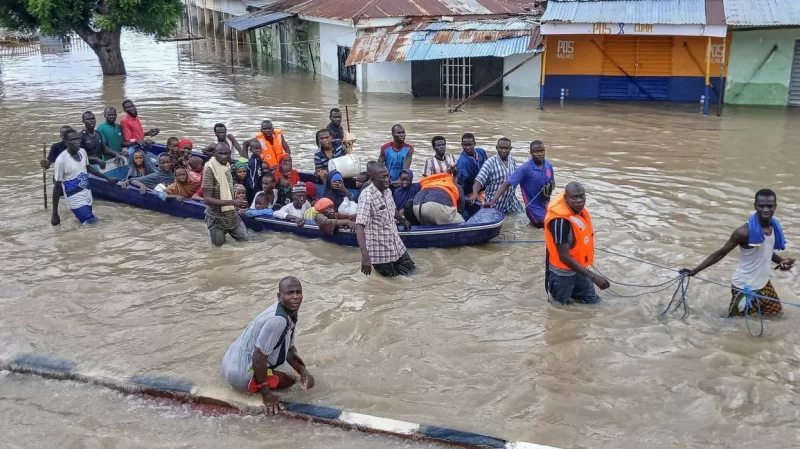
Every rainy season, Lagos floods, and every rainy season, the conversation is the same: blocked drains, overwhelmed canals, a stressed government. This is familiar, but not wrong, however, incomplete. Underneath the flooding headlines is a slower, quieter, and another story, the ground itself might be going down.
A peer-reviewed geodetic study combining GPS, Envisat, Sentinel-1, and GRACE satellite data found subsidence rates ranging from about 2mm a year in the most stable areas to as high as 87mm a year in the worst affected coastal zones, with the fastest rates concentrated around coastal districts and areas carrying heavy structures built on reclaimed areas. At the high end, it is nearly 1m of ground loss in a decade, in a city that already sits barely above sea level.
This occurrence is not erosion in the simple sense of waves eating a beach, though that is happening too. Subsidence is the ground beneath entire neighbourhoods physically compacting and sinking, and it changes how we should be thinking about flood risk, safety of structures, and water policy.
The subsidence might be driven by three things acting together, and it is worth naming them precisely because each one is a policy failure as much as a technical one.
Groundwater overextraction – Public water supply has never kept pace with its population, and the gap has been filled, quietly, informally, by private boreholes for decades. Every estate, every hotel, every factory that can afford a drilling rig has sunk its own well into the aquifer. Nobody is tracking the cumulative drawdown. When water is pumped out of the subsurface layers faster than it can be recharged, the pore spaces that held the water collapse, and the ground above settles. This is basic soil mechanics, consolidation under reduced pore pressure, playing out at the scale, largely unmonitored. The same geodetic study directly ties this overextraction, combined with land reclamation, to the flooding, aquifer contamination, and saline water intrusion the city is already experiencing.
Rapid, uncontrolled land reclamation – Much of the most valuable real estate in Lekki, Victoria Island, Ikeja, Badagry, sits in zones independently identified by satellite radar analysis as subsidence hotspots, where alluvial soils, heavy building loads, and groundwater withdrawal combine. Reclaimed land settles under its own weight for years, sometimes decades, after it is built. When that consolidation is compressed for speed and profit rather than managed with proper pre-loading and monitoring, buildings and roads may inherit a foundation problem before the first pile is even driven.
The sand economy feeding the reclamation – That fill sand has to come from somewhere, and it is coming from the lagoon and coastline itself. According to reports, up to 84 percent of the Lagos shoreline has been lost over the past 50years, retreating at an average rate of 2.64m a year, erosion linked in part to urbanisation and the sand mining trade that supplies it. Coastal communities like Akodo-Ise and Idotun in Ibeju-Lekki are already watching their land disappear, with residents and researchers pointing directly at dredging as a driver, removing sand from the seabed strips away the natural buffer that would otherwise absorb wave energy, so the coast erodes faster once this is gone. It is a closed loop, mine one part of the coast to build up another part that will eventually subside anyway.
Flooding from blocked drains is bad, but it is a maintenance problem, visible, fixable, political. Subsidence is a foundations problem, which is largely invisible until it becomes visible.
A road engineered to a certain drainage gradient stops draining properly when the ground settles unevenly. A seawall or flood barrier designed for the sea level today becomes inadequate not because the sea rose, but because the land it is protecting sank. Saline water intrudes further into freshwater aquifers as the pressure balance between fresh groundwater and seawater shifts, a slow feedback loop where the extraction causing subsidence also degrades the water people are extracting it for. The building risk is no longer theoretical. A dedicated study modelling subsidence against actual building collapse locations found the pattern is not random, differential ground settlement is a measurable contributor to structural failure risk, with several square kilometres of land, and thousands of buildings, in zones where subsidence related structural damage is a realistic near-term hazard.
Lagos is not alone in this. Jakarta records average subsidence of about 13.7mm (over 70mm in specific hotspots) a year and is a major reason Indonesia is relocating its capital. Bangkok and Tianjin appear on the same global list of coastal subsidence hotspots. What sets Lagos apart is that this is a well-documented global phenomenon with well-understood engineering responses, and almost none of that institutional memory has made it into planning and regulations in Lagos at this time.
Addressing the problem requires treating groundwater and land as engineered systems rather than limitless resources. The government should require rigorous geotechnical monitoring for reclaimed land before development, establish a real-time subsidence monitoring network to guide planning, and regulate groundwater extraction, sand dredging, coastal erosion, and land reclamation as a single interconnected system.
The Bottom Line, Lagos does not have a flooding problem that will be solved with bigger drains alone. It also has a ground stability problem, driven by how the city manages the water beneath it and the ground around it, and both of those are things engineers know how to measure, monitor, and manage. The resource should be treated as infrastructure worth protecting, not just real estate worth selling. The city is going down, a few millimetres at a time, in full view of the data. The only question is how much of it we are willing to notice before it becomes difficult to ignore.























You must be logged in to post a comment Login