Breaking News
Professor Irina O. Abramova: Closing the Gender Gap in Russian-African Relations, by Kestér Kenn Klomegâh
Japanese trained and educated Stergomena Tax, in her career, became the as the Executive Secretary of the Southern African Development Community [SADC]. She visited moscow a couple of times, but her attempts in bring SADC closer to Russia saw little results. Until today, the regional organisation SADC has a very weak relations with the Russian Federation.

While analysing several reports after the collapse of the Soviet era, thus opening a new chapter in relations with and the strategic importance for Africa, it is very noticeable to count only on finger tips women who devoted their [proactive] energy and enthusiastic power to strengthening relations between Russia and Africa.
It is well-known the Soviet-African relations’ historical and chronological stages, its evolutionary processes from Soviet times and the post-Soviet period until today. Russia is showing increasing its influence in Africa. Conferences, meetings and forums proliferate both ways, attracting quite a number of dignitaries from government, ministries, departments, institutions and agencies.
Women’s role in Russian-African relations has equally fundamental significance, an aspect that arguably has to be taken into serious account. With this in mind, there is the necessity to share views and thoughts on existing challenges and opportunities, and other pertinent issues affecting women and development of relations between Russia and Africa. We are also categorically referring to the topic of women’s empowerment in politics, economy and social spheres, as well as on international stage.
There are three women who came to mind: the Chairwoman of the Federation Council, Valentina Matviyenko, then South African Dr Nkosazana Dlamini Zuma and Tanzanian Stergomena Lawrence Tax.
Japanese trained and educated Stergomena Tax, in her career, became the as the Executive Secretary of the Southern African Development Community [SADC]. She visited moscow a couple of times, but her attempts in bring SADC closer to Russia saw little results. Until today, the regional organisation SADC has a very weak relations with the Russian Federation.
Author of this article, in a long-ranging interview in October 2018 with the Executive Secretary of the Southern African Development Community, Stergomena Tax, discussed aspects of SADC-Russia’s economic cooperation. She also focused on strategies and challenges as well as future perspectives. One distinctive phrase she told me was “Russia has a long history of bilateral engagements with the Southern African countries, which constitute the Southern African Development Community, a Regional Economic Community [REC].”
According to her, it was difficult obviously to speak for Russia, but the general overview of why international partners and investors would consider SADC an attractive or strategic investment partner, the region is peaceful and stable. The southern African states have largely relied on multilateral and regional development financial institutions to fund their development projects, which Russia could not provide and guaranteed.
In the case of Nkosazana Zuma, she still remains an indisputable trailblazer in the uplifting and empowerment of women. Her career as a struggle activist and politician is testimony to her indestructible and courageous spirit. In 1999, then President Thabo Mbeki appointed Nkosazana Zuma as Minister of Foreign Affairs.
In this role, she actively championed South Africa’s foreign policy which centred on the promotion of human rights, stability, peace, collective development and advancement of this continent. It was during her tenure as Minister of Foreign Affairs that the African Union was launched in 2002.
In July 2012, Nkosazana Zuma was elected Chairperson of the African Union Commission. This was a major achievement in the sense that a woman and indeed a candidate of the southern region was successfully elected to this high post. She dealing with Russia, to promote Russia-Africa affairs was only short-lived. She is credited primarily due to the fact that there is a longstanding ties between Russia and South Africa.
Across Africa and in Russia, at least, the single woman who stands tall among women on several countless platforms is Professor Irina O. Abramova. Comparatively, Russian-African gatherings bring together women speakers and participants to panel sessions and discussions, the conferences offered the platform for interactions, socialisation and networking.
Who is Professor Irina Abramova
Professor Irina O. Abramova, Director of the Institute for African Studies of the Russian Academy of Sciences [RAS]. She took over the directorship in 2016 from Professor Alexey Mikhailovich Vasilyev, Academician of the Russian Academy of Sciences [RAS] and the Honorary President of the Institute for African Studies [IAS].
Earlier in 2011, she successfully presented her thesis on “Africa’s Resource Potential in the World Economy of the 21st Century” at the Institute for Oriental Studies of the Russian Academy of Sciences and obtained a D.Sc. degree in International Economics. Abramova is the author of over 250 academic works, including 10 monographs, among them – “The New Role of Africa in the Global Economy in the 21st Century.”
Abramova actively cooperates with higher education institutions of Moscow and St. Petersburg, successfully combining academic and pedagogical activity and sharing her knowledge and experience with students of Lomonosov Moscow State University, Russian State University for the Humanities, RUDN University and St. Petersburg University.
Abramova’s role and contributions
There are principally two directions: policy advocacy and academic works.
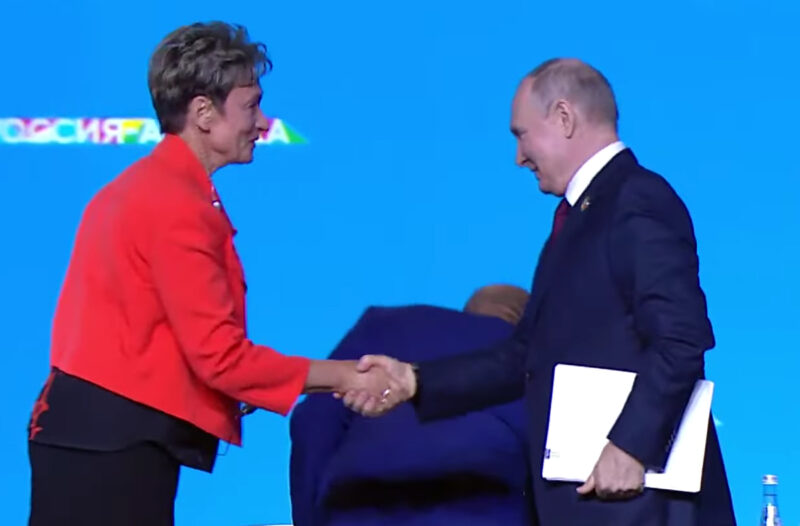
- (a) Over the years, Abramova since her appointment ad director of the Institute of African Studies, she has passed through the boardroom experiences, panel sessions, group brainstorming sessions and numerous presentations among others. She has shared very insightful thoughts with both Russians and Africans. These are politicians, academics, researchers, corporate business executives and ordinary citizens. It is worthy to note her display of moderating huge conferences attended by high-level dignitaries including African leaders with Russian President Vladimir Putin. (See the attached cover photograph).
Abramova moderated, since its inception in 2018, special African sessions at the St. Petersburg International Economic Forum [SPIEF]. The St. Petersburg International Economic Forum, popularly referred to as SPIEF, brings together international business leaders, government officials and representatives of expert and media communities to discuss various topics and jointly search for effective solutions to the most pressing challenges in Russian and global economies.
Furthermore, she moderated both the first and second Russia-Africa summits held respectively in southern coastal city of Sochi [October 2019] and in St. Petersburg [July 2023]. These summits were exclusively to review and design future pathways for Russia and Africa. After the first Russia-Africa summit held in Sochi, and within the framework of the joint declaration that was adopted, the Ministry of Foreign Affairs of the Russian Federation created a Secretariat of the Russia-Africa Partnership Forum.
With hopes for a comprehensive and enduring collaboration on long-term programs, Secretariat of the Russia-Africa Partnership Forum has since then been networking for potential Russian, African and regional organisations with the aim of effectively promoting especially Russia’s economic interests in Africa and, on bilateral basis, to foster beneficial cooperation with African countries.
As basic principles of advocacy, Abramova has inspired policy campaign and success stories. One distinguishing feature which has kept us progressing, however, is her unlimited positive motivations, shaping the conversation in the most transformative approach and convincing engagements. These are testimonies and best practices on advancing gender equality and women’s empowerment in the changing society.
In addition, she emphasizes the need to be optimistic about building strategic partnerships. She further portrays the fact that women can take leading initiatives from local African communities to the global platforms. In this advocacy context, Abramova pushes for the power of education [knowledge sharing], equality and inclusiveness; and finally drives people into taking business initiatives [innovations] and, of course, to get involve in decision-making process …that is taking positions in leadership.
In an insightful long-ranging conversation by this article author, the task of Russian researchers is to offer theoretically rationale and innovative policy solutions for improving Russia-African relations. One of the results of rethinking of foreign policy priorities of Russia on the basis of President Vladimir Putin’s initiative was, in particular, a definite shift in Russian foreign policy in the direction of the axis of the East and Global South. It serves as a new impetus for further development of mutually beneficial cooperation outside of the Euro-Atlantic partners.
“For Africans, Russia still appears as the most likely ally in defending its interests in the world arena as a natural counterweight to the hegemonic aspirations of one or a group of world powers,” she told me in the face-to-face interview. Russia’s relations with Africa is witnessing new trends. It is deepening and with more active political dialogue, activated economic, humanitarian and cultural cooperation. This is facilitated by negotiations at the highest level. Relations are steadily developing with leading regional associations, including the continental African Union [AU].
- (b) Professor Abramova as published several interviews both in local and foreign media. In December 2019, for instance, her articles in Rossiyskaya Gazeta and TASS News Agency, reiterated explicitly that Russians have to do away with negative perceptions and attitudes toward Africa. The attitudinal change has to reflect in all aspects of the relationship with Africa and Africans. Secondly, Abramova has highlighted Africa’s tremendous potential, including its unique natural resources, required for high-tech industries.
The middle class is expanding very fast there, already amounting to 280-300 mln people and this constitute a huge consumer market for products and services, according to her estimation. The fact that many prominent politicians and businessmen of the African continent graduated from Russian universities and speak Russian well contributes to strengthening of Russian-African relationship, the expert said, adding though that a new generation is about to take over in Africa, which is also reason why Moscow should maintain the existing solid social and cultural bilateral ties.
Referencing the above-mentioned article content, the key points are changing perceptions about Africa, strengthening the economic sectors and keeping eyes on the growing middle-class, the wealthy Africans and the elites in the continent. Cultural aspects play its prominent roles as well which should not be overlooked. These are some of the glaring factors necessitate raising multifaceted relations with Africa.
Abramova Deserves an Award for Policy Advocacy and Gender
Currently as a director and beyond as a policy advocate, Professor Abramova deserves an award for her role in promoting Russia-Africa relations. But at first, the media needs to identify her role and accordingly offered her that highest credit for bridging the gender gap, gender perspectives. She is a prominent academic, and does consistently policy advocacy for the Kremlin, for the MFA and for both Russia and Africa.
In a logical conclusion, the role of women today is extremely important integrating their skills in bilateral relations, multilateral development processes of Russia and the African continent with approx. 1.4 billion people, majority impoverished despite the huge endowed natural and human resources in Africa. For Africans, looking at the current geopolitical developments and emerging multipolar world, Russia is associated with the Soviet Union, the majority of Africans still have very warm feelings and lovely sentiments towards the Russian Federation.