Africa
The New Dawn for BRICS+: Matters Arising, by Kestér Kenn Klomegâh

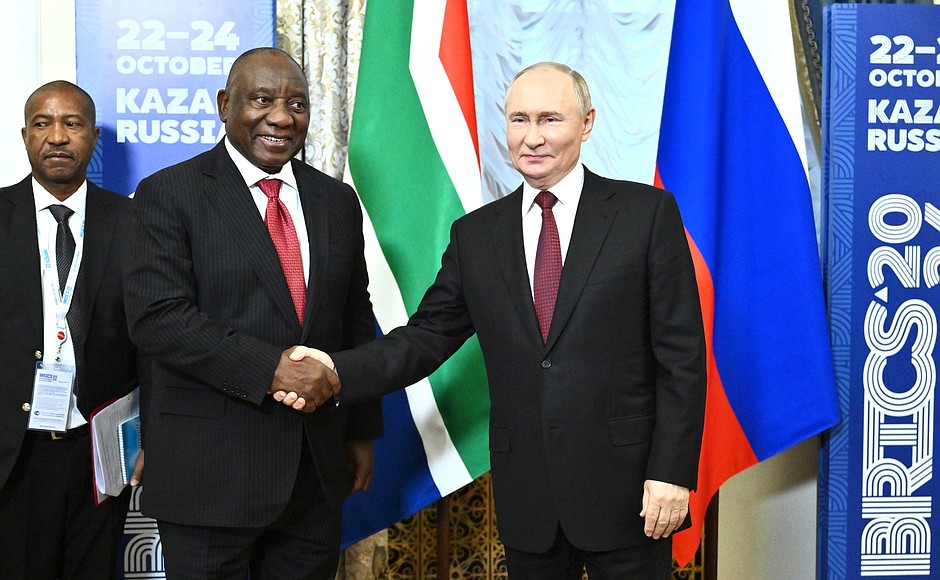
Within the context of geopolitical changes, the 16th annual BRICS+ (Brazil, Russia, India, China and South Africa) summit held in late October 2024 in Kazan, the capital of Republic of Tatarstan, focused of reviewing its organizational structure, emerging challenges, its strategic enlargement and future economic perspectives. According to Kremlin statements, more than 20 heads of state and government, mainly from Africa, Latin America, and Asia, have travelled to Kazan. It was historically symbolic: Russian President Vladimir Putin hosted more than 20 world leaders primarily to advance his shared idea of a “multipolar world” as a bulwark against United States dominance and hegemony. The BRICS+ has also reiterated its collective call for reforms of the UN Security Council.
What’s BRICS+ Today
Described as an informal association uniting the largest economic group of nations in the southern hemisphere which is referred to as the Global South, it incorporates distinctive features of 40% of the world’s natural resources, huge population, and intricate ethno-diversity. At the same time, an analysis shows traditionally large impoverished population is located in these countries in the Global South.
In 2006, Brazil, Russia, India, and China created the BRIC group, which expanded into BRICS in 2010 with the addition of South Africa. As BRICS+ that currently includes Egypt, Ethiopia, Iran, Saudi Arabia and the United Arab Emirates, as well as previous members, the 16th summit set the stage for critical review of its description and the broad challenging aspirations, and on a new path steadily advancing into a new future.
Ahead of the summit, Putin explicitly outlined the association’s parameters, explained what BRICS+ stands for, to drive in the true meaning in the geopolitical context. There have been several (mis)interpretations and misunderstanding of its description. And some overblown statements in the media, deepening rivalry between BRICS+ and the western world. While there are growing diverse interests and attracting partners to comprehensive, and multifaceted activities, the significant features worthy to note includes: BRICS was never meant to be created in opposition to any external country neither was it intended to be anti-western, anti-European and anti-United States. Prime Minister of India, Narendra Damodardas Modi, put it best, that “BRICS is not an anti-Western alliance; it is simply non-Western.” Most importantly, the key foundation of the association is to work together with transparency, guided by shared values, and with a common vision for economic development and ensuring peace and addressing these issues with members.
Economic Opportunities
Monitoring reports Putin indicated that more than 2,500 special economic zones operating within the BRICS nations, and their collaboration should be intensified. And that it’s essential to establish direct connections between the management teams of these zones, which offer preferential and beneficial conditions. This will enable them to share best practices in developing logistical hubs, localizing industrial production, and creating favorable global and competitive conditions for investors.
Perhaps, somewhat general perception is that China, with an estimated population of 1.5 billion, and high technology and entrepreneurial capability, is the world’s biggest economy. The United States of America is second. China is emerging as the global economic power, and sharing its industrial technology with many countries around the world. China thus emphasizes cooperation while Russia prioritizes both ideological and political confrontation, and worse, it has weak economic presence in the world.
Established in 2015, the BRICS New Development Bank has an enormous challenge to oversee the multiple financial questions of BRICS+ including to create a corresponding insurance platform, a reserve currency pool. There is a serious issue of using digital currencies in investment processes, and not only in BRICS countries but by BRICS countries in the interests of other developing economies which have good development prospects. It has to create a reliable platform for financial information exchange and a single payment system. A common BRICS currency, which could facilitate the development of economic cooperation and strengthen national currencies, among other things, has been especially intriguing.
On de-dollarization, BRICS New Development Bank President Dilma Rousseff, who was at the summit with her credits in U.S. dollars, acknowledged with Putin that the transition to a fairer global economic system would be delayed due to technical complexities and in global finance system. According to Dilma Rousseff, the U.S. dollar would continue being used as a weapon.
On October 23, after Putin’s meeting with President of the New Development Bank, Dilma Rousseff, the Kremlin report indicated that since 2018, the New Development Bank has funded about one hundred projects, amounting to a total of $33 billion. The increase in the share of settlements denominated in national currencies helps reduce debt servicing costs, strengthen the financial independence of BRICS states, and minimise geopolitical risks, that is, free economic development from political influence, as much as possible in today’s world.
Dilma Rousseff mentioned during the meeting that at present, the countries of the Global South are in considerable need of financial resources, and the conditions for securing such resources are rather challenging. However, this funds remain insufficient relative to the needs of the Global South. In this context, both the expansion of BRICS+ and emphasis on ensuring the necessary financial resources for projects in the countries of the Global South are of paramount importance.
BRICS+ Partner Category
At the summit, there was a general anticipation for growth of BRICS+. This was a clear and undeniable fact that with the expected growth in numeral strength, it would be necessary to accept he reality and focus on building economic relationships in order to make visible impact in the Global South. As Putin pointed out several times, the need to work on a ‘single structure’ and develop the category of ‘BRICS partner countries’ who in one way or other support its future as an alternative global architecture especially for the Global South.
While Russia strongly supports aspirations of different countries which want to join the association in a turbulent time amidst many challenges and threats mostly at the global level. On one hand, that BRICS practically doubled in size since January 1, 2024, and the adjustment period for those who have just joined it has not yet been fully completed, and that would be difficult to combine further expansion with the efficiency. On the hand, the vision of future cooperation between BRICS member states and the question to find suitable modalities for expansion would remain evolutionary.
Logical Conclusion
At the end of the October 23 meetings, full-fledged BRICS+ members adopted the Kazan Declaration titled “Strengthening Multilateralism for Just Global Development and Security” and the document consists of 43 pages, containing 134 provisions.
Russia has impressively built on the results achieved at the Johannesburg summit, particularly on the seamless integration of new participants into the multi-level architecture of BRICS. It further operated comprehensively within the framework of the declaration and an action plan declared in South Africa.
The 16th BRICS Summit took place in Kazan on October 22–24 under the Russian Chairmanship themed: “Strengthening Multilateralism for Just Global Development and Security.” Without doubt, these two factors will influence the formation of new centres of economic growth to be followed by enhancing political influence. Ultimately, BRICS+ continues to grow from strength to strength. BRICS represents 45 percent of the world’s population, covers 33 percent of the Earth’s land area, and has a continuous growth in trade and global commerce.