Africa
The Wike Magnetism: A Reflection On The Politics Of Power Circles In Nigeria -By Isaac Asabor
But it also offers an opportunity for reflection. Not on Wike himself, but on the system that enables a single individual to command such political gravity. Before I forget at this conclusive juncture, permit me to ask, “Are we building a democracy of substance or one of symbolism?” The foregoing question, dear reader, is the question we must all ask.

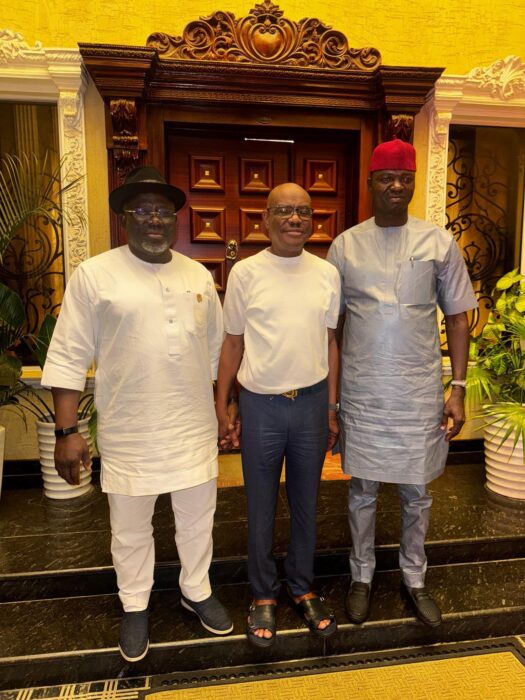
As my usual routine dictates, I woke up this morning, the twenty-fourth day of July 2025, and strolled into my study where I instinctively accessed my X account. The very first post that caught my eye was one made by the Governor of Delta State, Rt. Hon. Sheriff Oborevwori (@RtHonSheriff). The post, made barely 53 minutes earlier, read: “My brother Governor Francis Nwifuru of Ebonyi State, and I paid a courtesy visit yesterday to the Honourable Minister of the FCT, His Excellency Nyesom Wike, at his residence in the capital territory. I thank His Excellency for the warm reception.”
Accompanying the post was a photo of the three men, Wike, Oborevwori, and Nwifuru, in a cozy posing. The kind of photograph that sends a political message far louder than the accompanying words.
At first glance, this could pass for one of those casual political meet-and-greet sessions. But when observed through a discerning lens, especially considering the repeated nature of such visits from top-tier politicians across the federation, a troubling curiosity begins to form: “Why does it appear that a large number of Nigerian politicians are constantly gravitating around Nyesom Wike?” What makes him the apparent political lodestone in Abuja’s power circuit?
In contemporary Nigerian politics, few figures have managed to remain at the epicenter of national discourse like Wike. His name rings louder than most federal ministers. Despite holding just one of many ministerial positions, Minister of the Federal Capital Territory, Wike’s prominence appears to far outweigh the formal responsibilities of his office. His Abuja residence has become a beehive of political pilgrimage. It is as if visiting Wike has become a rite of passage or a political baptism of some sort.
But what exactly is the draw? Is it power? Influence? Strategy? Or simply optics? Truth be told, Wike has never been a wallflower in the Nigerian political theatre. As a former Governor of Rivers State, he carved a niche for himself as a fierce, no-holds-barred political brawler. He is known for saying it as it is, often brutally, and for playing politics with both heart and cunning. Some see him as a kingmaker, others as a spoiler. He rarely exists in the political middle ground.
Yet, we must ask: “Are these courtesy visits about national development or personal ambition?” “Are they designed to foster better governance or merely to align with a man many see as a power broker in the making?”
In fact, Wike’s brand of politics is neither hidden nor ambiguous. It is loud, assertive, calculated, and often polarizing. He made national headlines during the 2023 general elections not just for his role in the G5 governors’ drama but for the influence he wielded across political lines. Despite being a PDP member at the time, he worked tactically to scuttle the presidential ambition of his own party’s candidate, openly and unapologetically.
That audacity, coupled with his later defection into the Tinubu-led federal administration as Minister of FCT, signaled not just a career pivot but a reassertion of his political relevance. Since then, Wike has been playing a dual role: a federal official and an independent political force.
It is this dual identity that many politicians find either appealing or threatening. For the ambitious ones, being in Wike’s good books is a hedge against future political uncertainty. For those already wielding power, an alliance with Wike is a way to consolidate strength. And for those seeking validation or support, it is almost compulsory to be seen in his circle.
But “what does this political gravitational pull around Wike say about Nigeria’s democratic practice?” The foregoing question need to be answered as the situation portends the danger of personality-centric politics which unarguably does not augur well for Nigeria’s democracy and good governance.
As widely known, democracy, in its truest form, thrives on institutions, ideas, and collective leadership, not personalities. Unfortunately, what we continue to witness in Nigeria is a persistent and dangerous elevation of individuals over institutions. When political actors consistently defer to a single figure, even when that figure is not at the highest echelon of power, questions naturally arise about the health of the system.
This is not to suggest that Wike is doing anything illegal or untoward. But it does beg the questions: “Should governance revolve around individuals or institutions?” “Is democracy being deepened when political loyalty is hinged on relationships with power brokers instead of service to the people?”
Wike may be a man of influence, but the Nigerians elected a president, vice president, governors, senators, and representatives. If democracy is working as intended, the system, not selected personalities, should be the primary driver of political engagement.
The visits to Wike, when chronicled, paint a worrying picture of how personal influence can sometimes overshadow constitutional roles. These optics matter. They shape public perception. And public perception, in turn, affects trust in democracy.
From an analytical standpoint, Wike represents an intriguing case study in power dynamics within a fragile democracy. He has managed to stay politically relevant, if not dominant, by creating alliances across party lines, by mastering media narratives, and by asserting himself as indispensable.
Yet, the questions remain: “What institutional value does this proximity to Wike add to national or state governance?” |Are those who visit him leaving with policy insights, developmental blueprints, or just political reassurances?”
If political actors are queuing up at Wike’s door for mentorship, advice, or strategic collaboration on how to better serve the people, then it is a commendable phenomenon. But if, as many suspect, the visits are simply acts of political chess, designed to position, realign, or secure favors ahead of 2027, then we are witnessing politics for self, not for the state.
Again, it is germane to ask in this context, “What kind of democracy are we building?” The foregoing question is never out of place when analyzed from the perspective of the consistent focus on individuals like Wike. It raises a fundamental concern about the kind of democracy Nigeria is nurturing. “Are we building a democracy of ideas or a democracy of cliques?” “Are we encouraging the development of institutions or simply perpetuating the culture of political godfatherism under new faces?”
If democracy is to truly work in Nigeria, it must be structured in such a way that no individual, no matter how skilled or influential, can become larger than the system. Otherwise, we risk turning our hard-fought democracy into a glorified monarchy where influence, rather than the constitution, reigns supreme.
In fact, the recent visit by Governors Sheriff Oborevwori and Francis Nwifuru to Nyesom Wike is not just another harmless political photograph, it is a window into the soul of Nigerian politics. It shows us who holds sway, who the players believe they must align with, and where the political winds may be blowing.
But it also offers an opportunity for reflection. Not on Wike himself, but on the system that enables a single individual to command such political gravity. Before I forget at this conclusive juncture, permit me to ask, “Are we building a democracy of substance or one of symbolism?” The foregoing question, dear reader, is the question we must all ask.