
Africa
Why FG Must Always Embrace Constructive Feedback Whenever It’s Criticized -By Isaac Asabor
Until the presidency begins to wear maturity like a badge of honor rather than engage in mudslinging, the government risks turning valid national conversations into shouting matches where truth is drowned out by ego. And in the end, it is not Adesina who loses. It is Nigeria.

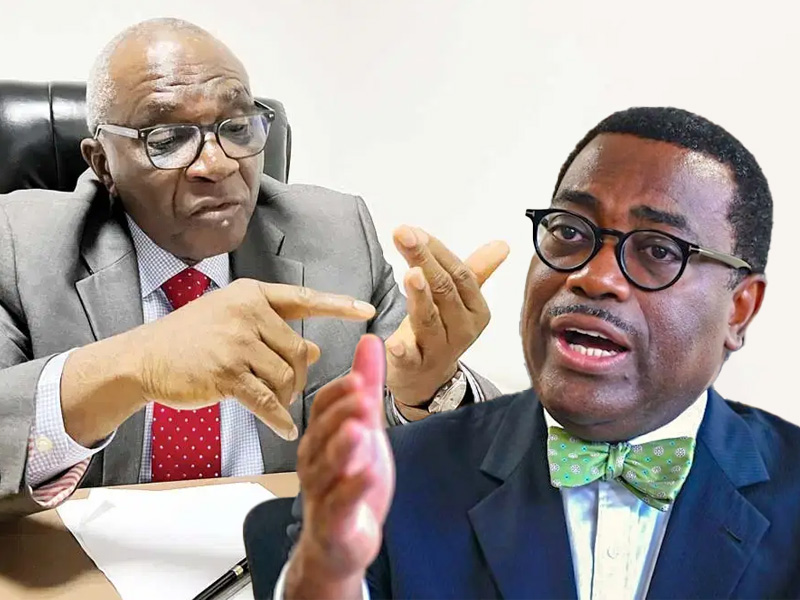
Democracy thrives not in echo chambers but in the robust contestation of ideas. Unfortunately, in Nigeria, criticism of government policy, especially when it comes from respected global figures, is often met with defensive hostility rather than mature engagement. A recent case in point is the scathing and dismissive reaction of Mr. Bayo Onanuga, the Special Adviser to the President (Information and Strategy) to comments made by Dr. Akinwumi Adesina, the outgoing President of the African Development Bank (AfDB).
In his statement, Dr. Adesina lamented that Nigerians today are worse off than they were in 1960, citing GDP per capita data as a basis. While one may interrogate the accuracy of his figures, particularly the claim that GDP per capita in 1960 was $1,847 compared to $824 today, the substance of his argument transcends mere statistical calculations. It is a reflection of the harsh, lived reality of millions of Nigerians who are experiencing what can only be described as a chronic economic downturn.
Rather than responding with introspection or engaging in constructive dialogue, the presidency chose to lash out in the usual acerbic tone that has now become the default playbook of government spokespersons. The response did not only attempt to discredit Adesina’s data but also subtly attacked his credibility, likening him to a politician in the mould of Peter Obi.
This knee-jerk reaction to criticism is emblematic of a deeper malaise within Nigeria’s political leadership: an aversion to accountability, and a mistaken belief that disagreement equals disloyalty.
A democracy is not a monarchy. In a democracy, the people, through civil society, the press, and thought leaders, reserve the right to question, criticize, and even condemn the policies of those in power. Leadership, in turn, is expected to listen, engage, and respond not with condescension or combativeness, but with facts, context, and above all, humility.
When a statesman like Dr. Adesina raises concerns, whether about GDP, food inflation, or declining quality of life, such concerns ought to spark national reflection, not retaliation. He is not a Twitter troll. He is not a propaganda merchant. He is a globally respected economist who has headed Nigeria’s Ministry of Agriculture and transformed the African Development Bank into a formidable financial institution.
For the presidency to dismiss his comments as uninformed or politically motivated only reinforces the view that this government is tone-deaf and intolerant of criticism, even when such criticism is rooted in good faith and national interest.
Without a doubt, the bigger picture in this context is beyond GDP. This is as the presidency’s response focused almost entirely on GDP figures, arguing that Nigeria’s economy has grown by leaps and bounds since 1960. That may be true on paper. The problem is that GDP growth in Nigeria has largely been non-inclusive and extractive, benefiting only a tiny elite while leaving the vast majority of citizens grappling with poverty, unemployment, and rising insecurity.
The very argument used by the presidency to refute Dr. Adesina ironically supports his core point. Take, for instance, the claim that MTN’s success in Nigeria is evidence of economic progress. Yes, Nigerians now own mobile phones, but what does that mean for someone who cannot afford three square meals? Or a graduate who has been unemployed for five years? Or a farmer who cannot access affordable fertilizer or secure roads to get produce to the market?
Economic progress is not measured by the number of mobile phone users or road length alone. It is measured by how many citizens can afford decent healthcare, how many children go to bed hungry, and how many families are one illness away from financial ruin. If anything, the comparison to 1960 should not be reduced to GDP alone, but should factor in quality of life, access to opportunities, and upward mobility, all of which are in a freefall in today’s Nigeria.
At some point, someone in the corridors of power must recognize that governance is not a boxing match where every punch must be countered. You do not win credibility by fighting everyone who criticizes you. In fact, the hallmark of democratic maturity is the ability to listen even when it hurts, to reflect even when you feel slighted, and to acknowledge mistakes without spinning them into imagined victories.
The presidency’s constant resort to intellectual brawling is not only counterproductive but alienates critical voices that could offer valuable insights for course correction. Instead of viewing critics as enemies, why not see them as mirrors reflecting what ordinary Nigerians are too tired or afraid to say?
Without a doubt, democracy thrives not through divisive rhetoric, but through open dialogue, constructive dissent, and the courage to question authority. Adesina’s comments presented an opportunity for thoughtful engagement grounded in context and shared national interests, rather than a dismissive response marked by sarcasm.
There is still time for the presidency to change course. Rather than always seeking to “clap back” at critics, the government should institutionalize a framework for deliberative engagement with opposing views. Instead of investing energy in writing lengthy rebuttals, invest in better communication strategies that explain government policies in relatable terms to the Nigerian people. Instead of weaponizing statistics, focus on the people behind the numbers.
In fact, leadership is not just about numbers. It is about empathy. It is about building trust. When a respected figure like Adesina speaks out, he is echoing what millions of ordinary Nigerians are silently enduring. Brushing that off with derision only deepens the growing chasm between the people and their government.
Nigeria is not a dictatorship. It is a constitutional democracy, and leadership must reflect the maturity that democracy demands. Fighting back every time someone holds up a mirror to the system is not strength, it is fragility masquerading as confidence.
It is time the presidency realizes that not every critique is an attack, and not every dissenter is a foe. Sometimes, even in criticism, there is patriotism. And sometimes, in silence, there is complicity.
Adesina spoke. The world listened. The government responded, predictably. But what Nigeria needs is not more rebuttals. What Nigeria needs is reflection, reform, and the humility to admit that even power can, and should, listen.
Until the presidency begins to wear maturity like a badge of honor rather than engage in mudslinging, the government risks turning valid national conversations into shouting matches where truth is drowned out by ego. And in the end, it is not Adesina who loses. It is Nigeria.



















boyarka
November 7, 2025 at 4:57 pm
Saved as a favorite, I love yyour site!