
Africa
Expediency Of Asking Wike, “How Market?” As Presidency Affirms Fubara Rivers’ Numero Uno -By Isaac Asabor
In Rivers today, the market has adjusted. Power has been clarified. Authority has been affirmed. And the godfather model, once dominant, has encountered resistance from the very system it sought to outgrow. So the question remains, not as an insult, but as a marker of political reality: “How market, Wike?” Because for the first time in a long while, Rivers politics is answering that question without waiting for his reply.

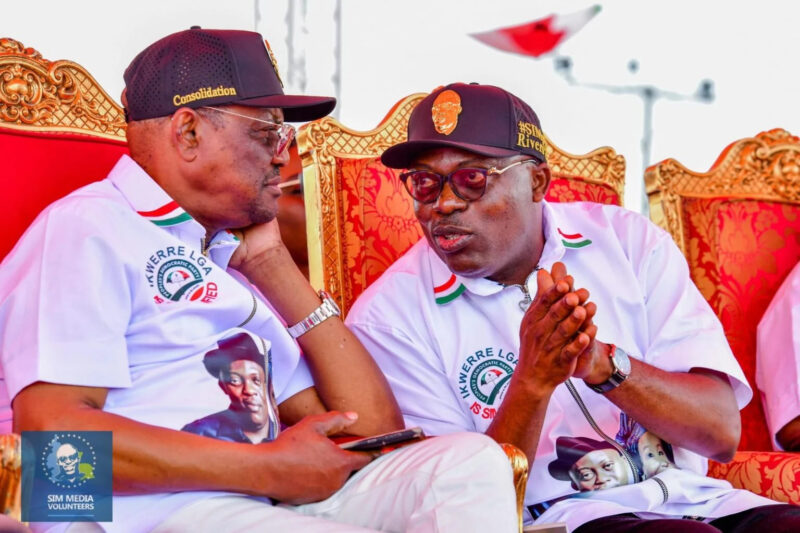
In Nigerian political parlance, some questions are not asked for answers, they are asked to mark moments or to mock. “How market?” is one such question. It is a street-level probe loaded with judgment, an assessment of whether a gamble has paid off, whether power has endured, or whether reality has finally caught up with ambition. In the context of Rivers State’s protracted political crisis, asking former governor and current Federal Capital Territory Minister Nyesom Wike that question is far from trivial. The reason is obvious: the political market in Rivers State, where Wike once reigned as the “Babaloja,” has shifted, and it has decisively slipped from his once ironclad grasp.
The Presidency’s recent affirmation of Governor Siminalayi Fubara as the leader of the All Progressives Congress (APC) in Rivers State is not a routine party clarification. It is a political intervention with consequences. It signals an end to ambiguity, a rejection of shadow authority, and a reassertion of a principle that has been under sustained assault in Rivers politics: that elected power is not subordinate to personal influence, no matter how loud or well-connected that influence may be.
When Daniel Bwala, Special Adviser to President Bola Tinubu on Policy and Communication, went on national television, Channels Television, yesterday to affirm Fubara’s leadership and insist that the governor must be allowed to govern without undue interference, he did more than speak for the Presidency. He restored a hierarchy that had been deliberately blurred. He acknowledged Wike’s role in Tinubu’s electoral victory, yes, but he also delivered a line that landed with unmistakable force: “Wike is not a member of the APC, and Rivers State must not be governed by proxy”. The foregoing single clarification, no doubt, collapsed months of political theatre.
For over a year, Rivers State has been locked in an artificial crisis, manufactured, prolonged, and weaponized. Lawmakers have brandished impeachment threats like bargaining chips. Party officials have issued contradictory statements. Governance has been stalled, not by lack of authority, but by the persistent overhang of a former governor who appears unwilling to accept the finality of electoral succession.
Without a doubt, the Presidency’s position has now exposed the core issue: this was never about party supremacy or constitutional interpretation. It was about control. Wike’s political style has always thrived on dominance. As governor, he centralized power, crushed opposition, and ruled Rivers with an iron certainty that brooked little dissent. That model, however effective in office, becomes problematic when exported into the post-office phase. Influence becomes interference. Guidance becomes coercion. Loyalty becomes entitlement.
Without a doubt, the affirmation of Fubara as Rivers APC’s ‘numero uno’ disrupts that model entirely. Again, it is instructive that the Rivers APC did not merely welcome the Presidency’s position; it embraced it with unmistakable relief. By thanking President Tinubu for adhering to party constitution and convention, the party was not engaging in flattery, it was staking a claim. It was saying that Rivers APC recognizes only one legitimate leader at the state level, and that leadership flows from the office of the governor, not from past glory or external pressure.
Their insistence that APC governors must lead the party at the state level to ensure cohesion and efficiency is particularly revealing. It suggests that the party has been operating under abnormal conditions, conditions where authority was contested, direction was unclear, and loyalty was constantly tested. The Presidency’s clarification has now given Rivers APC political cover to breathe, organize, and reassert itself without fear of reprisal.
More telling still was the party’s open condemnation of comments by Felix Morka regarding impeachment proceedings against Governor Fubara and his deputy. That condemnation was not mild. It was categorical. The suggestion that Morka should step aside as National Publicity Secretary was unprecedented. It reflected not recklessness, but accumulated frustration. A party chapter finally asserting that it will not be used as an instrument in a personal power struggle.
At this point, the question practically asks itself: “how market?” For Wike, the answer is uncomfortable. The political environment that once amplified his authority has begun to resist it. The silence from Abuja is no longer permissive; it is corrective. The institutions he once bent now appear determined to straighten themselves.
This is not a declaration of Wike’s political extinction. Nigerian politics is too fluid, too forgiving, and too transactional for such finality. But it is a clear indication that his strategy of perpetual relevance through dominance has reached its limit, at least in Rivers State.
The tragedy of this moment is not that Wike has lost influence; it is that he appears unwilling to recalibrate it. Former governors who transition successfully do so by reinventing themselves, as national figures, elder statesmen, or strategic players who understand restraint. Those who refuse to adjust often end up fighting yesterday’s battles with diminishing returns.
Governor Fubara’s emergence as Rivers’ undisputed political leader represents more than personal vindication. It restores a democratic norm that had been dangerously eroded: that a sitting governor is not a caretaker for a predecessor’s ambition. That loyalty does not nullify legitimacy. That the mandate of the people cannot be indefinitely subordinated to the will of one man.
President Tinubu’s role in this recalibration deserves attention. By intervening quietly, without inflammatory rhetoric or public humiliation, the Presidency demonstrated a sophisticated understanding of power. It acknowledged contribution, and then enforced boundaries. In doing so, it sent a broader message to Nigeria’s political class: alliances do not override institutions, and past services do not grant permanent veto power over governance.
The Rivers APC’s final call, for congresses to be conducted and for Governor Fubara to convene a stakeholders’ meeting, signals a desire to move forward. To harmonize interests. To rebuild a party structure that functions on clarity rather than fear. It is a call for political normalcy after months of engineered instability.
Against the foregoing backdrop, asking Wike “How market?” is not mockery for its own sake. It is political accountability framed in familiar language. It is a way of asking whether the gamble of overreach has paid off, or whether it has instead exposed the limits of personal power in the face of institutional correction. This is because markets, like politics, reward timing and adaptability. They punish excess and miscalculation.
In Rivers today, the market has adjusted. Power has been clarified. Authority has been affirmed. And the godfather model, once dominant, has encountered resistance from the very system it sought to outgrow. So the question remains, not as an insult, but as a marker of political reality: “How market, Wike?” Because for the first time in a long while, Rivers politics is answering that question without waiting for his reply.

















You must be logged in to post a comment Login