Breaking News
Opposition plots 2027 strategy as Atiku, Obi, Makinde skip Abuja summit
Nigeria’s six major opposition parties begin talks on a 2027 coalition as Atiku, Obi and Makinde stay away, with leaders backing a unity framework.

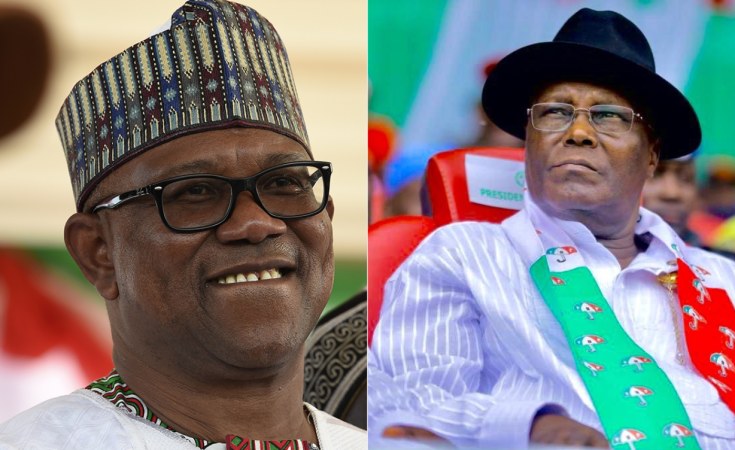
Nigeria’s opposition parties have taken the first formal step towards building a joint strategy for the 2027 general election, with leaders of six major opposition parties meeting in Abuja on Monday.
The summit, held at the Shehu Musa Yar’Adua Centre, however, took place without some of the country’s biggest opposition figures, including African Democratic Congress (ADC) presidential candidate Atiku Abubakar, Nigeria Democratic Congress (NDC) presidential candidate Peter Obi, Allied Peoples Movement (APM) presidential candidate, and Oyo State Governor Seyi Makinde.
Their absence did not prevent the gathering from attracting other presidential and vice-presidential contenders.
Among those present were Social Democratic Party (SDP) presidential candidate Prince Adewole Adebayo, Peoples Redemption Party (PRP) presidential candidate Donald Duke, and APM vice-presidential candidate Lawal Musa Daura.
Senior officials, including members of the National Working Committees (NWC) and Boards of Trustees (BoT) of the participating parties, also attended.
G100 pushes four-year transition plan
The summit opened with a proposal from the G100 for opposition parties to work towards a Government of National Competence operating under a single four-year transition term.
Presenting the opening remarks on behalf of the group, Mallam Salihu Moh. Lukman said the proposal was designed to move beyond a simple arrangement for sharing political ambitions.
“The Framework before you proposes something more demanding than a merger of ambitions: a Government of National Competence, built on competence, integrity, national inclusion, and fair representation of every party that contributes to the effort,” Lukman said.
He said the proposed arrangement should be backed by “a political commitment to a single four-year term, written into an enforceable Transition Charter.”
Lukman insisted that lessons from previous political agreements showed that promises without enforcement mechanisms were unlikely to survive political disagreements.
“We want to underline the word ‘enforceable.’ This gathering does not need more sincerity. Nigerian politics has never suffered from a shortage of sincere promises. What it has suffered from is promises that nobody could enforce when the person who made them changed his/her mind,” he said.
According to him, the final agreement “must be written, it must be witnessed, and it must have consequences”.
2023 defeat blamed on opposition vote fragmentation
Lukman used the 2023 presidential election to make the case for opposition cooperation, noting that the combined votes of leading opposition candidates exceeded those of the eventual winner.
He recalled that opposition parties had contested separately in 2003, 2007 and 2011 before changing strategy in 2015, when they agreed on rules of engagement and eventually defeated the ruling party.
He said the approach was abandoned in 2023, resulting in a divided opposition vote.
“The winner took just under nine million votes. One opposition candidate took close to seven million. Another took just over six million. Thirteen million votes on one side of the argument, under nine million on the other. And the side with fewer votes formed the government, lawfully, constitutionally and entirely predictably,” he said.
He said the result should not be attributed to electoral conspiracy.
“Nobody stole thirteen million votes. We divided them ourselves, in public, and we did it knowing exactly what the consequence would be,” he added.
Lukman also referenced Kenya’s 2002 election and Malaysia’s 2018 election as examples of opposition groups defeating long-established ruling structures after uniting.
“In neither case did the opposition win because it had become more virtuous. It won because it had become one,” he said.
For him, the lesson from those experiences was “arithmetical,” rather than moral.
Coalition machinery unveiled
The G100 presented a proposed institutional structure for the opposition alliance.
At the centre would be a Central Leadership Committee made up of national chairmen, national secretaries, presidential candidates and vice-presidential candidates from the participating parties.
A Publicity and Communication Committee would coordinate the coalition’s public messaging, while a Legal Committee would oversee legal strategy and provide advice on coalition matters.
The G100 would remain outside the political decision-making structure, serving only as facilitator and observer.
Five working groups are also expected to prepare documents within four weeks covering democratic renewal, a single-term transition, national reforms, opposition unity and the selection of a common presidential candidate.
Their reports will be submitted to a second summit for consideration.
Lukman stressed that the initiative was not yet about dissolving political parties or forcing candidates to abandon their ambitions.
“It is not asking any party to dissolve. It is not asking any party to disappear into another party. It is not asking any candidate to stand down this morning… That question is not on the agenda of this Summit, and any report that says otherwise will be wrong,” he said.
He said the immediate task was to create “the table” before deciding who would occupy “the seats” around it.
Minority Caucus urges opposition to learn from APC
House of Representatives Minority Leader Hon. Fred Agbedi said opposition parties must overcome their differences if they hoped to defeat the ruling party in 2027.
Agbedi said the Minority Caucus had chosen to work with the G100 to facilitate greater cooperation among opposition parties.
“In the spirit of creating a viable opposition and ensuring that we win collectively the 2027 election, the Minority Caucus of the House of Reps decided that we partner with the G100 to see how opposition parties can come together, streamline our ambitions, and ensure that we take this government out,” he said.
He urged opposition leaders to learn from the strategy that helped the APC win the 2015 presidential election.
Agbedi also warned that the current political leadership appeared to operate on the assumption that “all is fair in politics”.
He urged politicians to sacrifice individual ambitions where necessary, warning that another divided opposition could reproduce the experience of 2023.
“What will it benefit us when we are divided and scattered, and we go into an election, and we come back to collate the millions of votes we had divided amongst ourselves that could not give us victory? It will be like an exercise in futility, and we pray that we shouldn’t in 2027 go back to that,” he said.
Duke willing to sacrifice presidential ambition
Donald Duke, the PRP presidential candidate, said he was ready to give up his own ambition if opposition parties jointly settled on another candidate.
Duke said personal egos had historically made it difficult for opposition forces to unite around a common objective.
He called on political leaders to put their ambitions aside and work collectively.
“If we think we can go it all alone, then we will fail,” he said.
Opposition leaders endorse unity project
ADC National Vice Chairman for the South-South, Usani Uguru Usani, who attended with members of the party’s NWC, said the current political environment offered opposition parties an opportunity to make decisions based on the government’s performance.
He expressed confidence in the coalition but warned opposition parties against turning their attacks on one another.
“There is something that is happening among the opposition people or party. We seem to be attacking ourselves much more than we attack a common enemy, which is not correct,” Usani said.
APM National Chairman Yusuf Mamman Dantalle described the summit as an important moment in Nigeria’s political history.
He urged participants to look beyond their individual and party interests.
“For us to achieve this will be remembered for what we do today, that we have the opportunity, or what we refuse to do today, that we have the opportunity,” he said.
Dantalle pledged his party’s commitment to “the project Nigeria.”
Dr Babangida Aliyu, BoT Secretary of the Tanimu Turaki-led PDP faction, said the initiative was filling a gap that had existed in Nigeria’s political process.
He blamed personal ambition and financial interests for some of the country’s political problems and advocated extending the coalition-building process to state and local government levels.
“We are not here to pick or to nominate or to tell other parties to not run. Now we are going to lay the foundation that when the time comes, we should be able to say this is the way to go,” he said.
PRP National Chairman Dr Hakeem Baba-Ahmed urged those seeking presidential and vice-presidential offices to recognise the seriousness of the moment.
He said the six participating parties were facing what he described as “an existential threat” through litigation.
“Our back is against the wall, but we’ll fight back. In 2027, we will together remove this government and put the Nigerian nation in a different trajectory,” Baba-Ahmed said.
SDP National Chairman Prof. Sadiq Gombe said Nigerian voters had repeatedly shown an appetite for good governance.
He cited the 2023 presidential election, where he said the three leading opposition candidates secured approximately two-thirds of votes cast, and the Osun State election, where he said extensive deployment of security and financial resources by the ruling party did not determine the result.
Gombe pledged the SDP’s support for the coalition “irrespective of whatever” and urged opposition parties to honour existing unity agreements.
NDC National Chairman Senator Moses Cleopas Zuwoghe, speaking on behalf of his party and Peter Obi, also backed the initiative.
He commended the G100 and said cooperation among opposition parties was necessary because, in his assessment, Nigeria was “in a comatose” state under the current administration.
“It is a good thing when opposition political parties that are not pretending, but are convinced that our country is in a comatose… think through and establish a pathway to rescue this nation,” he said.
Six parties adopt coalition communiqué
The summit ended with the adoption of a Joint Communiqué by the six opposition parties.
Under the agreement, the parties committed themselves to a structured negotiation process aimed at developing a framework for opposition cooperation ahead of 2027.
They also formally approved the creation of the Central Leadership Committee, Publicity and Communication Committee and Legal Committee.
Five working groups will now develop, within four weeks, proposals covering the National Covenant for Democratic Renewal, Single-Term Transition Charter, National Reform Programme, Framework for Opposition Unity and Roadmap to a Common Presidential Candidate.
The proposals will be considered at a second summit, with the Central Leadership Committee to determine its date and venue.
The communiqué also called on the United States Government to ensure the timely and lawful disclosure of all non-exempt official records concerning President Bola Ahmed Tinubu that are relevant to legitimate public interest.
The parties referred to an ongoing Freedom of Information Act suit before the United States District Court for the District of Columbia, while stressing that their demand did not presume what any undisclosed records contain or amount to a finding of wrongdoing.
They further agreed to formally communicate their position to the ECOWAS Commission.
The parties reaffirmed that the G100 would remain strictly a facilitator and observer and would not assume the authority of the political parties.
Africans Angle News