
Breaking News
Olukoyede: EFCC records 10,872 convictions, N1.23tr recoveries under my watch
EFCC Chairman Ola Olukoyede says the commission secured 10,872 convictions and recovered N1.23tr, $684.48m and other currencies in 34 months.

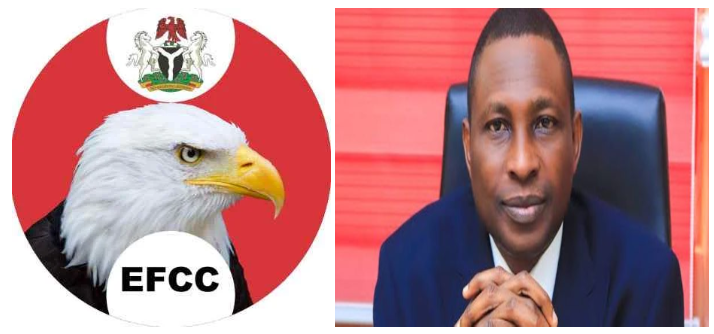
The Economic and Financial Crimes Commission (EFCC) recorded 10,872 convictions and recovered N1.23 trillion alongside millions of dollars, pounds and euros during the 34 months Ola Olukoyede served as its Executive Chairman, the commission has disclosed.
Presenting his three-year stewardship report at the EFCC headquarters in Abuja, Olukoyede said the commission recovered N1.23 trillion, $684.48 million, £373,906 and €9.34 million between October 2023 and July 2026.
He said the commission investigated 39,615 cases, received 49,673 petitions and filed 14,476 cases in court within the period.
The EFCC boss said the commission achieved a 75.1 per cent conviction-to-filing ratio, while 1,370 convictions were secured from 1,889 cases filed during the first six months of 2026.
Olukoyede, however, admitted that the fight against financial and economic crimes was still ongoing, with criminals increasingly deploying sophisticated methods involving cybercrime, financial fraud, virtual assets and illicit financial flows.
He described his tenure as one marked by “sustained enforcement, institutional reform, prosecution, asset recovery, restitution and stronger collaboration at home and abroad.”
According to him, the statistics should be viewed as evidence of an effort to ensure that anti-corruption activities produce tangible economic value.
“Our responsibility is to convert information and intelligence into prevention, petitions into investigations, investigations into prosecutions, prosecutions into convictions, recoveries into restitution, and enforcement into measurable national value,” he said.
Cybercrime, fraud dominate offences
The EFCC chairman disclosed that 46,288 offences were recorded between 2024 and 2026 year-to-date across nine major categories of economic and financial crime.
Advance fee fraud and cybercrime accounted for nearly two-thirds of the recorded offences, while overall offences increased by 24.1 per cent from 2024 to 2025.
He said procurement fraud, bank fraud, cybercrime and economic-governance offences also experienced notable increases.
“This tells us something important,” he said.
“The fight against economic and financial crime is not only about grand corruption. Every day, we are protecting citizens, businesses and institutions from fraud, cyber-enabled crime and other forms of economic exploitation.”
The commission, he said, maintained its prosecution of major cases involving former governors, ministers, public office holders, agency heads, financial-sector operators and corporate officials.
Olukoyede mentioned the convictions of Saleh Mamman, Robert Orya and Chukwunyere Nwabuoku among recent cases demonstrating the commission’s accountability efforts.
He maintained that political status or official position would not protect anyone from prosecution.
“No office or title places anyone beyond the reach of the law. We will continue to investigate professionally, prosecute on the strength of evidence and allow the courts to determine guilt or innocence,” he said.
N1.233tr recovered from October 2023
According to Olukoyede, the EFCC recovered N1.233 trillion in assets and funds between October 1, 2023 and June 30, 2026.
Of the naira recoveries, N397.26 billion, representing 33 per cent, went directly to the Federal Government, while N836.34 billion, representing 67 per cent, was recovered for MDAs, state revenue services, companies, individuals and foreign victims.
He said the commission’s focus was not simply to recover assets but to ensure they were returned to their rightful beneficiaries.
Consequently, N661.32 billion and $492.37 million were released to beneficiaries during the period.
Individuals and corporate bodies received N325.35 billion, while N335.97 billion was released to MDAs, the Nigerian Revenue Service, state internal revenue services and other public institutions.
The EFCC also recovered about N288.1 billion in federal and state taxes, including N173.2 billion for the Federal Government and N114.9 billion for state internal revenue services.
A further N257.2 billion was recovered for federal ministries, departments and agencies.
EFCC recoveries fund education, credit schemes
Olukoyede said recovered proceeds were also contributing to programmes with wider national economic benefits.
He recalled that the Federal Government directed in August 2024 that N50 billion each be allocated from EFCC recoveries to NELFUND and the Nigerian Consumer Credit Corporation.
In 2026, another N50 billion each was approved for the two programmes.
The EFCC chairman also cited the transformation of the recovered NOK University into the Federal University of Applied Sciences, Kachia, Kaduna State.
He said the institution admitted and matriculated 1,909 students in December 2025.
“Anti-corruption enforcement can restore fiscal space, strengthen federal and sub-national revenue, return working capital to institutions, companies and citizens, support financial-market integrity, protect the extractive and digital economies and strengthen Nigeria’s international credibility,” Olukoyede said.
Court orders lead to forfeiture of 10,053 assets
Beyond financial recoveries, the EFCC obtained interim and final court orders resulting in the forfeiture of 10,053 tangible assets between October 2023 and July 2026.
The forfeited properties included 8,198 electronic items, 1,177 real estate assets, 370 vehicles and 251 plots of land.
Schools, factories, hotels, shops, oil rigs, barges, machinery and aircraft were also among the assets.
The commission additionally secured the forfeiture of 102 tonnes of solid minerals.
Olukoyede said the sale of assets covered by final forfeiture orders generated about N12.07 billion, which was remitted to the Federal Government.
Nigeria removed from FATF Grey List
The EFCC chairman said Nigeria’s removal from the FATF Grey List in October 2025 was another major achievement supported by the commission.
He said EFCC operations targeting money laundering, terrorist financing, asset freezing and confiscation, virtual assets and other high-risk areas contributed to strengthening the country’s anti-money laundering and counter-financing of terrorism regime.
The commission’s campaign against unlicensed bureaux de change also produced 234 cases and 73 convictions during the period.
Olukoyede said the crackdown was aimed at creating a more formal and transparent foreign-exchange market and reducing opportunities for illicit finance, speculation and round-tripping.
EFCC digitalises 60% of operations
Olukoyede said his administration also implemented several institutional reforms.
These included new arrest and bail guidelines, a review of sting operations and the establishment of the Department of Fraud Risk Assessment and Control, Security Department, Immigration and Visa Section and Cybercrime Rapid Response Centre.
The commission commissioned new directorates in Enugu and Ilorin and established others in Ekiti, Anambra and Katsina states.
According to Olukoyede, nearly 60 per cent of EFCC processes and operations have now been digitalised.
He said the commission also invested in technology, its new academy, the 24/7 Cybercrime Rapid Response Centre and EFCC Radio.
Financial crimes becoming more sophisticated
While highlighting the commission’s achievements, Olukoyede warned that the changing nature of financial crime presented a continuing challenge.
He said organised crime was increasingly operating across borders, making international cooperation essential.
The EFCC currently collaborates with the FBI, UK National Crime Agency, Royal Canadian Mounted Police, INTERPOL and other international law-enforcement organisations.
Olukoyede, who was re-elected president of NACIWA, said regional collaboration was particularly important for tackling cross-border financial crimes and recovering illicit assets.
He said the EFCC would focus going forward on prevention, faster restitution, improved investigative technology and more professional engagement with citizens.
“We have made significant progress, but the work is not finished. It continues with renewed determination,” Olukoyede said.
He pledged that the commission would continue its anti-corruption campaign within the bounds of due process, with emphasis on delivering “measurable value for the public.”
Africans Angle News






















You must be logged in to post a comment Login