
Africa
Palm Fronds and Pigeon Blood: Rethinking the African Holy Spirit -By Patrick Iwelunmor
The formation of a child’s spiritual imagination begins with the hands that hold them. If those hands both bless and wound, they will learn a God whose love is inseparable from fear. The work before us is not only to prosecute offenders but to dismantle the religious imagination that sanctifies cruelty. The African version of the Holy Spirit, if it is to be worthy of its name, must hover over our chaos with the creative word, anoint to heal rather than harm, and side always, without hesitation, with the little ones in our midst.

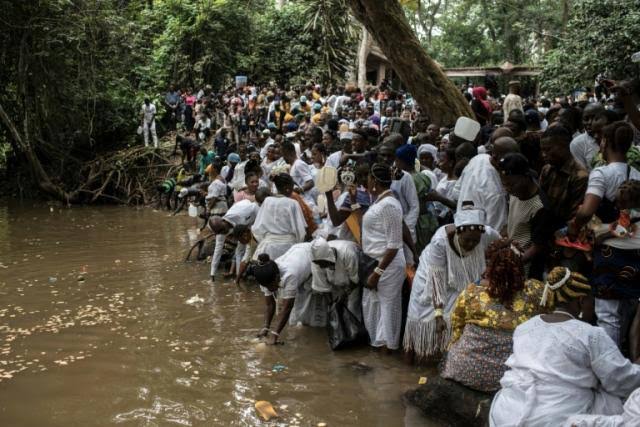
The recent viral footage from Eneka, Port Harcourt, presents a scene as disturbing as it is revealing: a row of children, some barely of school age, kneeling in a church compound, their bodies struck repeatedly with palm fronds by a pastor who moves from one to the next with ritualistic deliberation. A basin of reddish liquid, said by observers to contain pigeon blood, sits nearby, lending the moment an added air of mystery and menace. The pastor would later defend his actions as a response to the prompting of the Holy Spirit. His arrest, along with that of other church workers, was followed by public outrage, yet not without the counterpoint of some parents who defended the practice as an act of “spiritual cleansing.”
Such an incident invites a deeper inquiry into what may be described as the African version of the Holy Spirit, an understanding of divine agency shaped by historical layers of culture, theology, and lived socio-political realities. To read this moment only as religious excess would be to miss the complex genealogies of belief that make such practices both imaginable and defensible to segments of the population. Here, the Holy Spirit is neither a purely biblical figure nor a simple reproduction of Western Pentecostalism; it is a hybrid construct, a theological and cultural bricolage formed at the intersection of African traditional religion, missionary Christianity, postcolonial disillusionment, and the charismatic emphasis on visible displays of spiritual power.
In African religious imagination, the spirit-world has never been an abstraction; it is an intimate presence woven into the fabric of daily life. Pre-colonial purification rites, intended to ward off malevolent forces or cleanse ritual impurity, often involved symbolic acts upon the body, sometimes painful, sometimes humiliating, on the assumption that the spiritual and the physical are indivisibly linked. The missionary project, particularly under colonial regimes, layered upon this a reading of the Holy Spirit as a moral disciplinarian, an unseen inspector of conduct who affirms or condemns through visible signs. In the contemporary African charismatic movement, these strands have coalesced into a vision of the Spirit as both comforter and warrior, an enforcer against the invisible enemies said to plague health, prosperity, and family stability.
It is within this cultural-theological ecology that the Eneka incident makes a troubling sense. When a pastor flogs children in the name of deliverance, he is acting from within a framework that regards pain as proof of spiritual seriousness and endurance as evidence of moral transformation. In such a system, the ritual is not seen as an aberration but as a necessary, if severe, intervention against forces that threaten the child’s destiny. The palm fronds, far from being inert vegetation, are read as charged instruments of purification; the basin of blood as a liquid shield against spiritual contamination. The children’s cries are not signals to stop, but confirmations that the power at work is real.
However, the sociological and psychological dimensions cannot be ignored. In contexts where the state is chronically absent and poverty shapes every horizon, religious institutions often assume roles far beyond their theological remit; they become informal courts, welfare agencies, and centers of communal identity. Authority within such spaces is rarely challenged, for the leader is not merely a pastor but a mediator between the congregation and the forces that govern their lives. This concentration of authority, untempered by external accountability, allows harmful practices to be reframed as acts of love, even as their immediate effects are traumatising.
The African version of the Holy Spirit, in this iteration, reveals both the resilience and the vulnerability of religious belief. On one hand, it reflects a capacity to indigenize Christianity, to make it speak to local cosmologies and lived anxieties. On the other hand, it exposes how easily the sacred can be co-opted into the service of domination and control, particularly over those least able to resist. The child in this drama is not simply a passive object; he or she is the site upon which theological and cultural narratives are inscribed, narratives about obedience, destiny, purity, and danger.
The law, however, speaks in a different register. Nigeria’s Child’s Rights Act of 2003, along with equivalent statutes across African states, enshrines the principle that the welfare of the child must be paramount, prohibiting degrading or exploitative treatment. Rivers State, the site of this incident, has its own Child’s Rights Law, which aligns with these protections. In this legal grammar, children are recognized as autonomous persons whose dignity cannot be subsumed under ritual necessity. From such a standpoint, the defence of parental consent is irrelevant: one cannot consent on behalf of another to their degradation. The police intervention in Eneka, therefore, was not an attack on the church but an enactment of the state’s obligation to protect the vulnerable.
If the African version of the Holy Spirit is to be a force for life rather than a pretext for harm, it must undergo a theological reformation. This requires disentangling divine authority from the infliction of suffering, and reimagining the Spirit not as an enforcer but as an advocate for the voiceless. It means constructing ecclesial spaces where children’s safety is non-negotiable, where discipline is never humiliation, and where spiritual power is measured by the capacity to heal, to nurture, to protect. Such a reorientation is not a dilution of African spirituality but its deepening, returning to the most life-affirming impulses within both traditional and Christian heritages.
The formation of a child’s spiritual imagination begins with the hands that hold them. If those hands both bless and wound, they will learn a God whose love is inseparable from fear. The work before us is not only to prosecute offenders but to dismantle the religious imagination that sanctifies cruelty. The African version of the Holy Spirit, if it is to be worthy of its name, must hover over our chaos with the creative word, anoint to heal rather than harm, and side always, without hesitation, with the little ones in our midst.
For in the final measure, the vitality of Africa’s faith traditions will not be proven by the noise of their revivals, nor by the size of their congregations, but by the safety, dignity, and joy of their children. And on that measure, the Spirit is speaking still. The question, as always, is whether we will listen.
























You must be logged in to post a comment Login