
Africa
Preventing Financial Crimes Amid Mounting Insecurity: Why Following the Money is Now a Survival Imperative -By Blaise Udunze
A 2024 survey by the National Bureau of Statistics (NBS) found that Nigerians paid N2.2 trillion in ransom between May 2023 and April 2024. This astonishing sum does not account for unreported payments made through informal negotiators, mobile transfers, or unregulated community channels.

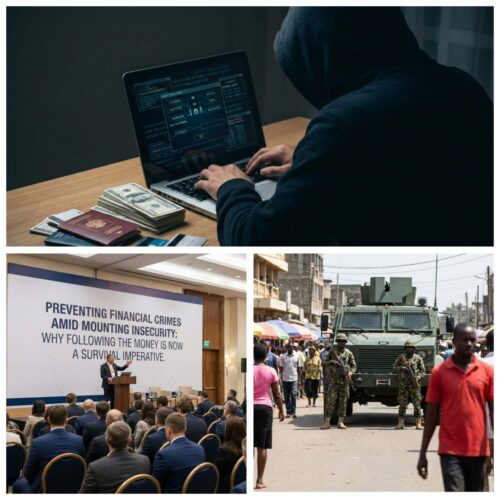
Nigeria today faces a sobering dual reality: a deepening security crisis and an entrenched financial-crime ecosystem that quietly feeds, sustains, and normalises that crisis. Across the North, Middle Belt, and parts of the South, kidnappers, bandits, insurgent cells, political actors, compromised security agents, and a complex chain of financial facilitators operate within a shadow economy of violence, one that generates billions, claims thousands of lives, and steadily erodes the authority of the state.
For over a decade, security experts and Nigeria’s international partners have warned that no meaningful progress will be made against insecurity unless the financial oxygen sustaining violence is cut off. Yet the country continues to prosecute its anti-terrorism efforts largely through military responses, as though the conflict could be resolved solely on the battlefield. What remains missing is a decisive, transparent, and politically courageous confrontation with the economic networks that make insecurity profitable.
This war is not only about guns and bullets. It is about money.
Money moves fighters.
Money buys weapons.
Money fuels political desperation.
Money underwrites chaos.
Until Nigeria addresses the financial pipelines behind its insecurity, the crisis will continue to reproduce itself.
Kidnapping: The Lucrative ‘War Fund’ Sustaining Insurgency
The rise in mass kidnappings is neither accidental nor spontaneous. It has evolved into a rational, structured, revenue-generating enterprise.
Appearing on Channels TV’s Politics Today in October 2025, Yusuf Datti Baba-Ahmed warned that insurgent and bandit groups now treat ransom payments as reliable “war funds.” The data support his claim.
A 2024 survey by the National Bureau of Statistics (NBS) found that Nigerians paid N2.2 trillion in ransom between May 2023 and April 2024. This astonishing sum does not account for unreported payments made through informal negotiators, mobile transfers, or unregulated community channels.
Kidnapping has matured into a fully formed economy with well-defined roles: negotiators, informants, logistics providers, cash couriers, and security collaborators. Proceeds are reinvested in weapons, motorcycles, communication devices, safe houses, and even land acquisitions.
In the words of a security analyst, “Every successful kidnapping is a fundraiser.”
Sabotage from Within: Keffi’s Explosive Memo and a System Built to Fail
If Nigeria’s external security threats are troubling, the internal compromises are even more alarming.
A leaked memo by Major General Mohammed Ali Keffi accused senior government and military officials of diverting billions of naira earmarked for arms procurement under former Chief of Army Staff, Lt. Gen. Tukur Buratai. Keffi’s allegations included:
– Weapons paid for but never delivered
– Falsified battlefield reports
– Civilian casualties mislabelled to justify inflated expenditures
– Political interference obstructing investigations into terror financing
His claims echoed the earlier warning by Gen. T.Y. Danjuma, who accused sections of the military of working in concert with armed groups and abandoning vulnerable communities.
Keffi’s memo became even more consequential following the 2025 detention of former Attorney General Abubakar Malami by the EFCC over allegations of money laundering, terrorism financing and suspicious financial activity linked to 46 bank accounts.
Together, these revelations paint a disturbing picture: even as Nigerians endure mass abductions, elements within the political and security elite appear to be enabling or shielding the financial networks behind the violence.
Why the Crisis Persists: A Financial Crime Lens
Nigeria’s insecurity cannot be divorced from the environment in which illicit finance thrives. Key enablers include:
1. Informal Economies and Unregulated Cash Flows
With over 70 percent of rural transactions still cash-based, terror groups exploit:
– Hawala networks
– POS and mobile-money agents
– Cattle markets and mining sites
– Barter systems centred on livestock and grains
These channels operate beyond the reach of AML/CFT systems.
2. Identity Fraud and Weak KYC Enforcement
– Criminal networks routinely open accounts with:
– Fake NINs
– Compromised SIM cards
– Recycled BVNs
– Mule identities
3. Collusion within Financial Institutions
The EFCC estimates that up to 70 percent of financial crimes involve bank personnel, primarily through:
– Unauthorised cash withdrawals
– Suppressed Suspicious Transaction Reports (STRs)
– Manipulated internal alerts
4. Weak Prosecution and Political Interference
Cases drag on for years, and many evaporate entirely before reaching court often due to political considerations.
5. Ungoverned Spaces
Large territories across the North serve as hubs for:
– Arms trafficking
– Illegal mining
– Kidnap-for-ransom camps
– Cross-border smuggling
Public Patience Thins: NLC Moves to the Streets
Public frustration is reaching a boiling point. On December 10, the Nigeria Labour Congress (NLC) announced a nationwide protest scheduled for December 17, citing the “degenerating security situation” and the rise in mass abductions.
The NLC condemned the November 17 abduction of female students in Kebbi, noting that security personnel had been withdrawn from the school shortly before the attack. The union called the act “dastardly and criminal” and directed all affiliates and civil-society partners to fully mobilise for the protest.
This marks a significant shift. For the first time in years, Nigeria’s most influential labour body is placing insecurity at the centre of national mobilization, further underscoring the argument that the current crisis is not simply a security failure but a systemic breakdown of governance, accountability, and financial integrity.
The Financial Engine of Terror: The 23 Suspects Who Moved Billions
A Sahara Reporters investigation uncovered a network of 20 Nigerians and three foreign nationals allegedly linked to the financing of Boko Haram and ISWAP. Their transactions, running into hundreds of billions, were quietly channeled through personal and corporate accounts.
Among those named:
– Alhaji Saidu Ahmed, Zaria businessman: N4.8bn inflows
– Usaini Adamu, Kano trader with 111 accounts: N43bn inflows, N50bn outflows
– Muhammad Sani Adam, forex and precious stones dealer: N54bn across 41 accounts
– Yusuf Ghazali, a forex trader linked to UAE-convicted terrorists, operated 385 accounts
– Ladan Ibrahim, a Sokoto official, is accused of diverting public funds
– Foreign actors included the late Tribert Ayabatwa (N67bn inflows) and Nigerien arms dealer Aboubacar Hima, who moved over $1.19 million.
Strikingly, several of the suspects arrested in 2021 were quietly released without trial, continuing a pattern of impervious investigations and political bottlenecks.
This network confirms a painful truth: Nigeria’s insecurity is not driven solely by men wielding rifles in the bush. It is sustained by individuals in cities, businesses, and bureaucracies, people with access, influence, and remarkable financial mobility.
The Political Dimension: Irabor’s Revelation and the Unnamed Sponsors
The political undertone of Nigeria’s insecurity was reinforced by the former Chief of Defence Staff, Gen. Lucky Irabor (rtd), who admitted that politicians were among those financing terror groups. According to him, some trials were conducted “away from public consumption.”
His statement revived key questions:
– Why is the state shielding the identities of terror sponsors?
– Who benefits from the secrecy?
– What political consequences are being avoided?
Security sources told TruthNigeria that Nigeria’s published list of 19 terror financiers in 2024 represented only a fraction of the full network.
Baba-Ahmed’s accusation that former Kaduna Governor Nasir El-Rufai was part of the political forces that aggravated Northern insecurity, an accusation the former governor has previously denied, adds further urgency to demands for transparency.
The Human Cost: Expanding Killing Fields
Despite repeated assurances, violence continues to spread:
– 303 students and 12 teachers abducted in Niger State
– 38 worshippers kidnapped in Kwara
– Simultaneous raids across Plateau, Kaduna, Benue, and Niger
– Whole communities uprooted by weekly attacks
As Amnesty International observed, “In many rural communities, only the graveyards are expanding.”
SBM Intelligence now describes large portions of the North as “open killing fields,” areas where the state’s influence has collapsed, and community vigilantes have become the default security providers.
Expert Voices: Why Nigeria Must Finally Follow the Money
Security experts converge on a single message: Nigeria cannot defeat terrorism without dismantling its financial infrastructure. Dr. Friday Agbo, a security researcher, disclosed, “Terror groups survive because their financial lifelines remain untouched.”
Jonathan Asake, analyst and former SOKAPU president, said, “Publish the full Dubai list. Without transparency, impunity will remain the norm.”
Gen. Irabor (rtd.) revealed, “There are politicians involved. The conflict is multi-layered: ideology, criminality, and political manipulation.”
These assessments underscore one reality: ideology is secondary. Money is primary. It is the oxygen of Nigeria’s terror landscape.
What Must Change
Nigeria must elevate financial crime to the level of a national-security emergency. Key reforms include:
– Integrating BVN-NIN-SIM identity databases and upgrading real-time monitoring
– Targeting illicit markets: illegal mining hubs, cattle markets, unregulated border posts
– Deploying AI-driven analytics to detect layered transactions, mule networks, and ransom flows
– Strengthening bank compliance units and protecting whistleblowers
– Improving inter-agency intelligence sharing (EFCC, NFIU, DSS, NDLEA, Police, CBN)
– Criminalising unexplained wealth, especially in conflict zones
– Investing in safe-school infrastructure, rural policing, and local reporting channels
Choosing Truth Over Convenience
Nigeria’s two-front war is neither mysterious nor new. It is a well-documented, financially engineered crisis protected by silence, vested interests, and institutional decay. The NLC’s mobilisation signals a turning point; citizens are unwilling to accept official evasions while insecurity intensifies. To end this crisis, Nigeria must:
– Expose and prosecute terror financiers
– Purge corrupt insiders in the security system
– Dismantle ransom economies
– Strengthen financial intelligence
– End political protection for criminal networks
Until these reforms are pursued with integrity, billions will continue to move, weapons will continue to flow, and Nigeria will continue to bleed.
Blaise, a journalist and PR professional, writes from Lagos, can be reached via: blaise.udunze@gmail.com




















You must be logged in to post a comment Login