Breaking News
Rift between Zimbabwe and Zambia Deepens Over Geopolitical Security, by Kestér Kenn Klomegâh
The Southern African Development Community (SADC) has also influenced this diplomatic rift. Former Zambian Vice President Nevers Mumba, leading the SADC Electoral Observation Mission to Zimbabwe, issued a critical report on Zimbabwe’s elections. The report highlighted irregularities and questioned the legitimacy of Mnangagwa’s victory, further straining diplomatic relations.

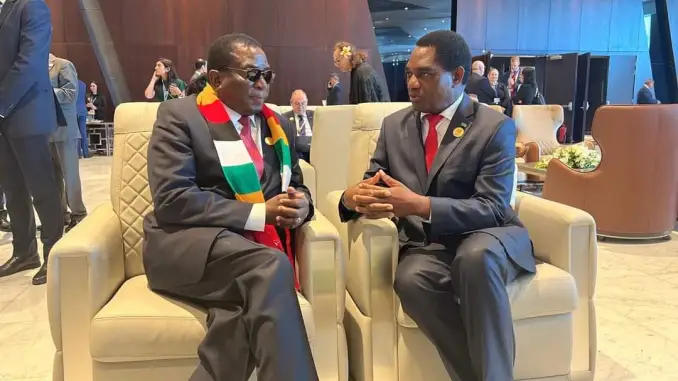
The Government of Zambia has sought an official clarification from the Government of Zimbabwe over comments made by President Emmerson Mnangagwa, who claimed that Zambia’s security sector is heavily funded by the United States.
Mnangagwa made these statements during a conversation with Russian President Vladimir Putin on the sidelines of an investment summit in St. Petersburg, the northern capital of Russia. He suggested that the West had shifted its support from Zimbabwe to Zambia, consolidating their influence through substantial security and financial assistance.
During the meeting, Mnangagwa sought assistance for “defense and food security,” expressing concerns about U.S. influence in Zambia. Mnangagwa claimed that the United States is “consolidating its power” in Zambia through increased security and financial aid, which he suggested aims to isolate Zimbabwe.
“The United States is making us feel lonely,” Mnangagwa remarked, indicating a perceived encirclement by Western powers.
Mnangagwa’s remarks were captured in a video where he expressed a desire to strengthen ties with Russia to counterbalance Western influence. He lamented that the West had “abandoned” Zimbabwe in favor of Zambia.
As the U.S. consolidates its influence in Zambia, Zimbabwe finds itself increasingly isolated, turning to Russia for support. The future of Zimbabwe-Zambia relations will depend on the evolving dynamics of international alliances, regional politics, and internal developments within both countries.
Relations between Zimbabwe and Zambia have been tense since Zambian President Hakainde Hichilema took office. The situation worsened after Nevers Mumba, head of the Southern African Development Community (SADC) Electoral Observer Mission to Zimbabwe, declared Zimbabwe’s August 23, 2023 elections neither free nor fair. This report was met with disapproval from some members of Zimbabwe’s ruling party, Zanu-PF.
President Hichilema, who has close ties with Zimbabwe’s opposition leader Nelson Chamisa, appointed Mumba to the observer mission. Historically, Zimbabwe and Zambia shared strong bonds, particularly during Zimbabwe’s liberation struggle, but these relations have deteriorated since Hichilema’s election victory over former President Edgar Lungu in 2021.
Zimbabwe and Zambia once enjoyed strong diplomatic relations, largely built on shared history and mutual support during Zimbabwe’s fight for independence. However, the political dynamics have shifted significantly with new leadership in Zambia, leading to a re-evaluation of alliances and partnerships in the region.
According to News Day report, Mnangagwa’s comments reflect the broader geopolitical tensions and the shifting balance of power in Southern Africa, as nations navigate their relationships with global superpowers like the United States and Russia.
The ongoing dialogue between Zambia and Zimbabwe’s Foreign Affairs ministries will be crucial in addressing the current diplomatic friction. As both nations work through these tensions, the outcome will likely influence the future stability and cooperation within the Southern African region.
The Southern African Development Community (SADC) has also influenced this diplomatic rift. Former Zambian Vice President Nevers Mumba, leading the SADC Electoral Observation Mission to Zimbabwe, issued a critical report on Zimbabwe’s elections. The report highlighted irregularities and questioned the legitimacy of Mnangagwa’s victory, further straining diplomatic relations.
Zimbabwe’s political landscape remains volatile, with Mnangagwa’s administration facing allegations of corruption, human rights abuses, and election rigging. The SADC report, combined with increasing pressure from Western nations, has sparked fears of an orchestrated regime change. Mnangagwa’s government views the US’s growing influence in Zambia and SADC’s critical stance as part of a broader strategy to undermine his rule.
Russia-Zimbabwe relations were established a long time ago when it was struggling for political independence which it finally gained on 18 April 1980. Zimbabwe, with roughly 15 million people as per 2022 census, is a landlocked country in southern Africa. In southern African region, it is the biggest trading partner of South Africa. Zimbabwe is one of the members of the Southern African Development Community (SADC).