
Opinion
Russia-Ukraine Conflict: Can BRICS Broker Peace? Part III, by Kestér Kenn Klomegâh

State Duma, the lower house of parliamentarians, and the Federation Council, the upper chamber of legislators, voted to declare and approve the ‘special military operation’ in the Ukraine, which categorically aims at de-militarizing and denazyfying the former Soviet republic. The Russia-Ukraine conflict began on 24 February 2022, and has shown explicit sign of endless militarized venture on Ukraine. It has, so far, had devastating implications and impacts, destabilized the global economic system, with majority of countries in the Global South calling for peaceful resolution to the conflict between these two former Soviet republics who, after the Soviet collapse, have attained their political independence.
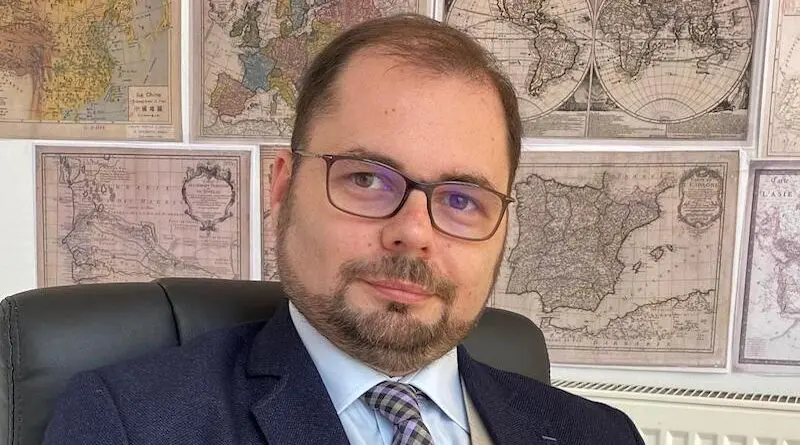
In this interview, Professor Sergiu Mișcoiu at the Faculty of European Studies, Babes-Bolyai University in Cluj-Napoca (Romania), where he also serves as a Director of the Centre for International Cooperation and as Director of the Centre for African Studies, discusses aspects of strategy and approach by the BRICS association (China, India and South Africa) in pursuing common, comprehensive and sustainable security, and most importantly how BRICS members can peacefully resolve the conflict differences between Russia and Ukraine through dialogue and consultation. Here are the interview excerpts:
Russia-Ukraine conflict has raged on since late February 2022, and now the main question is why BRICS, an informal association, has not so far been successful in brokering peace?
Professor Sergiu Mișcoiu: BRICS is indeed an informal association of states. Its unity and its capacity to act collectively in order to impose an alternative international order to the one still led by the Western states has been repeatedly overestimated. It would be more accurate to portray BRICS as a heteroclite group made of states with different capabilities and interests, with different historical allies and foes. Between China, an autocratic state who has been trying since the 2010s to openly challenge the USA’s still quasi-hegemonic status in the global world, and Brazil, a semi-consolidated democracy aspiring to emerge as an important semi-peripheral power in the Southern hemisphere, there are definitely less resemblances than differences. Their exhibited anti-Westernism – which is only for the time being in the case of Brazil – can barely hide the fundamental differences between the world’s views of these two states, and the same can be said about almost all the other BRICS countries taken two by two.
For all these reasons, the BRICS states have initially regarded the Russian invasion of Ukraine in a rather different light – as an opportunity to vassalize Russia and to indisputably become the main counter-hegemon (by China), as a fait divers or as another war (by South Africa), as a historical revenge against the US-led order (by Brazil), as source of potential conflict and unrest (by India). It was only after the attempts of reconciliation that these states found a common position with regard to this conflict, mainly revolving around the idea of a negotiated peace. But the fact that Russia belongs to this international association is a major delegitimizing factor which prevents BRICS to look like an independent international peacemaker.
In its several declarations and communiques, BRICS has collective stated ‘political dialogue’ and ‘mechanism of diplomacy’ in resolving political crisis and conflicts. Are these methods, dialogue and diplomacy, working in the case of Russia-Ukraine conflict?
SM: For such methods to work, it would be necessary that all the parties involved in the conflict genuinely believe that they could lose if the war continues, and that they cut a favorable deal if peace is achieved. None of these conditions if fulfilled, as Russia continues its advancement in Donbass and its attacks against the critical infrastructural system and Ukraine succeeded to occupy parts of the Russian territory and to strike deeper into the country. Under these circumstances, all the current attempts to make peace are rather show-offs meant to legitimize the peacemakers. China is the main champion of such attempts, sometimes more or less implicitly in the name of BRICS. But all these attempts of China (not only in the case of the Russian-Ukrainian war) were seen by the “beneficiaries” as being tactical moves of Beijing in the effort to reinforce its position of diplomatic actor rather than some genuine steps towards achieving peace. As a whole, BRICS lacks the degree of unity that could put enough pressure on the states in conflict to force them to search for peace and is perceived in the context of the Russian-Ukrainian war as being too close to the interests of Russia in a more or less transparent way.
How do you assess efforts made by China, India and South Africa during these past two years? And what are your views and interpretations of the proposal, which underlined ‘constructive role’ in the process for another future Peace Summit by India?
SM: Unlike China, India seems to play a different card, as it displays a much more subtle intention to legitimize itself as a major international actor and a more genuine concern for achieving peace, in a Gandhi-like claimed tradition. Criticized for his domestic national-populism, Prime-Minister Modi has recently succeeded to play a more convincing international role, especially thanks to his efforts to support the creation of the favorable conditions for the initiation of a dialogue between Ukraine and Russia. India has no interest to see a victorious Russia and a triumphing China, whose friendship with its rival, Pakistan, has been a constant concern for New Delhi. So, once again, BRICS do not act as a group. Instead, India’s more balanced attitude has created the premises for a more consensual environment of international negotiations around the Russian-Ukrainian war. Which doesn’t mean that peace is guaranteed. But which means that the individual efforts of some of the BRICS countries could be more efficient than the hesitant actions of the group as a whole.
Can BRICS use its boastful numerical strength (as more 40 countries have been listed awaiting ascension) and to stand tall with reverberating voices on the platform, particularly during the forthcoming XVII BRICS Summit in October, to attempt brokering peace between Russia and Ukraine?
SM: Given their profiles and their international stances, the new members of BRICS who joined in 2024 (Iran, Egypt, Ethiopia and the United Arab Emirates) offer a wider global coverage to the association but also increase the potential disunion when critically important collective decisions will be needed. As the 2024 Summit will take place in Russia, which is even in its friends’ eyes the country which started the war against Ukraine, any attempt to issue a common declaration in favor of peace and reconciliation will be deprived of credibility. However, Russia will try to use the momentum to claim that there is international support for its actions. But this is precisely the opposite of today’s efforts of countries such as India or the Emirates, which will not appreciate the confiscation of the summit to push the individual agenda of the Kremlin.
In conclusion, BRICS could have worked as a peace broker if it was: (1) genuinely animated by the same universal values, (2) more united around some clear common goals, and (3) exterior to the conflicts it claims to mediate. As it is today, it only allows for the temporary advancement of some of its members’ agendas.






















You must be logged in to post a comment Login