
Opinion
The Next Chapter Begins for BRICS+ and Africa in Emerging Multipolar World, by Kestér Kenn Klomegâh

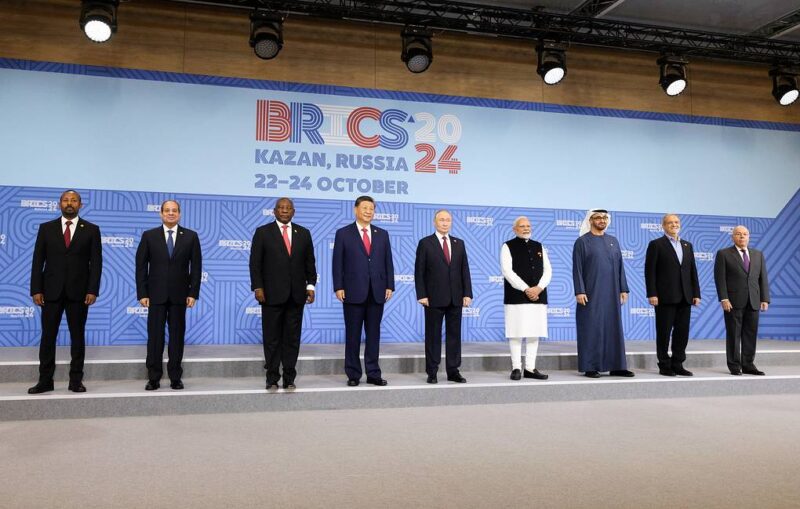
The 16th BRICS+ summit in Kazan, capital of Tatarstan, with Egypt and Ethiopia participating for the first time, has opened a distinctive chapter for Africa, particularly to seize emerging opportunities for driving further economic growth, sustainable development and regional collaboration. BRICS+ (Brazil, Russia, India, China and South Africa) has witnessed the two the second wave of enlargement after South Africa joined in 2010. BRICS+ has also undergone structural and organizational changes, and now being described as non-western association, its primary goals to enhance economic integration with key emerging nations, fostering trade, investment, development, security, and cooperation among leading emerging market economies. The geographical focus is on Global South where Africa is also an integral part. Within the geopolitical context, the association is guided by shared values, and with a common vision for economic development and ensuring global peace and security. Prime Minister of India, Narendra Damodardas Modi, put it best, that “BRICS is not an anti-Western alliance; it is simply non-Western.”
Under Russia’s chairmanship, the BRICS+ has hit a number of historic milestones including the creation of he ‘partner states’ category aimed at building a a global force, ‘like-minded’ leaders of friendly countries, as reiterated by Russian President Vladimir Putin. In tracking BRICS+ summit’s achievements, Egypt and Ethiopia joined South Africa in full-fledged participation, then also President Putin held special meeting with leaders from Egypt, Ethiopia, South Africa, Congo Republic and Mauritania.
President Vladimir Putin had a meeting with Prime Minister of the Federal Democratic Republic of Ethiopia Abiy Ahmed. Ethiopia’s accession to BRICS was a momentous decision and yet further proof of Ethiopia’s prestige on the international stage. History pointed out the fact that their bilateral relations are based on a rich history and longstanding traditions of friendship, mutual respect, and cultural and spiritual affinity between Ethiopia and Russia (then Soviet Union).
At the current stage, bilateral trade is seemingly growing despite existing multiple challenges. It may be modest in absolute terms, but there is positive dynamics with a 65 percent growth in 2023. There is optimism that this would change broadly with Africa, to back away from skyline rhetoric of diplomacy and to engage more consistently and in practical terms to increase economic ties, in the near future, and specifically with Ethiopia and Russia becoming ‘like-minded’ friends in BRICS.
President Vladimir Putin had a meeting with President of the Arab Republic of Egypt Abdel Fattah el-Sisi on the sidelines which stressed the question of promoting multifaceted bilateral relations across various domains based on the Treaty on Comprehensive Partnership and Strategic Cooperation, and have generated steady momentum in terms of trade and economic relations. Egypt accounts for almost one third of Russia-Africa trade. In 2023 for instance, it increased by 16.4 percent, and this growth not only spilled over into 2024 but also accelerated.
Putin and Abdel el-Sisi appreciated the continuation of systematically carrying out major joint projects, including the construction of the El Dabaa Nuclear Power Plant and a Russian industrial zone. Reports show tremendous efforts to draft a free trade agreement between the Arab Republic and the Eurasian Economic Union which is still underway. As well-known in Maghreb region, Egypt is considered a strong and reliable partner for Russia. Furthermore, Russia and Egypt have similar approaches to many current global issues, and appreciate bilateral cooperation at United Nations’ platforms.
With South Africa’s Cyril Ramaphosa on the sidelines of the BRICS Summit in Kazan, Putin praised as impressively positive the level of bilateral trade and economic cooperation between Russia and the Republic of South Africa. Russia attaches special significance to strengthening relations with African countries. Collaborative work is underway to implement joint agreements approved at the Russia-Africa summit in St Petersburg, notably a declaration and an action plan until 2026. South Africa played several roles on the seamless integration of new participants into the multi-level architecture of BRICS. In addition, the foreign policy agency would hold in Sochi for the first ministerial conference of the Russia-Africa Partnership Forum which is scheduled for November 9–10.
President of the New Development Bank Dilma Rousseff explained during a meeting with Putin that BRICS steadily encompassing additional countries from the Global South, enabling NDB to identify new areas and domains for cooperation, it also entails the necessity for ensuring extra financial resources for development projects in the countries of the Global South. “At present, the countries of the Global South are in considerable need of financial resources, and the conditions for securing such resources are rather challenging,” underlined Dilma Rousseff.
During the media conference, Vladimir Putin outlined mechanisms to support Africa’s development, to back up with the rapid population growth. According to Putin, BRICS would create a working group at the New Development Bank in order to develop mechanisms for effective and reliable investment in African countries. Many countries in African and in Asian regions are less urbanized, but urbanization would definitely ramp up, and both people and countries would strive to catch up with the living standards in other regions of the world, including Europe.
The 2024 Kazan summit, themed “Strengthening Multilateralism for Fair Global Development and Security,” marked the sixteenth annual gathering of the association. One significant achievement was the official announcement to create BRICS+ “partner countries” which is made of 13 members, including three (3) African countries as partners, not full members. These are Algeria, Nigeria and Uganda. Here is the full list: the new partner countries include Algeria, Belarus, Bolivia, Cuba, Indonesia, Kazakhstan, Malaysia, Nigeria, Thailand, Turkey, Uganda, Uzbekistan, and Vietnam.
Nevertheless, BRICS+ has made multipolar world and South-South cooperation its catch words and these constitute its ultimate aspirations. In the final declaration, BRICS+ however underlined the association’s preparedness to collaborate with reforming the current international financial architecture to meet the global financial challenges including global economic governance to make the international financial architecture more inclusive and just, especially for developing world.
On International Monetary Fund (IMF), the declaration re-affirmed BRICS+ commitment to maintaining a strong and effective Global Financial Safety Net with a quota-based and adequately resourced IMF at its centre. And on G20, it recognized the importance of the continued and productive functioning of the G20, based on consensus with a focus on result-oriented outcomes.
On cross-border payment system, the declaration further recognized the widespread benefits of faster, low cost, more efficient, transparent, safe and inclusive cross-border payment instruments built upon the principle of minimizing trade barriers and non-discriminatory access. It welcomed the use of local currencies in financial transactions between BRICS countries and their trading partners. The relevant agencies of member countries would collaborate in the financial sector to expand the use of national currencies in mutual settlements and to create an independent payment system.
In early 2024, the association added Egypt, Ethiopia, Iran, Saudi Arabia and the United Arab Emirates as full members, all of whom attended this year’s Kazan summit as full participants. BRICS, an informal association comprising Brazil, Russia, India, China, South Africa, Iran, Egypt, Ethiopia, and the United Arab Emirates, expanded in 2010 to include South Africa, forming BRICS.




























You must be logged in to post a comment Login