Opinion
Vladimir Putin and the New World Order, by Kestér Kenn Klomegâh

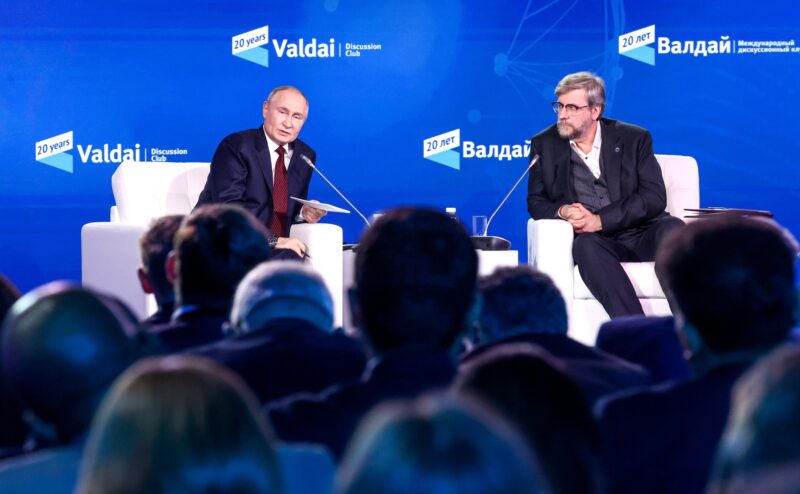
The Valdai Club, a well-recognized and influential Russian academic thin tank, marked its 21st annual meeting with the traditional indepth and broad discussions, coincidentally on November 7, which is a significant date both for Russia and the entire world. The Valdai Club’s substantive discussions, with participation of both local and foreign experts from Asia, Africa, Europe and Latin America, largely centered on the changing geopolitics and its impact on developments and, most essentially on the emerging new global order of the 21st century.
As the Valdai Club passed its 20th year, it has witnessed significant political developments on a dramatic scale these two decades. This alone shows its historical uniqueness, the period, characterized with complexity and contradictions, also generated a solid platform for making tremendous contributions to shaping political history. The history brings in its fold different political waves and economic crises, which sometimes makes the future world unpredictable. But experts, as the popular saying goes ‘two heads are better than one’, have conscientiously studied the dynamics of the changes and design an analytical future.
With an increasing influence, Russian President Vladimir Putin, under his leadership on November 7, outlined the shape and components of the emerging new world architecture. It took him and the entire Valdai Club experts and participants deep into the night, ended close to midnight. Here are a few significant features Putin tried to outline to the world.
- i) Building a new world system: If you look back 20 years and evaluate the scale of changes, you can assume that the next twenty years will be no less, if not more difficult. There comes, in a way, the moment of truth. The former world arrangement is irreversibly passing away, actually it has already passed away, and a serious, irreconcilable struggle is unfolding for the development of a new world order. It is irreconcilable, above all, because this is not even a fight for power or geopolitical influence. It is a clash of the very principles that will underlie the relations of countries and peoples at the next historical stage.
Hegemony in the new international order is not a consideration. When, for instance, Washington and other Western capitals understand and acknowledge this incontrovertible fact, the process of building a world system that addresses future challenges will finally enter the phase of genuine creation. The world is changing radically and irreversibly. This is the dynamics of historical development. God willing, this should happen as soon as possible.
- ii) Soviet Union’s contributions: Russia, then called the Soviet Union, made a major contribution to consolidating some political trends. The Soviet Union assisted states that had renounced colonial or neo-colonial dependence, whether in Africa, Southeast Asia, the Middle East or Latin America. It can be emphasized that in the mid-1980s, it was the Soviet Union that called for an end to ideological confrontation, the overcoming of the Cold War legacy, an end to the Cold War and its legacy, and the elimination of barriers that hampered global unity and comprehensive world development. Undoubtedly, the Soviet Union was motivated by sincere aspirations for peace and universal wellbeing. Both Russia and the vast majority of nations are committed to bolstering the spirit of international advancement and the aspirations for lasting peace that have been central to development since the mid-20th century.
iii) Six principles of a new phase of historical progression. (a) Firstly, openness to interaction stands as the paramount value cherished by the overwhelming majority of nations and peoples. The endeavour to construct artificial barriers is not only flawed because it impedes normal and advantageous to everyone economic progression, but also because it is particularly perilous amidst natural disasters and socio-political turmoil, which, unfortunately, are all too common in international affairs.
(b) Secondly, it has consistently underscored the diversity of the world as a prerequisite for its sustainability. It may appear paradoxical, as greater diversity complicates the construction of a unified narrative. Naturally, universal norms are presumed to aid in this regard. Can they fulfil this role? It stands to reason that this is a formidable and complicated task. Firstly, we must avoid a scenario where the model of one country or a relatively minute segment of humanity is presumed universal and imposed upon others. Secondly, it is untenable to adopt any conventional, albeit democratically developed code, and dictate it as an infallible truth to others in perpetuity.
(c) Thirdly, we have said more than once that the new world can develop successfully only through the broadest inclusion. The experience of the last couple of decades has clearly demonstrated what usurpation leads to, when someone arrogates to themselves the right to speak and act on behalf of others. Those countries that are commonly referred to as great powers have come to believe that they are entitled to dictate to others what their interests are – in fact, to define others’ national interests based on their own. Not only does this violate the principles of democracy and justice, but worst of all, it hinders an actual solution to the problems at hand.
(d) Next, the key principle of security for all without exception is that the security of one nation cannot be ensured at the expense of others’ security. It is not anything new. It has been set out in OSCE documents. We only need to implement them. The bloc policy and the legacy of the Cold War colonial era run contrary to the essence of the new international system, which is open and flexible. There is only one bloc in the world that is held together by the so-called obligations and strict ideological dogmas and cliches. It is the North Atlantic Treaty Organisation, which continues expansion to Eastern Europe and is now trying to spread its approaches to other parts of the world, contrary to its own statutory documents. It is an open anachronism.
(e) The fifth point is about justice for all. Inequality is the true scourge of the modern world. Countries face social tension and political instability within their borders due to inequality, while on the international stage the development gap that separates the so-called Golden Billion from the rest of humankind may not only result in more political differences and confrontation, but also, and even more importantly, exacerbates migration-related issues.
There is hardly a developed country on this planet that has not faced an increasingly uncontrolled and unmanageable inflow of people seeking to improve their wellbeing, social status and to have a future. Some of them are simply trying to survive. We are confident that such issues as food security, energy security, access to healthcare and education, and finally, the orderly and free movement of people must not be impacted by whatever conflicts or disputes. These are fundamental human rights.
(f) The sixth point is that we keep emphasising that sovereign equality is an imperative for any lasting international framework. Of course, countries differ in terms of their potential. This is an obvious fact. The same applies to the capabilities and opportunities they have. In this context, we often hear that achieving total equality would be impossible, amounting to wishful thinking, a utopia.
However, what makes today’s world special is its interconnected and holistic nature. In fact, sometimes countries that may not be as powerful or large as others play an even greater role compared to great powers by being more rational and results-driven in using their human, intellectual capital, natural resources and environment-related capabilities, by being more flexible and smart when tackling challenging matters, by setting higher living and ethical standards, as well as in administration and management, while also empowering all their people to fulfil their potential and creating a favourable psychological environment. This approach can bring about scientific breakthroughs, promote entrepreneurial activity, art and creativity, and empower young people. Taken together, all of this counts in terms of global influence and appeal. Let me paraphrase a law of physics: you can outperform others without getting ahead of them.
(iv) Russia’s role in shaping the new world. Russia is is playing roles in structuring this emerging new world. It has an aspiring to global dominance in its tracks. Russia’s role is certainly not limited to protecting and preserving itself. It may sound a bit grand, but Russia’s very existence guarantees that the world will retain its wide colour, diversity and complexity, which is the key to successful development. Russia is fighting for its freedom, rights, and sovereignty. By way of history, Russia is guided by its own values, interests and ideas of what is right and what is not, which are rooted in the identity, history and culture. It does protect its sovereignty, and further upholds universal rights and freedoms, and the existence and development of the absolute majority of the countries around the world. In a nutshell, at least these are some of the broad and multi-dimensional description of the future world.