
Africa
Why The Masses Will Suffer Most When FG Suddenly Ban Importation Of Solar Panels -By Isaac Asabor
It is tempting for leaders to chase the optics of nationalism: “Made in Nigeria”, “Buy Naija to grow the Naira”, and the like. But policies must be anchored on the realities of the moment, not aspirations alone. There is a difference between wishful policymaking and strategic planning. Nigeria is in an energy emergency, and solar has become the people’s fallback. This is not the time to impose restrictions without safeguards.

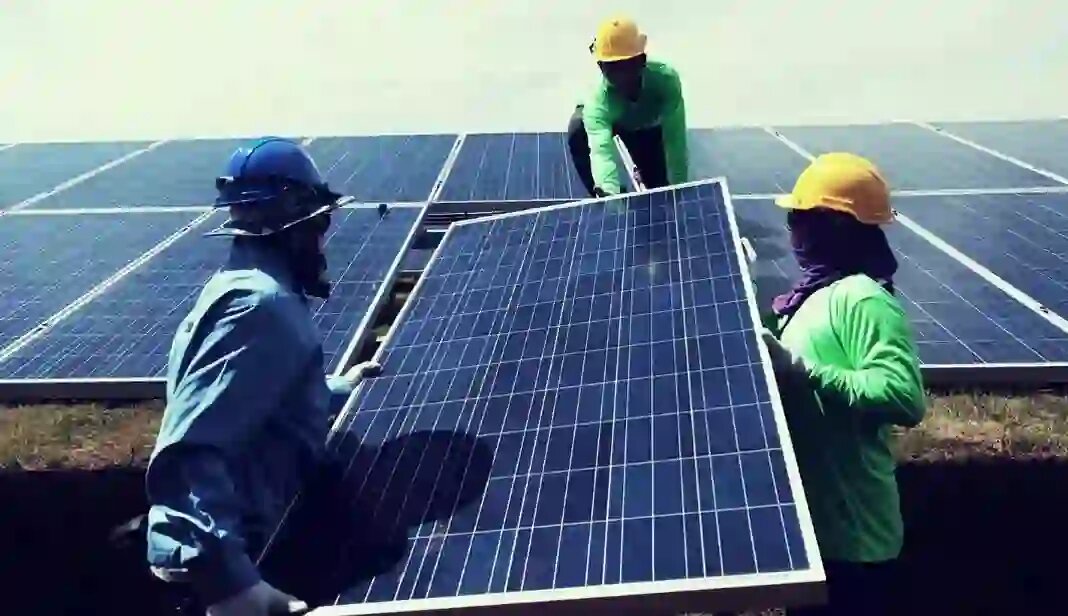
In a country where access to electricity is more a privilege than a right, solar energy has become the last hope of the common man. From small barbershops and tailoring sheds to community health centers and low-income homes, solar panels now dot the rooftops of the forgotten corners of Nigeria, silently powering lives the national grid has long abandoned.
So, when the federal government, through the Minister of Innovation, Science and Technology, Chief Uche Nnaji, recently announced plans to ban the importation of solar panels, citing the need to promote local production, it sent shockwaves through the renewable energy sector. And rightly so.
The Renewable Energy Association of Nigeria (REAN) has since rejected the move, warning that the decision, if implemented in haste, would be catastrophic. Their warning is not rooted in opposition to local industry development. On the contrary, REAN supports local manufacturing. But they understand a fundamental truth that seems to have eluded the corridors of power: you do not cripple a lifeline before building an alternative.
At the heart of this policy debate lies a harsh, glaring reality, millions of Nigerians are living off-grid. These are people who have given up on the promises of the national power sector. With over 85 million Nigerians lacking access to grid electricity according to the World Bank, solar energy has grown into a people-powered solution. It is not just an energy alternative; it is a survival mechanism.
In urban slums and rural villages, solar panels power water pumps, charge phones, light up homes, run refrigerators for drug storage, and keep small businesses afloat. To abruptly ban solar panel imports is to literally switch off that light.
Let us be clear: promoting local manufacturing is a noble and commendable goal. But doing so by slamming the doors on imports overnight is an economic and social miscalculation.
The government’s logic, anchored on Executive Order No. 5 and a belief that local entities like NASENI (National Agency for Science and Engineering Infrastructure) can meet the country’s solar demand, is optimistic at best and misleading at worst. Even if NASENI has commenced production, the reality is that local capacity is grossly insufficient to meet the surging demand. Most of the private sector players are still at infancy or pilot stages. To throw the entire burden of supply on them would be suicidal, for the industry and for consumers.
Besides, local production is not built in a vacuum. It needs time, investment, skilled labor, technology transfer, infrastructure, and financing, all of which are still lacking or underdeveloped in the current Nigerian context. Cutting off imports before strengthening these pillars is akin to pulling the ladder while asking people to climb.
Given the foregoing, it is germane to ask, “Who Bears the Brunt?” The answer to the foregoing question cannot be farfetched as it is not the policymakers in Abuja or the well-connected contractors that will feel the heat. It is the poor. The market woman who needs her solar lantern to sell tomatoes after sunset, the schoolchildren who use solar-powered lamps to study, the hospital in a remote area relying on solar power to store vaccines, the barber whose entire business model rests on uninterrupted energy, these are the ones who will pay the price.
In fact, banning solar imports without affordable alternatives in place will cause a price surge. Local producers, without economies of scale, will initially charge higher prices. Imported panels, even with shipping and duties, are currently cheaper and more accessible for many Nigerians. If only locally produced panels are allowed, supply shortages and inflated prices are inevitable.
And let us not forget that this planned abrupt ban could deter investors. The renewable energy sector has been one of the few bright spots in Nigeria’s gloomy economic landscape. It has attracted innovation, foreign partnerships, and youth employment. A hasty, poorly coordinated import ban signals policy instability, a red flag for investors.
There is a smarter, more sustainable way to achieve the same end goal without burning the bridge Nigerians are currently walking on. The government must gradually phase out solar panel imports, not slam the door shut. This can be done through import quotas that shrink annually, giving local producers time to scale, tax incentives, grants, and subsidies for local solar panel manufacturer and, encouraging joint ventures between foreign solar firms and local producers to facilitate technology transfer and training.
Other ways of phasing out solar panel imports include, Investments in research, development, and infrastructure to support scalable and competitive manufacturing as well as a transparent timeline and stakeholder consultation, to allow for industry preparation and adjustment.
This dual-track approach, supporting local growth while keeping the market open, will help Nigeria transition into self-sufficiency without sacrificing the immediate needs of the people.
It is tempting for leaders to chase the optics of nationalism: “Made in Nigeria”, “Buy Naija to grow the Naira”, and the like. But policies must be anchored on the realities of the moment, not aspirations alone. There is a difference between wishful policymaking and strategic planning. Nigeria is in an energy emergency, and solar has become the people’s fallback. This is not the time to impose restrictions without safeguards.
In truth, the conversation should not be about banning imports but about reducing dependence gradually while strengthening local capacity. That cannot happen overnight. To pretend otherwise is to gamble with the energy security of millions.
The poor cannot afford policy experiments. They are not in boardrooms; they are on the margins, hustling to survive each day. Solar energy has been their silent partner in that struggle. To threaten it with a sudden ban is to betray the very people the government claims to serve.
Yes, we must grow our local industries. But we must do so without crushing the poor under the weight of bad timing. A well-planned transition is possible. But only if the government listens, reflects, and acts with empathy.
Because if we get it wrong, the lights would not just go out, they may not come back on.


























You must be logged in to post a comment Login